

We’re releasing our new site on the 1st November to all paid subscribers. A few teasers below of the offering and some snips:
Model Hub (follow my models, edit my models, or make your own models from scratch).
Follow my portfolio in real time + my watchlist + daily notes.
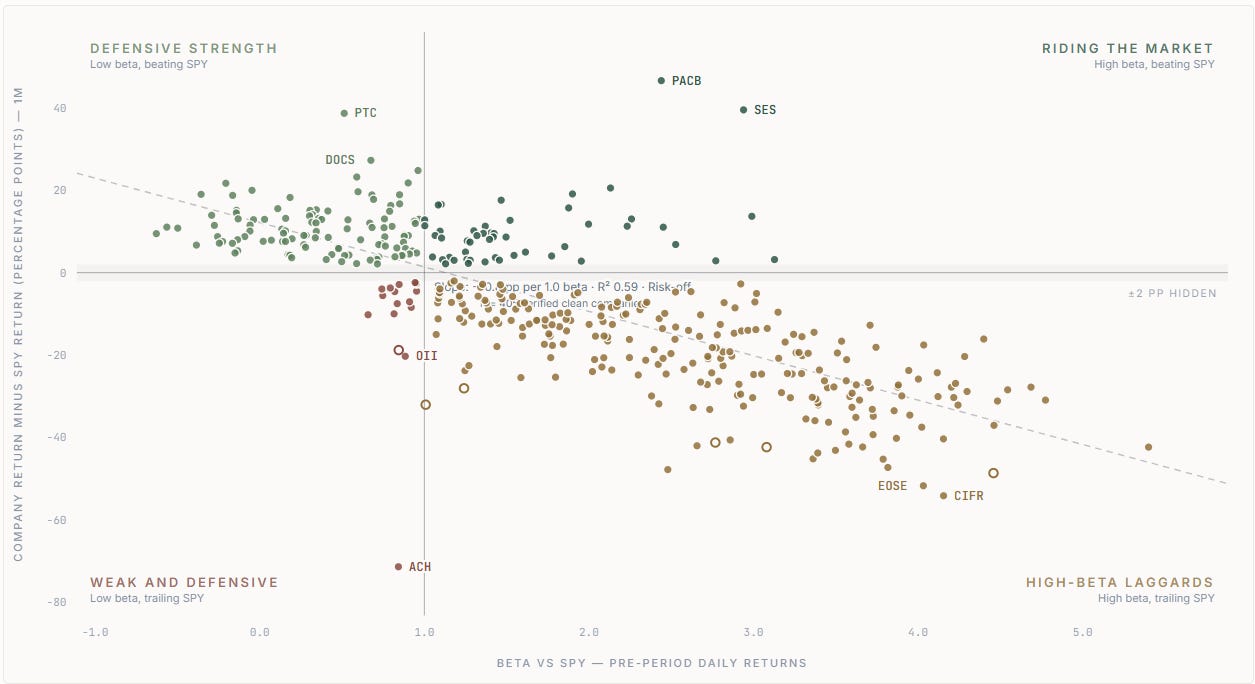
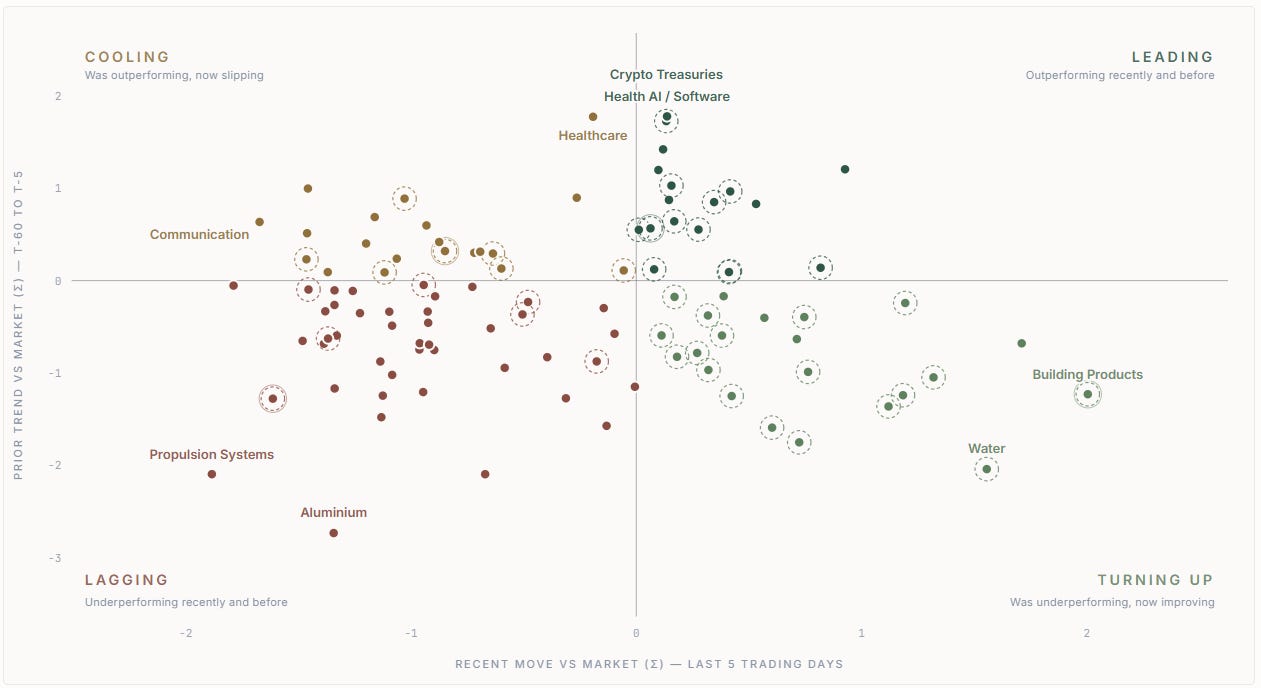
Track all stocks across +25 themes. Track rotation, relative strength, and tech moves vs QQQ.
A technical and fundamental screener.
& much more.
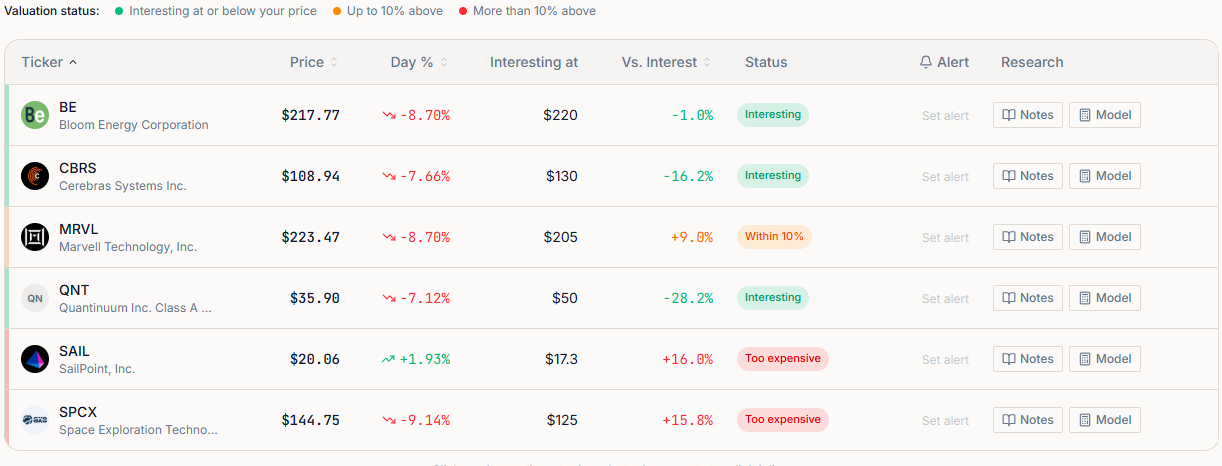
Paid subs will get editable access to this CBRS model on the site starting November 1st.
Prices remain at just $24 and will remain like that until launch. If you sign up before prices rise, you’ll lock in that price for the rest of the time you stay a subscriber.
I’m biased of course…but the offerings on this site are top-tier for the price. It’ll only get better too.
Cerebras (CBRS) 2031 Model
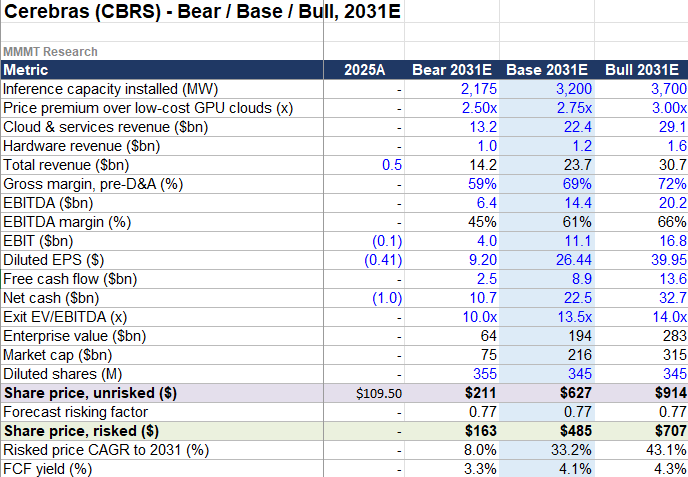
Our model of Cerebras (CBRS) yields a risk-adjusted base case value of ~$485 per share in 2031 which is a ~34% compounded annual return from the $107.80 share price on 22nd October 2026.
The risked bull and bear cases are ~$700 and ~$165 per share respectively (539% upside down to 51% upside).
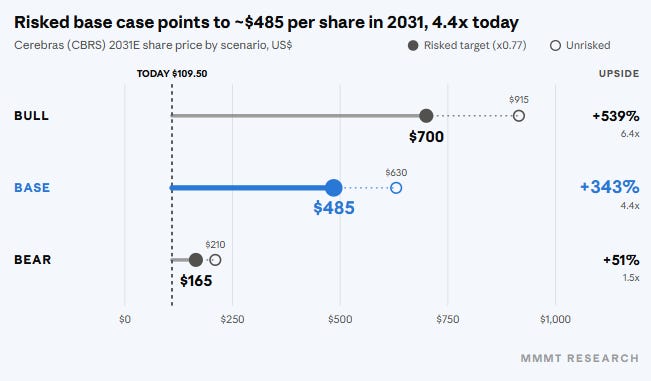
Because visibility beyond 2026 is genuinely limited, we apply a forecast risking factor of 0.77 to every case which is a 5% haircut for each of the five forecast years. That essentially means each year ahead we become 5% less confident in our numbers. Compounded over five years (0.95 to the power of 5), that takes ~23% off our 2031 values. We think this matters in today’s market: AI hardware, token pricing and customer commitments are changing so quickly that a five-year model is useful only if it is honest about how much could change along the way.
Before risking, the cases are ~$210, ~$630 and ~$900 per share.
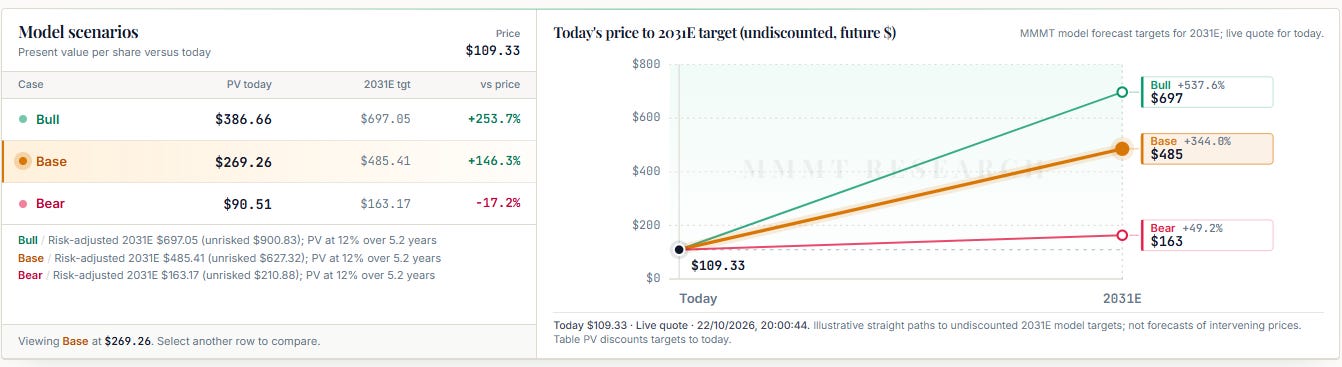
Each case is a complete, internally consistent scenario rather than a single variable flexed up or down.
Overview of Our Model
Revenue & EBITDA growth
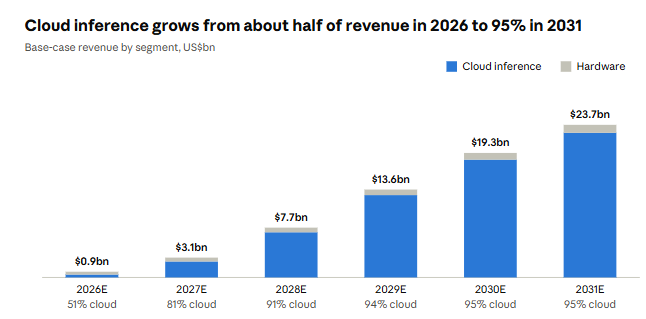
Cerebras is turning from a company that sells AI computers into one that rents out ultra-fast inference capacity. We believe that shift will define the majority of its value over the next five years. As such, in our base case this cloud inference business accounts for ~97% of Cerebras’s EBITDA by 2031.
That transition is already under way. In the second quarter of 2026, revenue from Cerebras’s cloud and services business rose 281% year on year to $126.0M on a reported (GAAP) basis while hardware sales fell to $54.1M from $70.3M.
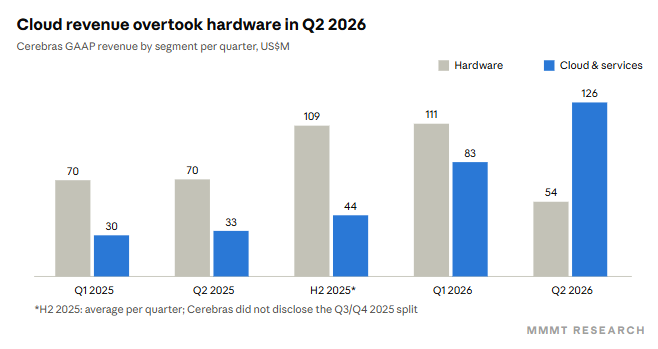
Management raised its full year 2026 guidance for core revenue to $880-890M and plans to more than triple revenue in 2027.
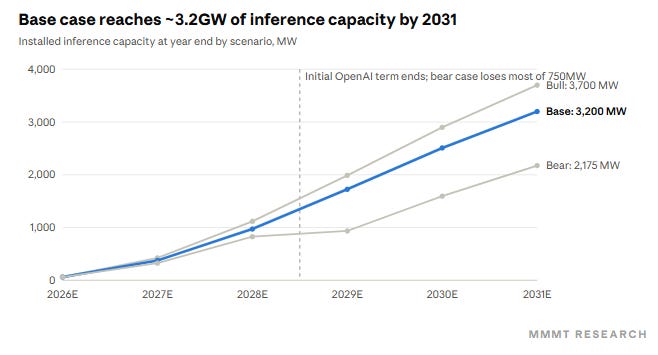
In our base case, revenue grows from ~$890M in 2026 to ~$23.7bn in 2031 as installed inference capacity rises from ~60MW to ~3.2GW.
Hardware keeps growing to ~$1.2bn but becomes a small/immaterial part of the business. Much of the near term revenue is already contracted with $25.4bn of remaining performance obligations (signed contracts not yet delivered and billed) at 30 June 2026 which roughly double our cumulative 2026-28 base-case revenue of ~$11.7bn.
Main Assumptions
Our model is built on 13 assumptions that vary by scenario covering inference capacity and pricing, OpenAI’s renewal, hardware sales, margins, operating costs, capital intensity, dilution and the exit multiple.
Our base case is deliberately conservative at $19.57 of diluted EPS in 2030. Three main assumptions drive that:
1. Other customers pay less than OpenAI: The OpenAI deal works out at roughly $27M of revenue for every megawatt of computing capacity over the life of the contract. We assume Cerebras earns below that from other customers.
2. Cerebras’s price premium shrinks: AI companies are charged by the token. Today Cerebras charges about $0.75 per million output tokens against $0.17 at the cheapest GPU-based cloud providers. That means there’s a ~4.4x premium that customers pay because Cerebras models are far faster. We assume rivals catch up on speed or Cerebras cuts prices over time that that premium narrows to ~2.75x by 2031.
3. Margins improve but not to the maximum: Cerebras’s cloud gross margin rises from ~37% today to ~70% by 2031.
Model Simplifications
We value Cerebras on 2031 EBITDA multiplied by an exit multiple, plus net cash, divided by fully diluted shares. We then multiply each case by a risking factor of 0.77 (a 5% haircut for each of the five years we forecast) to reflect how hard it is to see out to 2031. We do not model interest income, the tax benefit of past losses or stock-based compensation expense. Dilution is captured through the share count instead. Each of these omissions should be small relative to the uncertainty in installed capacity.
We kept the model deliberately simple with two main segments: cloud inference, driven by installed megawatts and revenue per megawatt, and hardware system sales. Training revenue, sovereign deals and smaller customers sit inside these two lines rather than being modelled separately.
Bear, base and bull cases - 2031
Our bear and bull cases are deliberate and fair moves around our base case rather than best and worst cases scenarios. For what it’s worth, my bull case (un-risked and assuming a lot goes right) is far above the current bull case here.
The bear case assumes OpenAI does not renew after 2028 and that pricing and margins come under pressure. The bull case assumes OpenAI takes more of its 1.25GW option and pricing holds up better.
Key Assumptions
OpenAI
OpenAI is the foundation of our forecast.
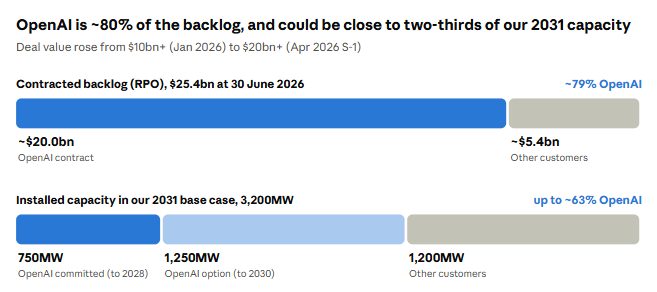
In January 2026 it agreed to buy 750MW of Cerebras inference capacity through 2028 which was worth ~$10B. By the April 2026 S-1 the commitment had doubled to more than $20B (or $27M of revenue per MW), with an option on a further 1.25GW through 2030.

Our base case assumes OpenAI renews and that Cerebras wins steady business elsewhere reaching ~3.2GW of installed capacity by 2031. In our bear case OpenAI does not renew after 2028 meaning 750MW leaves the base in 2029 and only 30% of it is re-leased. That single switch costs ~$125 per share against the un-risked base case.
The speed advantage
Cerebras’s bull case rests on speed.
AI models write their answers one token at a time and Cerebras’s chips generate those tokens far faster than GPUs currently do.
On OpenAI’s gpt-oss-120b which around 15 providers serve, Cerebras runs at ~1,730 tokens per second which is about 6x the median provider. On Moonshot’s much larger Kimi K2.6 it ran at 981 tokens per second which 6.7x the next best GPU cloud.
That is why customers such as OpenAI, Cognition and Figma use Cerebras even though it lists its tokens at ~4.4x the price of low-cost GPU clouds.
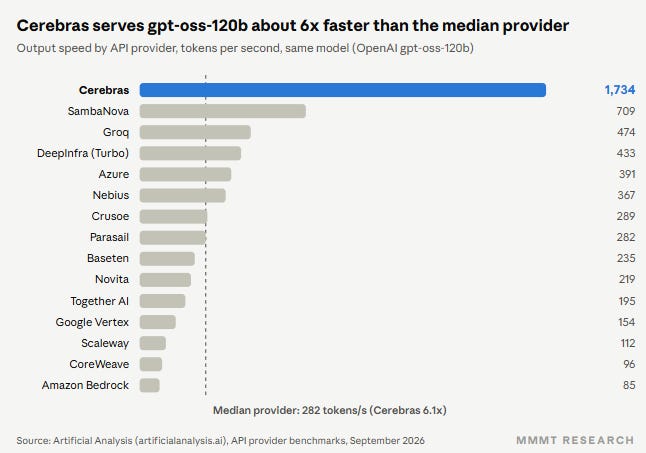
In our model, speed ultimately shows up as price. We have to assume rivals narrow the gap so Cerebras’s premium falls to ~2.75x (from 4.4x) by 2031 in our base case (2.5x bear, 3.0x bull). As rivals get faster, customers will pay less extra for Cerebras’s speed so each token it sells earns less. Industry wide price cuts matter less though because we assume each new generation of Cerebras systems produces more tokens per megawatt to offset them.
Revenue per megawatt therefore falls from $11.45M a year in 2027 to ~$7.9M in 2031. Total revenue still rises sharply from ~$3.1B to ~$23.7B because of capacity growing from under 400MW at the end of 2027 to ~3.2GW by 2031.
Pricing per megawatt
The OpenAI contract implies ~$27M of revenue per megawatt over its life. Our base case assumes $11.45M per MW/year in 2027 falling ~9% a year to ~$7.9M by 2031 as Cerebras’s price premium narrows and as commodity token price cuts are offset by new system generations producing more tokens per megawatt.
The bear case assumes $11M with the premium narrowing to 2.5x by 2031. The bull case has $12M with the premium holding at 3.0x. Dynamic pricing for latency sensitive peak demand could add upside but we exclude it for now to stay a bit more conservative.
The path to high margins
Margins are thin today at Cerebras and that’s a key risk.
Core gross margin was 41% in Q2 2026 and GAAP gross margin 14% with management guiding to a 17-19% core operating loss for 2026.
We expect margins to rise as installed capacity fills up for three reasons.
First, Cerebras is currently renting data centre space and capacity from third parties while its own facilities are built and paying someone else’s mark-up as its own data centres come online.
Second, most of a data centre’s costs such as power contracts, cooling, staff and the equipment itself are fixed so each extra paying customer on the same capacity adds revenue at little extra cost.
Third, each new generation of systems produces more tokens for the same power and space.
In our base case, cloud gross margin before depreciation climbs from 37% in 2026 to 70% in 2031 and EBIT margin reaches ~47%. That takes diluted EPS from a loss in 2026 to $19.57 in 2030 and $26.44 in 2031.
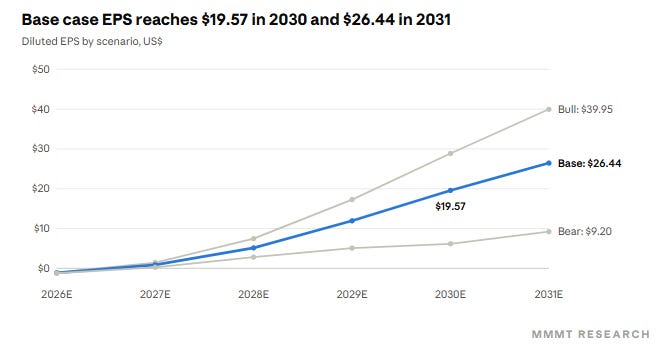
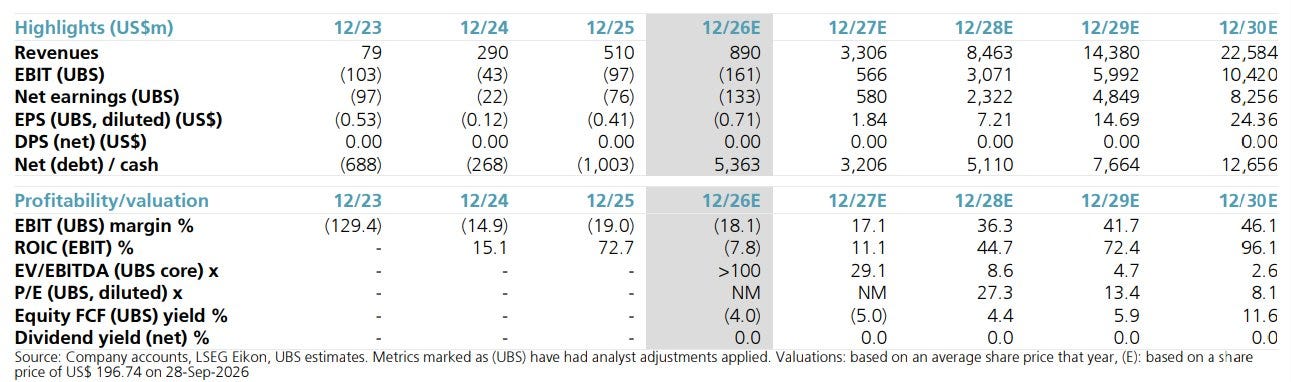
For what it’s worth, this is far below forecasted numbers from UBS of $24.35 in EPS in 2030.
Who pays for the data centres
Capital intensity is the biggest open question in our model and one of the biggest in the AI trade right now.
Cerebras had $8.6B of cash after raising $6.4B in its May 2026 IPO plus an $850M credit facility. Our base case assumes partners and customers fund most of the build out leaving Cerebras to spend ~$5M per incremental megawatt.
If Cerebras has to fund chips and facilities itself…capex could be 2-3x higher and it would likely need more equity or debt. That is why our bear case assumes 355M fully diluted shares in 2031 against 345M in the base case.
Our bull case also carries a slightly higher share count 350M but for a different reason. OpenAI’s warrants for up to 10% of the company vest only if it buys 2GW of capacity which happens in a strong outcome.
That dilution is a cost of success and the extra earnings in the bull case would more than offset it.
Exit Multiples
Our base case comes down to three operating numbers for 2031: ~3.2GW of installed capacity, ~$7.9M of revenue per megawatt and a ~61% EBITDA margin. Together they produce ~$14.4bn of EBITDA which we value at ~13.5x.
If we then add ~$22.5bn of net cash and divide by 345M diluted shares we get ~$630 per share before risking and ~$485 after.
Why 13.5x: We apply the multiple to 2031 when Cerebras is no longer a start-up but is still growing revenue ~23% a year at a ~47% EBIT margin.
At 13.5x EBITDA, our base case equates to ~24x 2031 earnings, ~17x EBIT and a ~4% free-cash-flow yield. We think that is a fair price for that profile rather than an overly stretched one but tweak that how you will.
EBITDA can flatter a capital heavy business but because we assume partners fund most of the build out… ~60% of our 2031 EBITDA turns into free cash flow.
Why 10x and 14x: Our bear case uses 10x which is the kind of multiple investors pay for mature computing infrastructure. That would be in line with what Cerebras would look like if the OpenAI deal weakened and its speed premium faded.
Our bull case uses only 14x which is conservatively barely above the base case. We would rather put the upside into what the business achieves than into a higher multiple: the bull case is ~45% above the base because of more capacity and better pricing, not because the market necessarily pays more for it. I think this could be tweaked higher though but a lot of this will be dependent on the macro down the road.
Opportunities not included in the model
OpenAI’s 1.25GW option
OpenAI holds an option on a further 1.25GW through 2030 on top of its 750MW commitment. Our base case does not depend on it being exercised. If it were, OpenAI alone would account for 2GW, close to two-thirds of our base-case capacity and its warrants would vest.
Hyperscaler distribution
Cerebras plans to bring disaggregated inference to Amazon Bedrock in the first quarter of 2027 and expects a joint offering with AMD for up to 5x throughput gains. Selling through AWS could open Cerebras to enterprise customers that would never sign a direct contract.
Sovereign and on-premise AI
Governments and regulated industries increasingly want AI compute within their own borders. Cerebras built its early business on G42 in the UAE and could repeat that model elsewhere. Our hardware line grows at 20% a year in the base case which leaves room for a large sovereign contract to surprise to the upside.
Key risks
Customer concentration: OpenAI’s $20bn+ contract is roughly 80% of Cerebras’s $25.4bn backlog. A delay, a cut or a move to rival chips hits revenue directly which is why our bear case models a non-renewal after 2028. This makes CBRS quite a concentrated bet on OpenAI’s continuous growth for the time being.
Rivals close the speed gap: Nvidia, with its CUDA software ecosystem and its Groq licence, AMD, Broadcom’s custom chips and Google’s TPUs are all targeting fast inference. If they catch up, Cerebras’s price premium falls faster than we assume.
Funding the build-out: We assume partners fund most data-centre capacity. If Cerebras has to fund it, capex could be 2-3x higher and require more equity or debt.
Near-term margins: Cerebras is renting third-party capacity while its own data centres come online which compresses margins: GAAP gross margin was 14% in Q2 2026.
Dilution: Fully diluted shares of ~314M compare with 237.6M outstanding, and the 2026 equity plan reserves a further 42.7M shares with annual increases from 2027.
Share overhang: The IPO lock-up ends two trading days after Cerebras reports third-quarter results, releasing the last tranche of pre-IPO shares. Insiders have already sold including a filing by the CTO to sell over $150M of stock in August. This is a near-term supply issue rather than a threat to 2031 value in our opinion but there appears to be a lot more room to the downside at the moment.
Volatility and valuation: The shares are down ~72% from their post-IPO high of $386 in May 2026 and our valuation depends on an exit multiple five years out which has a lot of uncertainties.
