

COIN is building the infrastructure for the AI native finance world we’re entering and few people are fully aware what’s happening.
Introduction

Company: Coinbase
Ticker: COIN
Market Cap: $52B
CEO: Brian Armstrong
Headquarters: New York
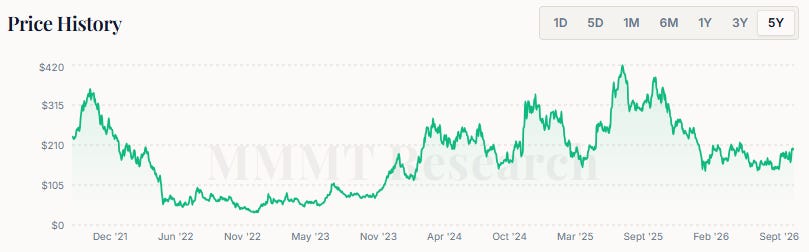
The market continues to see COIN as a leveraged bet on crypto trading volumes and Bitcoin spot prices. When BTC fell from $127k down to $58k (54% drop), COIN fell 68%.
And vice versa too. When BTC rises, COIN tends to rise more.
Given the revenue mix for COIN in 2021 until last year, this was a fair way to model COIN. But given the lack of diversification in the revenue and PE ratios above 70x…the stock never interested me more than just owning Bitcoin itself.
This is a very different story in 2026 as 88% of net revenue is now not tied to BTC spot prices. And the market is slowly waking up to it which is giving investors an opportunity to enter before we’re past the tipping point.
COIN is now split out between:
A regulated exchange (spot BTC, derivatives, equities, prediction markets)
On chain settlement stack (Base + x402 + CDP)
A stablecoin platform (USDC distribution)
From here on out, COIN’s price will be driven more and more by the on chain settlement stack and stablecoin performance. BTC spot prices will continue to drive the narrative in the near term, but over the course of a 3-5 year window, we’ll start to see a decoupling from the volatility (although even that is lessening) we see in crypto prices.
The Wider Theme
This section is broken down into:
Bitcoin and Ethereum and Why you Should be Bullish Crypto
Stablecoins
Tokenization
Agentic Commerce
Bitcoin and Ethereum and Why You Should be Bullish Crypto
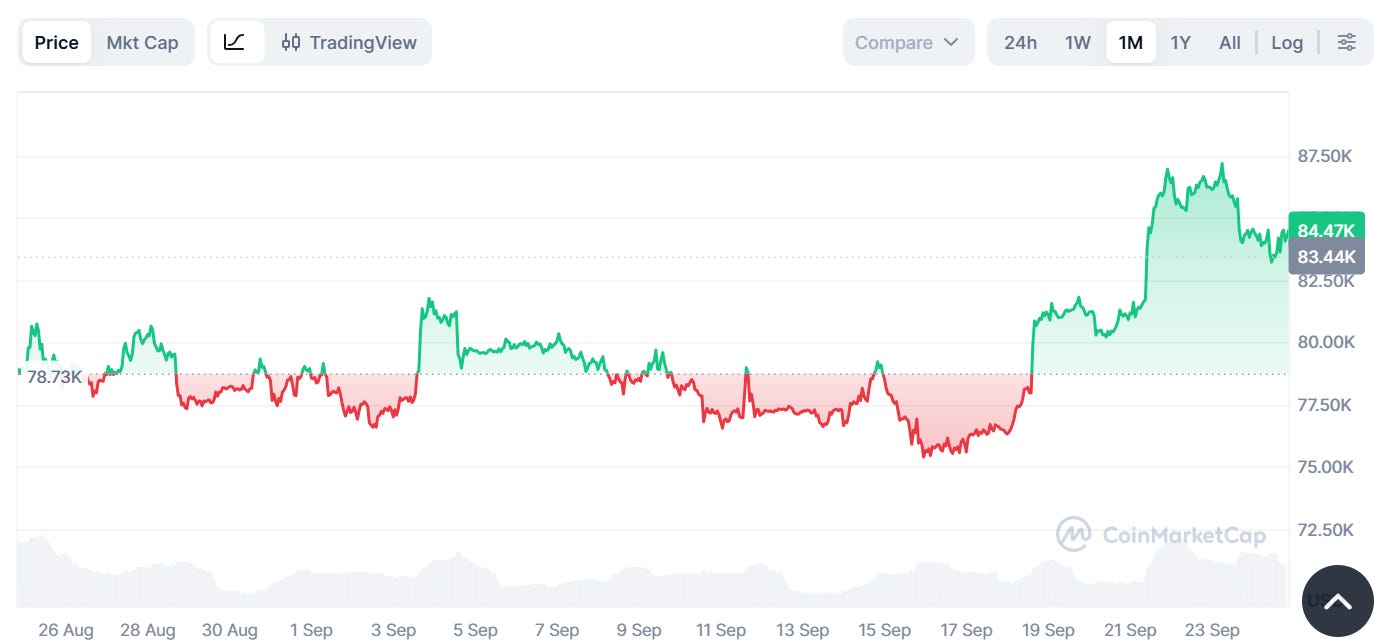
As this article goes on, I hope you’ll understand that COIN will not be a stock that will move in line with crypto prices. But the underlying tailwind behind it is of course the adoption of crypto so it’s important we touch on this.
Bitcoin (and Ethereum) has been a technology that only until recently people saw as a store of value rather than a technology that can be widely applied. Only more recently are we seeing crypto actually have clear use cases.
Capital and attention from Bitcoin’s rise over the last 10-15 years has created the buildout in exchanges, blockchains, stablecoins, settlement rails etc and it’s only now when agent count is multiplying month on month that crypto actually has applications and alignment with what is happening with AI.
Like I’ve said before in a very simple sense:

In other words, there’s a growing connection between AI and crypto now. As broader AI adoption transitions into agents acting on behalf of users (rather than an advanced chatbot)…we’ll see demand, utility, and applications increase across the digital asset space too.
As we start to see agentic count creep up slowly…more and more people will start to understand crypto and the true applications. That alone will reprice the asset well before we hit maturity.
Stablecoins
Imagine a world where agents are calling an API 400 times per second. Each call costs ~3/10th of a cent. Visa’s fixed fee is $0.03-$0.04 per payment meaning the payment fee is larger than the thing being bought. On top of that, the payment then takes a day or two to actually arrive (with nothing clearing on a weekend).
An agent calling an API 400 times per second 24/7 using this payment method won’t work here. It’s a crazy mismatch. Yet this is the situation emerging if stablecoins don’t become mainstream.
This is why the next phase in commerce is all about verification, speed, and automation which is exactly the reason stablecoins were created. And if you really start to zoom out and understand what’s been going on, you should have a pretty clear idea that the past 5-10 years has been the slow buildout of the infrastructure layer for the next era in commerce.
The last hurdle that we’re currently going through is mainly regulatory and how stablecoins will be governed. That shows you how early we truly are here to this revolution.
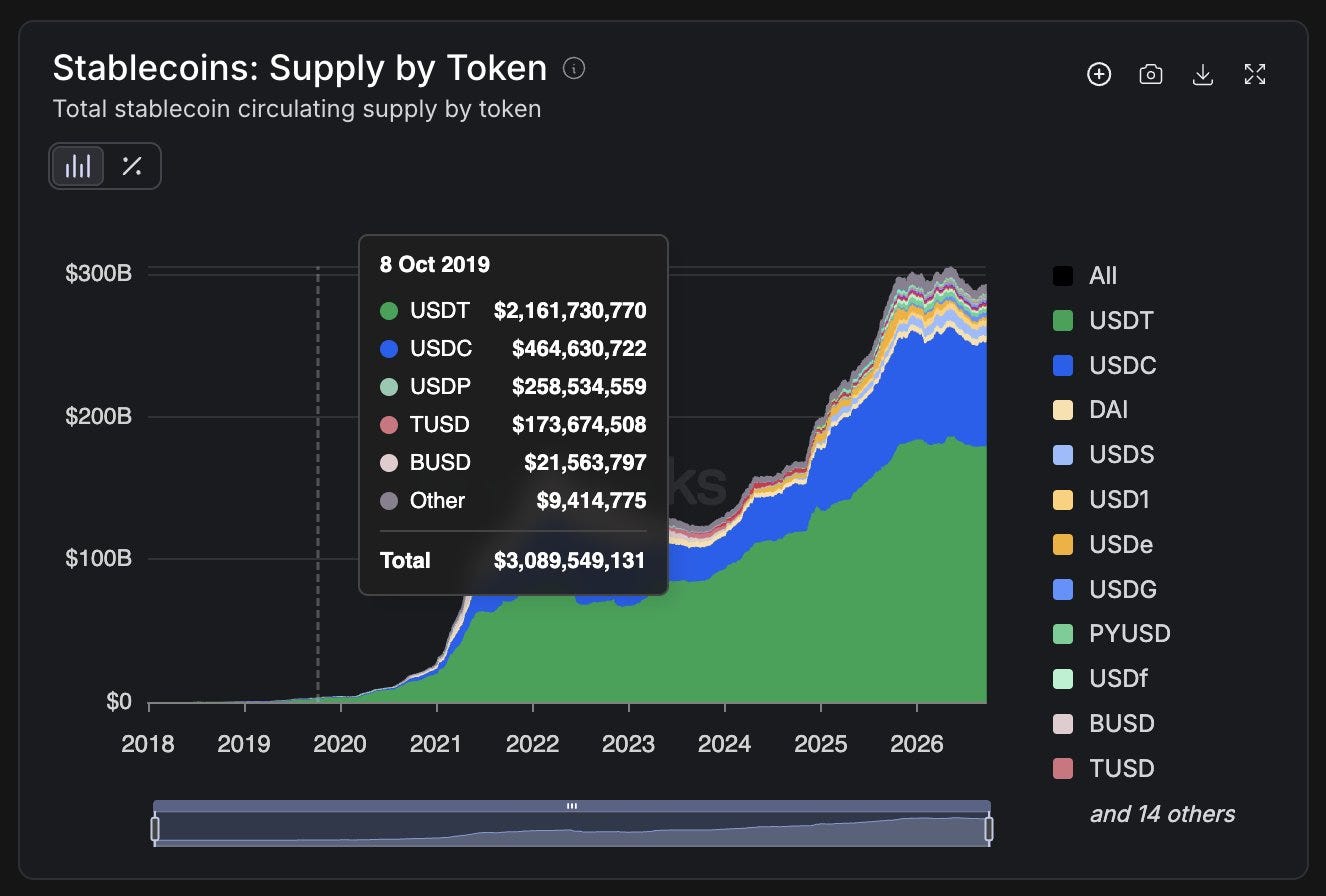
The scale we’re working with now is no longer trivial despite the need to get over regulatory hurdles. Stablecoins now have a $300 billion market cap with transaction volume over $11 trillion (same range as Visa and Mastercard’s annual payment volume) growing at 80% CAGR compared to ~8.5% CAGR for ACH (Automated Clearing House - the network US banks use to move money between accounts).
Relative to $93 trillion for ACH, we’re still just at a fraction of the total movement, but the growth rate tells you which system is built for where commerce is heading.
The important thing to understand as an investor is where the economics actually land. As agent driven transactions mature, the transaction fees will become less and less. When that does happen, the durable value will sit with whoever earns yield on the reserves backing the stablecoin… and not who gets the fee on each transaction.
This is the company COIN is building. It’s not just a platform where these transactions happen. Through its commercial relationship with CRCL it also captures a substantial share of that reserve yield itself.
Tokenization
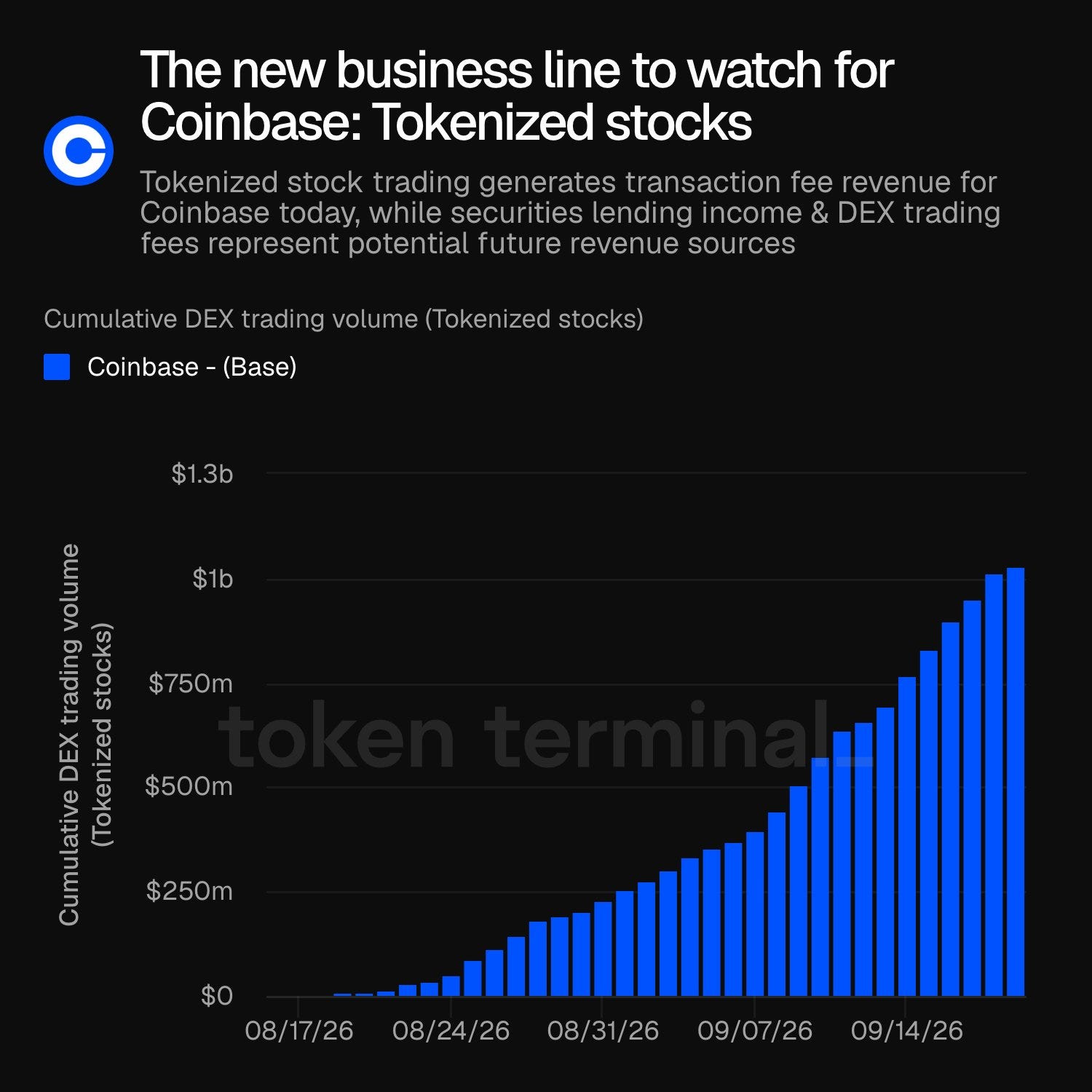
When you understand tokenization and the benefits of tokenization, I think it’s hard not to think the risk to reward lies on the buyers side.
Whether that’s through COIN, or through HOOD or even through pure plays like SECZ is up to you.
The core thing to understand on tokenization is that assets held (which in the US is ~$195.9 trillion) becomes a lot more mobile. By mobile I mean that assets become easier to value, easier to convert, and easier to use as collateral…essentially assets that actually start working vs assets that are just sitting there idle.
Idleness is the problem tokenization solves.
Idle assets are locked behind slow settlement, fixed market hours, manual administration, and intermediaries who gatekeep who’s even allowed to hold it. Tokenization gets rid of each of these bottlenecks and turns idle capital into working capital.
This leads to:
Settlement in seconds
Markets that never close
Self-executing assets
Idle assets become productive collateral
Exposure for everyone to the capital markets
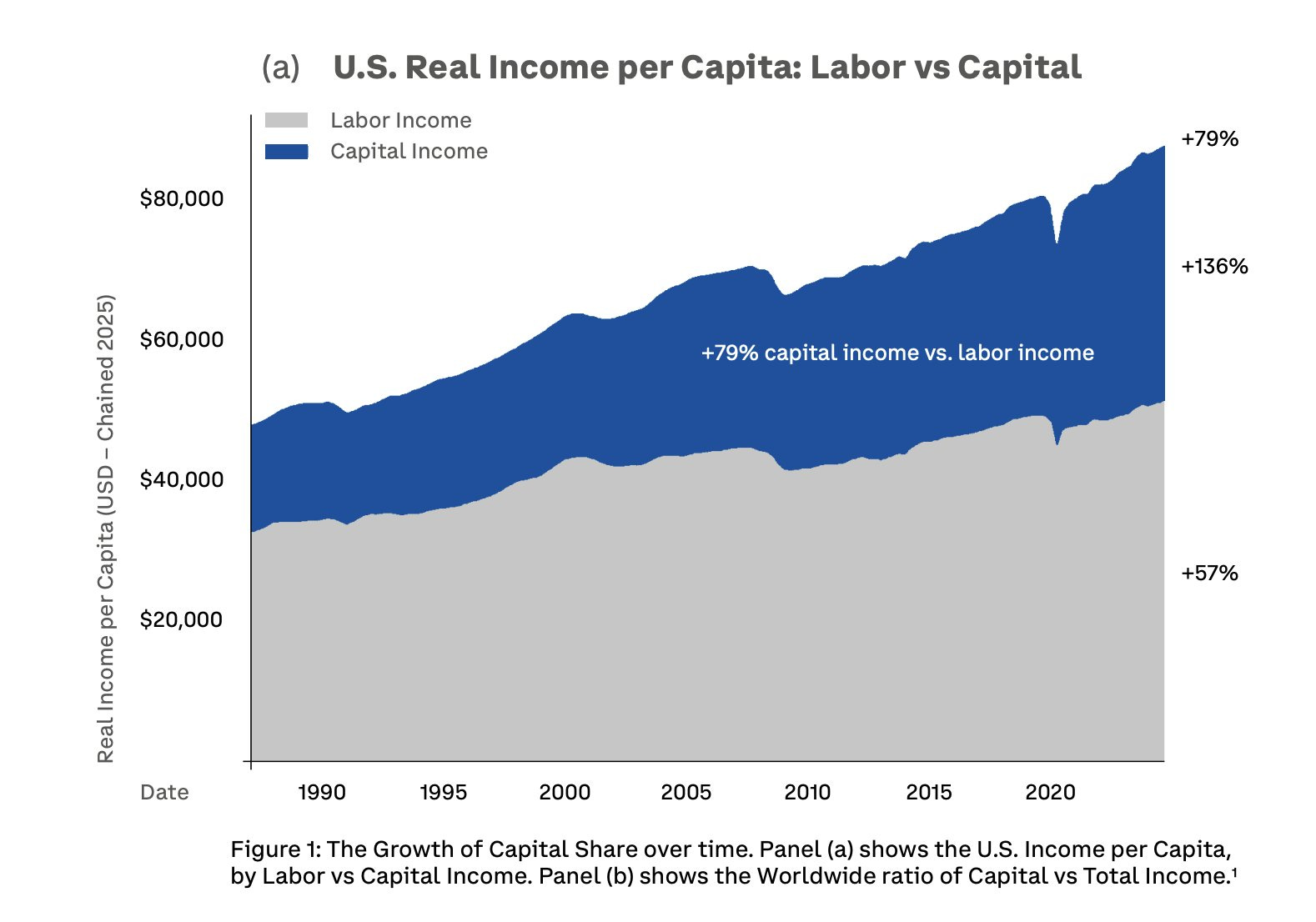
Right now we have ~$14.8B in tokenized Treasuries and only just a recent launch of tokenized equities. All US government debt is currently $31 trillion so $14.8B represents only 0.047% so the greenspace ahead is substantial.
A modern brokerage app today earns most of its revenue from activity around the asset…not from the asset itself. A share sitting in a brokerage account doesn’t really do anything unless it’s being bought or sold. It’s deadweight on a balance sheet. Tokenization changes this. If even a small part of a custody balance can be reused as collateral, lending inventory, or a hedge of some sort, the economics of those “idle assets” becomes a lot more interesting for both the platform (COIN) and the holder.
But you don’t need the entirety of this $195.9 trillion to become tokenized for this number to matter. Even a small percentage becoming more mobile is still measured in the trillions of dollars of newly productive capital.
For COIN, it’s betting on exposure to this entire theme through the infrastructure layer (custody, exchange, on/off ramps) that has to exist for any of this $195.9 trillion to actually move.
McKinsey puts tokenized real world assets (ex-stablecoins) at ~$2-4T by 2030. Citi’s base case sits at $5.5 trillion for tokenized securities specifically with a wider range of $2.7-$8.2 trillion. Some forecasts from BCG and others go far higher when you then include tokenized deposits and stablecoins in the definition too.
We get into the numbers of what this means for COIN in the valuation section.
Agentic Commerce
This all comes together with another big tailwind which is agentic commerce.
Just last week, Meta’s consumer agent - Muse - was released and it hit #1 on the app store.

The key difference between Muse and the rest of these frontier models so far is that its the first genuine reach event for consumer agents. Muse launched with 100 million tokens per week which has essentially allowed the general population (those without technological expertise) to put an autonomous agent to work for them on real tasks.
→ Using an agent to find flight credits to book flights.
→ Using an agent to cancel unused subscriptions.
→ Using an agent to shop around for better insurance deals.
→ Using an agent to move your money into a higher yield savings account.
It’s going to be a world where each agent is essentially just performing a load of smaller transactions beneath it. All this requires transacting with services the agent may have never touched before.
If you then extrapolate that to hundreds of millions of Muse users…you get an explosion in the amount of machine to machine transactions that no existing payment rail is built for.
Morgan Stanly & Bain are forecasting the agentic commerce space to be ~$300-500 billion by 2030.
Again, we get into what this means numerically in the valuation section.
Where We Are Today
Everything above is the exact gap crypto fills.
Not necessarily the payments between parties that already have a billing relationship…but the agents discovering a new API or data course mid-task with no prior account, no API, and nothing set up prior.
This is exactly where COIN’s Base sits. Base already carries ~98% of x402 machine payment volume transactions.
The story today though is that agentic payments are slim. The data is showing no material increase in x402 payments because agents aren’t massively economically useful right now. Agents are assisting with telling humans what to buy and where to buy it…but the next stage of giving agents access to a credit card is not happening.
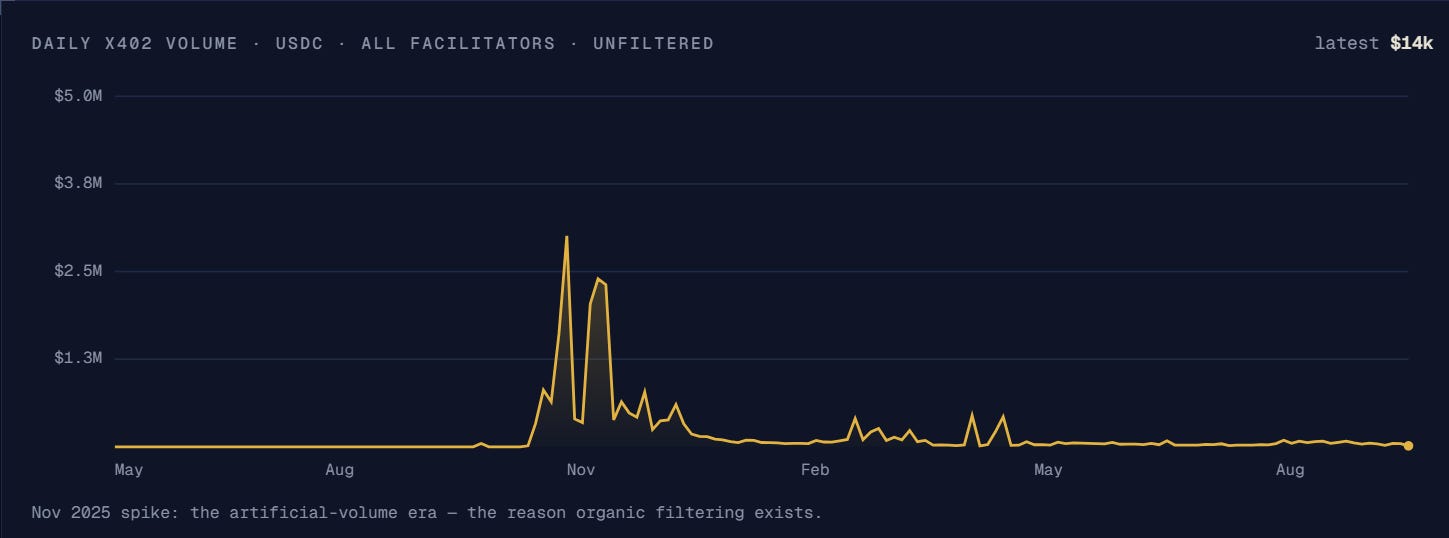
The reason the numbers are so small today is because there’s millions of tiny pings but no meaningful spend yet. I.e. we’ve seen 5.7 million one-cent payments on Polygon ($57,000 total).
But this does tell you what’s happening.
The infrastructure is being built well ahead of the traffic it was designed for. Things like wallets, settlement rails, and payment standards are live and working, but the population of agents genuinely transacting with purpose hasn’t shown up yet.
Muse is the clearest example of this directionally but even it (the most consumer facing example of an agent) still asks for human approval before spending money. If human approval is still needed, and connecting credit cards is therefore still the route, then agentic x402 payments simply aren’t a material thing yet.
Until agents can transact with stablecoins and until the regulatory environment and the infrastructure continues to get built out this remains a thesis.
But just be aware what is happening despite x402 payments being thin:
Visa (V) has a framework called Visa Intelligent Commerce (VIC) built with Cloudflare (NET) which lets merchants cryptographically verify an agent is legitimate before treating a payment as trustworthy. This launched back in June 2026 and shows us that the big players aren’t sitting on the sidelines waiting to see if agentic commerce becomes a thing. They’re actively building now.
AWS shipped native x402 support into CloudFront and AWS in July 2026. This means payment-gating for agents is now built directly into core AWS infrastructure and not something developers need to add on themselves.
Cloudflare (NET) has also partnered directly with x402 by verifying payments at its network edge (i.e. closer to the agent) rather than having to route back to an origin NET server. It’s also built a “Monetization Gateway” that lets websites, datasets, and tools charge agents directly through the protocol.
Composition is shifting towards genuine commercial use with payments of $1 or more growing from 49% to 95% of total transaction value.
The Coinbase Opportunity
Some firms out there touch one piece of the above. I.e. Robinhood (HOOD) and Securitize (SECZ) are great plays on tokenization. Circle (CRCL) is a pure play on USDC / Stablecoin adoption.
But nobody owns the entire stack aside from COIN…and that’s ultimately the thesis.
You have:
Stablecoins: COIN holds the commercial relationship with Circle that gives it a direct claim on USDC reserve economics. This is a key layer of the stack that will survive fee compression as agentic payment volume scales.
Renewed the same CRCL deal through to 2029. USDC is the #1 regulated stablecoin in the world by transaction volume but sits behind Tether if you blend regulated and unregulated stablecoins by market cap and AUM.
COIN is also becoming a multi-stablecoin platform. It already supports PYUSD (PayPal) and USDT (Tether). The aim for COIN is to have “good economic arrangements” with every major stablecoin and not necessarily just USDC.
Base (COIN’s own chain) did $32 trillion in stablecoin transfer volume over the last 12 months already.
Tokenization: It sits at the custody, exchange, and on/off-ramp layer that any tokenized asset has to pass through to actually move. Tokenization doesn’t work if cash and securities can’t settle on the same ledger. COIN owns that infrastructure that makes that settlement possible.
COIN has already launched tokenized equities on Base for non-US customers. US customer access is still pending the SEC’s “innovation exemption.”
COIN has also launched pre-IPO perpetual futures for non-US customers which gives retail access to private companies and it’s another big benefit of tokenization.
Agentic Commerce: It owns Base, the chain that carries ~98% of x402 machine-payment volume.
I’ve separated agentic commerce out throughout this article aside from in the valuation section where it’s grouped in with total S&S revenue. The revenue isn’t material enough yet to be given a separate line item in COIN’s reports or in my valuation work.
Earliest signs so far we’re seeing are agents buying inference and compute.
Brian Armstrong has been explicit in saying that Base has a huge competitive lead vs newer entrants like Stripe (Tempo) and Robinhood’s L2 with about a 2 year head start.
Crypto Adoption: It runs the exchange that still captures the bulk of institutional and retail BTC/ETH trading activity that gives it the foundation and relationships that funds and reinforces everything else built on top. COIN is now much more than a single product exchange now though and is discussed by management as the “Everything Exchange” with spot trading, derivative trading, traditional equity trading, and prediction markets.
COIN also now holds ~12% of all on-chain assets. That’s a huge lead vs other peers.
Other Bets: Beyond the four core layers, COIN holds a growing set of smaller, higher risk, higher reward bets that represent free optionality on where crypto infrastructure heads next:
Prediction Markets: Already scaled to $100M ARR. If this becomes a recognized asset class the way sports betting did and options did…COIN is already a regulated leader building out this product. This growth has come from existing COIN users with zero marketing spend yet.
Derivatives: The Deribit acquisition has given COIN a lead in the crypto options and futures niche. Margins here are much higher than spot crypto trading. It also diversifies revenue away from the whole “consumer retail cyclical trading” bear COIN case.
Coinbase One: Crossed 1 million paying subscribers in Q2 2026 even during a down market for crypto trading which is more evidence that membership has value beyond just trading volume.
And if history repeats itself in any way, owning the stack tends to be the best investment. NVDA is the cleanest example. It didn’t just sell GPUs…it built CUDA (the software layer), NVLink (the interconnect layer), and much more. In other words, it captured value at every layer of the AI compute stack rather than just the chip. Apple did the same. Amazon did it with AWS (owning compute, storage, and the platform layer).
With COIN, you have the same structure (though less monopolistic) forming across crypto.
The bet of course isn’t that COIN becomes crypto’s NVDA. It’s that a company sitting on the dollar (stablecoins), the settlement layer (Base), the venue (the exchange), and the asset-migration (tokenization) should be worth more than the sum of its parts once those layers start reinforcing each other.
Now here’s the valuation:
Valuation
Total Transaction Revenue:
This is the bucket of revenue that the market already knows about. It’s the cyclical part of the business and it’s not the core bull case I have for COIN in anyway.
It’s still obviously important to model in the numbers because it’s a significant chunk of today’s revenue and will be a significant (but hopefully shrinking relative to the rest of the business) section of the overall revenue by 2031 onwards.
I model ~$7.2B in transaction revenue in 2031 as a bull case. TTM transaction revenue was ~$3.32B so that’s a CAGR through to 2031 which I see as viable based on:
Consumer spot notional $1.0-1.4T at a consumer take rate of 0.25% (down from today as fees compress). This is the volume that will be the lumpiest by far.
That’s ~$3.6B
Institutional spot notional of $3-5T at 0.05%. This is the larger volume that will exist when retail are quiet.
That’s ~$2.4B
Other transaction revenue is derivatives, non-spot pairs, and newer products like scale like prediction markets which are already at a $100M ARR.
I forecast ~$1.2B here
Total: ~$7.2B
These numbers rely on:
Digital asset turnover being higher in 2031 than it is now on average.
Consumer take rates going down but volume outrunning that.
“Other” transaction revenue has real potential.
A base case scenario has COIN generating $5.4B in transaction revenue which is only ~9.6% CAGR through to 2031.
Total Subscription & Services Revenue:

This is broken down into three separate items in my model:
Stablecoin revenue
Agentic commerce revenue
Other revenue
Stablecoin Revenue:
This is the bulk of the opportunity and where the risk to reward makes sense if the below numbers materialize.
US Treasury Scott Bessent forecasts stablecoin revenue to be ~$3T in 2030. We’ve also got forecasts from Bain & Co at ~$3.8T.
In my model, stablecoin revenue will be the following:
Balance x coupon rate x COIN’s share of the USDC economics.
I conservatively use 3.4% as the 2031 reserve rate (coupon rate) which sits under today’s value ~4% and more in line with CRCL’s Q2 2026 reserve return.
My model forecasts $10.8B in revenue in 2031. That’s:
$3T total stablecoin supply by 2031 (aligned with Bain & Co and Scott Bessent)
30% share of stablecoin supply for USDC → $900B suggesting USDC stock
$900B x 3.4% (yield) x 35% (blended share of USDC economics for COIN) → $10.8B
The above would be my base case.
A more bullish case would assume COIN is nearer to 45-50% of USDC economics.
i.e. $900B x 3.4% (yield) x 45% → $13.8B.
That 35% assumes distribution dilutes as USDC goes into banks, other apps, and non-COIN wallet.
Agentic Commerce Revenue:
McKinsey estimates the 2030 market to be upwards of ~$1T in the US and $3-5T globally. Directionally I think this is spot on. Timeline wise it’s much harder to gauge particularly with recent regulatory failings (i.e. CLARITY).
The TAM for COIN is therefore not this $3-5T figure. Most of that will settle on cards, bank rails, Amazon, Shopify, Stripe, Visa, etc. COIN’s realistic slice is the machine native layer: agent wallets, USDC settlements, Base, x402.
So in terms of forecasts for COIN themselves it’s a question of how much agentic volume flows through COIN’s rails combined with a realistic blended take rate.
Bull Case: Agents become a default checkout path and USDC/Base/x402 become default settlement options. I give this is a 20% chance.
$500B-$1T * 0.5% - 1% → $2.5B - $10B
Base Case: Stablecoins win a meaningful share of agent-to-merchant micropayments and some cross-border / always-on checkout, plus agent trading grows.
$100B - $400B * 0.4% - 0.8% → $400M - $3.2B
Bear Case: Agents pay for APIs, compute, research, and some digital goods on x402/USDC but retail checkout stays on cards.
$20B - $50B * 0.3% - 0.6% → $60M - $300M
This shows you the ranges that are present depending on just how much and how quickly the financial system changes. To reiterate, I believe directionally we will head towards the bull case figures. The timeline is much harder to anticipate right now.
The big, stock moving numbers only really appear if COIN becomes a core settlement and wallet layer for agents.
Total Revenue:
In total this puts my total revenue between ~$16.5B and ~$23.3B. I place my bull case revenue ~$22.7B with base case ~$16.1B and a bear case at ~$9.6B.
That means my bull and base case are currently above analyst estimates with a bear case below.
Net Income:
I assumed a net income margin of 43.2%.
In FY24 COIN already did 39% in net margins with Visa at ~50% margins. The bull case is that COIN starts to look like a rail and not an exchange…hence a bull case with those kinds of margins.
Bull case:
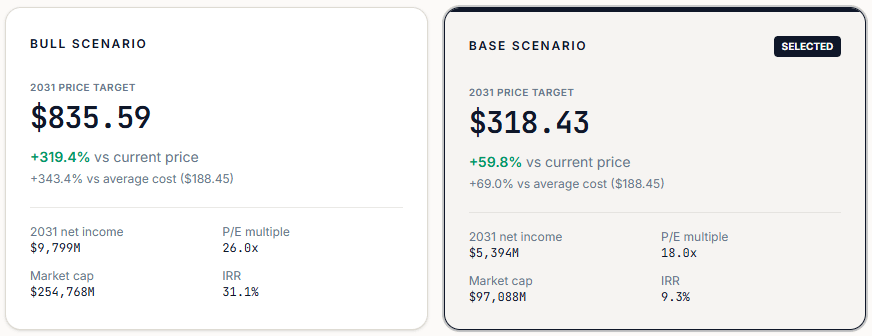
That gives me a net income figure of $9.8B (bull case) which at 304.9M diluted share count gives us an EPS of $32.14 in 2031.
Base case:
A base case assumes $16.1B in revenue at ~33.5% net margins because of a lower stablecoin mix (more transaction mix) and general scale.
This kind of result for me seems unlikely given how I see the agentic world playing out…but it’s important to model out a case where I’m wrong.
This gives me a net income figure of $5.39B and an EPS of $18.
Multiple
S&S revenue today is ~41% and our bull case model puts us towards a 68.4% mix shift.
This makes S&S the dominant revenue generator for COIN and that’s deserving of a far higher multiple than if transaction revenue were the key driver.
Transaction revenue is a volume x take rate business. It spikes when retail trades and collapses when they don’t and the fee simply keeps getting competed down. The market therefore prices that part of the business like a broker:
IBKR at 31x NTM PE
SCHW at 14x NTM PE
CME at 20x NTM PE
If we average those out, and consider that a base case has transaction revenue growing no faster than 10% per year, I think assuming a 16-18x multiple for this segment of the business is fair.
S&S revenue is deserving of a higher multiple because the cash flow generated here is more recurring, and structurally more durable than transaction revenue. Companies get valued higher for something that can generate increased cash flow with no material increase in incremental effort…and that’s where the stablecoin side of this business is heading.
V and MA for example trade in the 26x range and I think given COIN’s growth here and it being more crypto native, I think 26x-30x would be a fair range for this side of the business.
So to come up with an overall PE multiple, I simply take 68% (S&S revenue per my model) x 30x + 32% (transaction revenue per my model) x 16x which gives us an overall PE of 26x.
Bull case:
So 26x x $32.14 (EPS as above in bull case) → $836 which is a 322% increase of 27.1% per year.
Base case:
Let’s take a multiple more weighted towards transaction revenue vs S&S which would bring us closer to a 20x multiple.
A 20x multiple on $18 (EPS as above in base case) → $360 which is a 82% increase or 10.5% per year.
Disclaimer
Disclaimer: The Accuracy of Information and Investment Opinion
The content provided on this page by the publisher is not guaranteed to be accurate or comprehensive. All opinions and statements expressed herein are solely those of the author.
Publisher’s Role and Limitations
Make Money, Make Time serves as a publisher of financial information and does not function as an investment advisor. Personalized or tailored investment advice is not offered. The information presented on this website does not cater to individual recipient needs.
Not Investment Advice