Grid Upgrade: All the Bottlenecks You Need to Know
The Full Ecosystem
Everyone is talking about the grid…and for the right reasons.
But if there’s one lesson we’ve all learnt from the optics megatheme, it’s that huge money can be found by looking where nobody else is.
That’s why I’m writing this piece. I’m bullish on the plays a lot of us know about (ETN, HUBB etc), but there’s far more ways to play this theme than owning these stocks which now trade at PE multiples +30x.
The power grid upgrade isn’t an AI trade, nor a clean energy trade. It’s something far more fundamental. We’re on the verge of major economic growth, technological leadership, and energy transition…but every single one of these run through wires.
Not least old, overloaded, and massively underfunded wires.
BNEF’s latest grid outlook showed that globally grid CapEx has now topped $470B in 2025 and that rate of CapEx growth is still growing in the double digits. Capital is flowing into hardware, software, advanced power-flow control systems, and grid-enhancing technologies simultaneously. This is not just a cyclical spending spree…it’s the beginning of what forecasts are predicting as a $1.4 trillion infrastructure super-cycle running to 2030.
Here’s the part you need to understand though. You can’t simply just modernize a grid. You can’t train a transmission line crew in a few months. You can’t get HVDC cables delivered in under two years. You can’t manufacture a large power transformer to order and receive it before 2027.
The supply chain that builds and upgrades this infrastructure has some real constraints… in materials, in manufacturing capacity, in labour, in regulations that can’t be resolved by just increasing CapEx. This pressure is what makes the grid infrastructure buildout one of the most non-discretionary investment themes in the global economy today.

Before we get into this article, I want to mention my database that I am building for paid subscribers.
For the last 1-2 years I have shared a Google Spreadsheet. You can see the latest one here:
This document gives you access to:
My portfolio
My watchlist
My theme tracker
All of the stocks per theme I follow ranked by growth vs multiples (250+ stocks tracked amongst the one exciting themes).
What’s even better is that this document is becoming a web app.
Over the next few weeks I’ll be sharing sneak peeks as we enter beta testing with a group of paid subscribers helping shape the product into exactly what this community needs. This is being built with you, not for you.
Because what I’m building goes well beyond stock picks and data dumps. I’m building a platform where subscribers have access to all the research, all the data, and all the commentary they need — in one place, updated in real time. And I do it fully transparently. My exact portfolio is shared so you always know precisely where my own money is going as well.
If that sounds like something you want access to, the link is below.
Contents:
Why this is a decade-long structural theme
Bottleneck 1: The Transformer
Solid-State Transformers
Bottleneck 2: Grain Oriented Electrical Steel(GOES)
Bottleneck 3: Switchgears & Breakers
Bottleneck 4: High Voltage Cables
Bottleneck 5: Interconnection
Bottleneck 6: Transmission Line Construction
Bottleneck 7: Towers, Poles, & Structural Hardware
Bottleneck 8: Grid Resilience
Everyone is talking about the grid. But almost nobody is talking about it correctly.
A proper thesis requires understanding why the money flows, where it gets stuck, and which second and third-order beneficiaries capture the value that the first-order trades have already priced in.
This piece does that. We’re going to walk the entire grid upgrade chain from raw material to software layer, identify every genuine bottleneck, price those constraints, and give you the full investable universe for each one (which you’ll then see on my database/web-app). I mention every relevant public stock, and then offer my highest conviction name/names within each section.
Why This Is a Decade-Long Structural Theme

U.S. electricity demand is doing something it hasn’t done since the 1970s: it’s growing meaningfully.
For two decades, from 2000 to 2020, overall electricity consumption in the U.S. actually declined slightly as efficiency gains offset population growth. That era is over.
AI data centers, manufacturing reshoring, EV fleets, and the electrification of homes and industrial processes have reversed the trend sharply. Analysts now project the US will need more than 150 gigawatts of additional capacity by 2030. To put that in context, the entire existing U.S. power fleet is roughly 1,200 GW — so we need to add the equivalent of ~12% of the entire grid in 5 years.
The grid itself — the wires, poles, substations, transformers, switches, and software that move electrons from generation to consumption — was largely built in the 1950s through 1970s. More than half of U.S. distribution transformers are beyond their expected service lives. Many transmission lines are 40-50 years old. The system was designed for a one-directional flow of power from central plants outward. Now we’re asking it to handle bidirectional flows from millions of rooftop solar installations, intermittent wind, distributed storage, and the concentrated power demands of 50MW data center campuses.
Global grid capital spending crossed $470 billion for the first time in 2025, up 16% year-on-year. U.S. utility capex hit $202 billion in 2025, up 8% from the prior year which itself was up 12.6%. This isn’t a one-year event. It is the beginning of what many analysts are calling a $1.4 trillion utility infrastructure super-cycle from 2025 to 2030.
The constraint is not capital. Capital is flowing well.
The constraint is physical: you cannot build the grid faster than the materials and workers that go into it.
The Eight Bottlenecks
Bottleneck 1: The Transformer
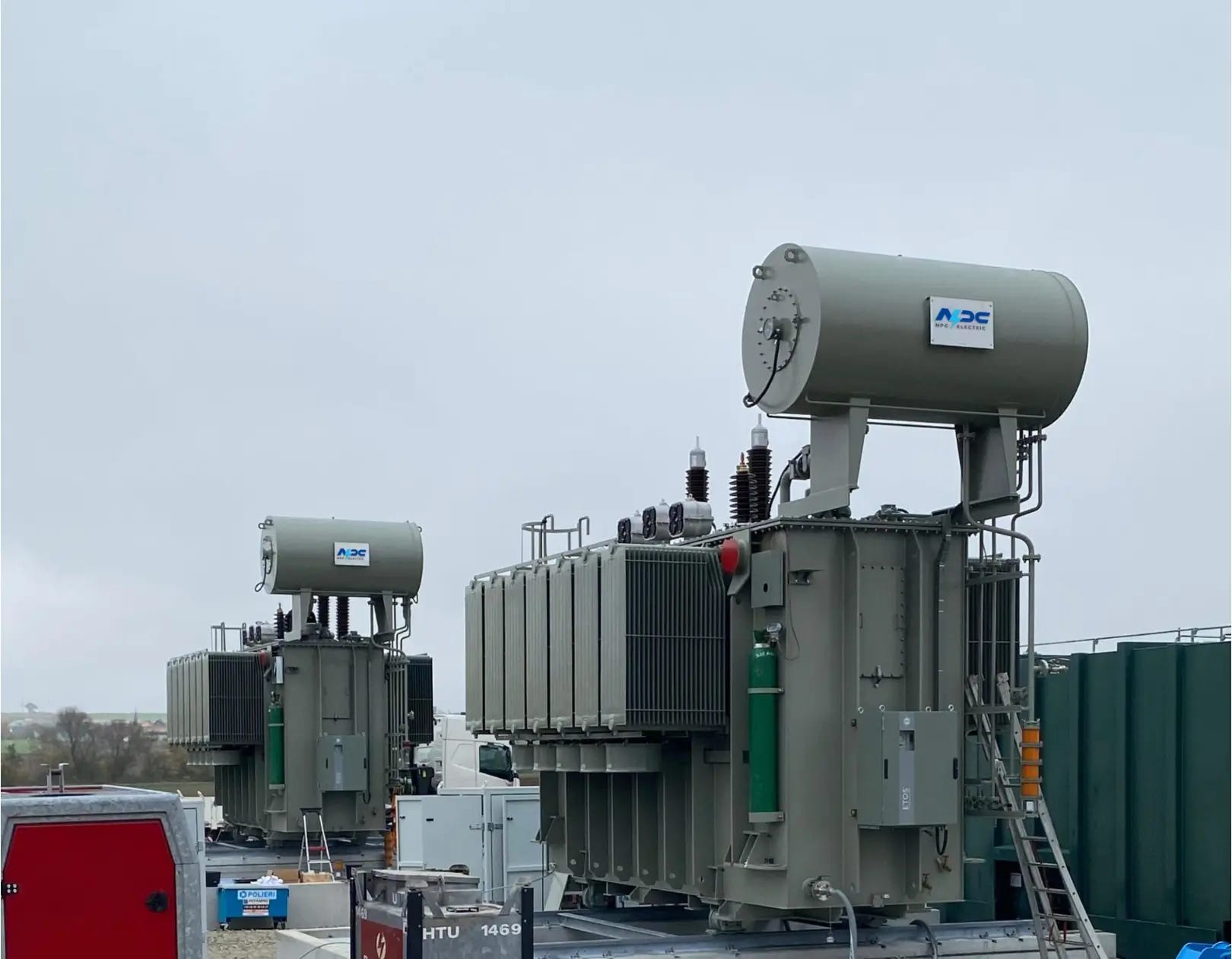
Electricity is generated at power plants at quite low voltages…10,000 to 30,000 volts. But the transmission of electricity at these voltages is inefficient today. Basic physics…the longer the wire, the more resistance, the more energy is lost as heat.
To move electricity economically across hundreds of miles of wires you therefore need to increase the voltage to +200,000 volts. This is what a transformer does. It steps voltage up before transmission and steps it back down before it reaches its end destination.
Pretty much all electricity generated in the US passes through at least 1-2 transformers before it is used.
How are transformers made?
Most transformers are made from a highly specialised steel alloy. It’s called grain-oriented electrical steel (GOES) - that’s the core part of a transformer.
You’ve also got:
The windings made from copper.
The insulation
Here’s some basic stats to evidence this bottleneck:
Power transformer demand has surged 119% since 2019 whilst distribution transformer demand is up 40%.
Wood Mackenzie estimate 30% supply shortfall for power transformer and 10% shortfall for distribution transformers.
Power transformers now have a 2.5 year (128 week) lead time.
Utilities are paying 4-6 times what transformers cost in 2022.
The global transformer industry carries a 2-3 year manufacturing backlog not expected to ease before 2027.
List of stocks:
Eaton | ETN
GE Vernova | GEV
ABB Ltd | ABBNY
Siemens Energy | SMNEY
Powell Industries | POWL
Hubbell | HUBB
Hammond Power Solutions | HMDPF
Hitachi Energy | HTHIY
SPX Technologies | SPXC: Has transformer components and electrical testing equipment business relevant to the bottleneck.
Legrand | LGRDY
Favorites:
Eaton | ETN | $140.1B
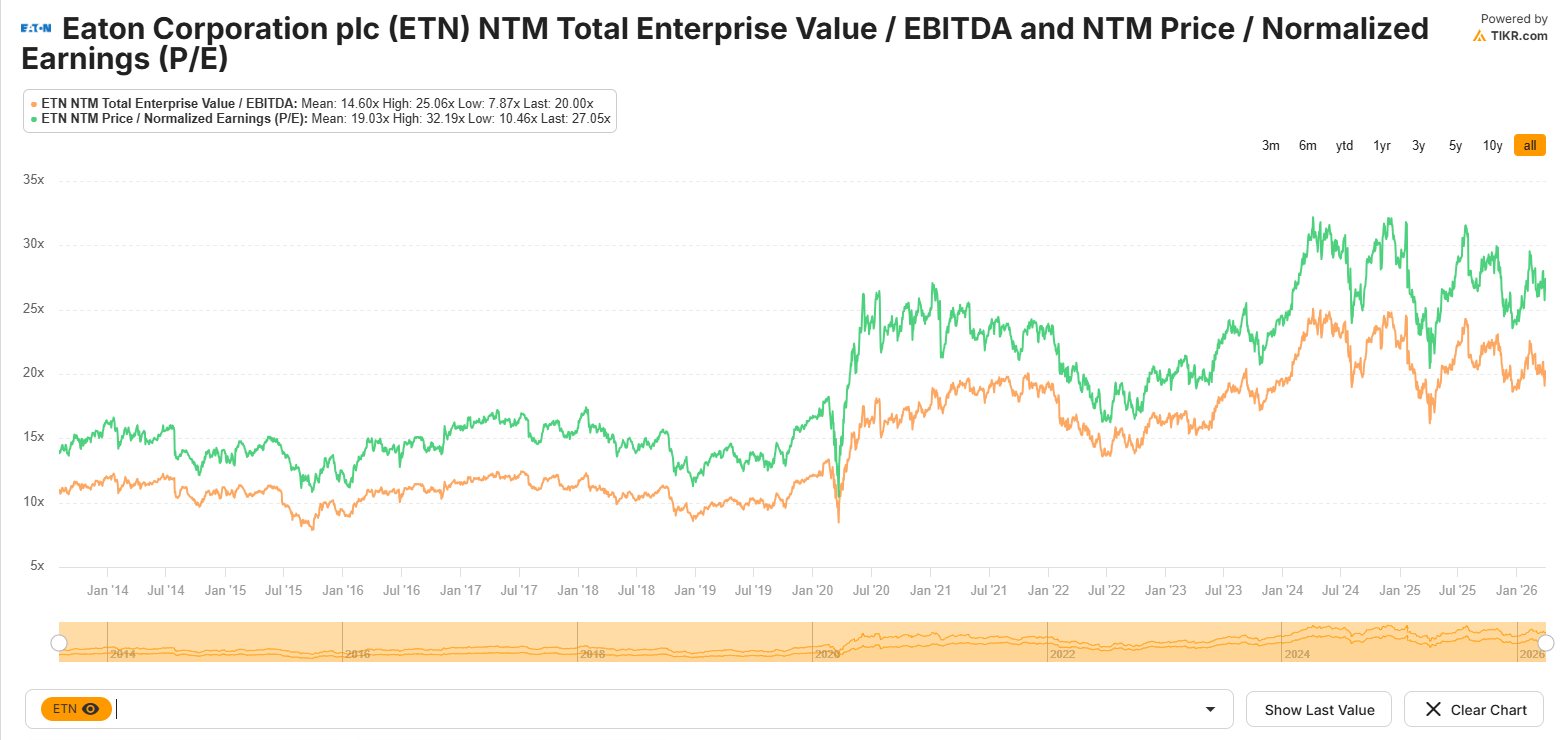
ETN is a diversified power management company that sits right in the middle of the US grid modernisation theme. It designs and manufactures the full stack of electrical infrastructure - transformers, switchgear, circuit breakers, power distribution units, busway systems etc - across every voltage class.
Specifically in the transformer space, ETN is one of the small number of Western manufacturers with the engineering capability to build the transformers. It’s also acquired Resilient Power Systems making them a play on solid-state transformer technology too (see below).
Considering the growth rate estimates for ETN (mid teens for EPS growth), a 27x PE is quite expensive…but there are many stocks that are expensive for a reason and I’d put ETN in that basket.
GE Vernova | GEV | $242B
GEV does much more than solve the transformer bottleneck. It’s a massive global energy company operating across:
Power
Wind
Electrification
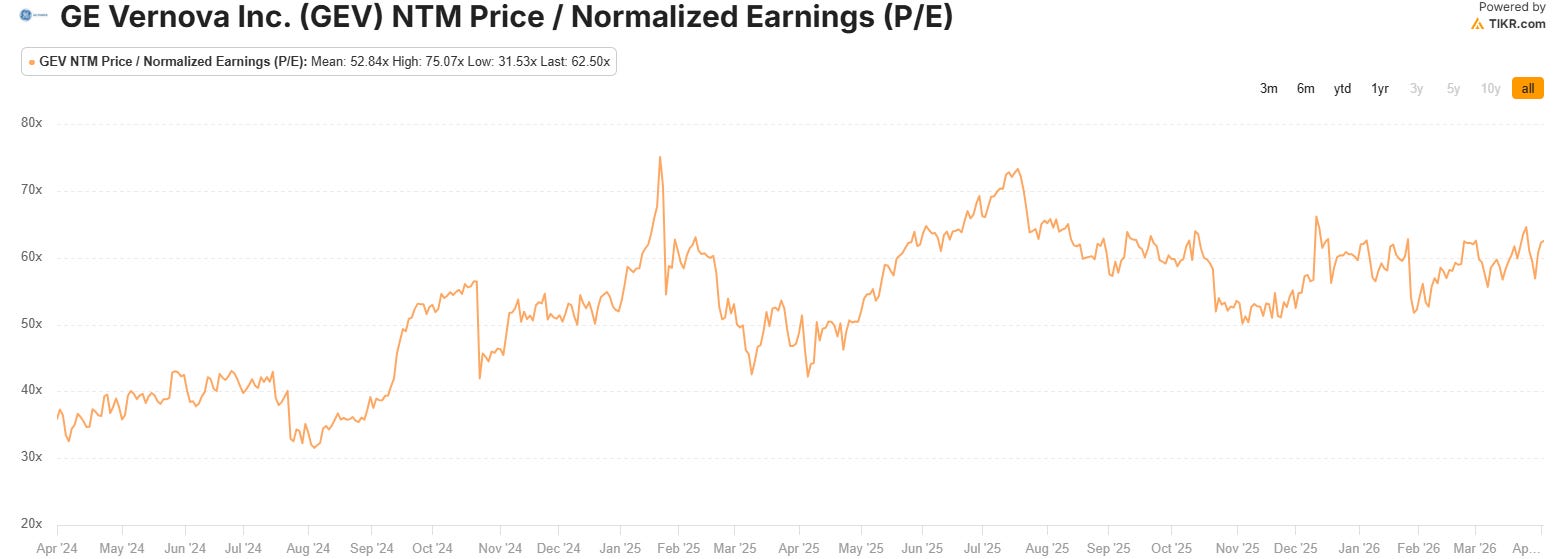
Its electrification segment is the fastest growing segment and supplies the hardware and software that connects generation to consumption. The business has an extremely strong moat but the investment thesis relies on you being comfortable buying a stock trading at 62x NTM EPS.
Here’s how I do “back of the napkin” maths on GEV:
Management guidance implies $5-6B in FCF in FY27-FY28 which means GEV is currently trading ~48x 2027 FCF which is a premium multiple, but it’s also a multiple that can be justified when FCF is growing at +40%. I can’t see GEV earning much more than 50x FCF multiple even if the electrification backlog doubles, and the wind segment stops becoming a drag. I wouldn’t be bearish on GEV at all, but I think at current levels you’re not aiming for more than 20-30% upside from here in the near term.
With that being said, I think GEV is one of those stocks you should always follow. If you get a +20% pullback I’d be inclined to invest as a fairly comfortable way to earn ~50% from a trade.
Solid-State Transformers (SST)
There’s a potential long-run solution to this transformer bottleneck though in Solid-State Transformers (SST) and the SiC Revolution.
The conventional transformer is a passive iron core filled with oil. It does one thing and one thing only: It converts voltage.
The emerging alternative is a software-designed power conversion built on Silicon Carbide (SiC) semiconductors. Instead of sitting on a pad and just converting voltage at a fixed ratio, an SST consolidates voltage conversion, fault isolation, power factor correction, frequency regulation, harmonics control, and phase balancing into a single programmable package managed in real time by software.
This means you replace not only the transformer, but the switchgear, tap changers, and capacitor banks as well.
The SST market is still in its infancy. It’s valued ~$180M as at 2025 but the technology is moving faster than I think most realize.
—> Eaton (ETN) acquired SST developer Resilient Power Systems in August 2025.
—> Navitas (NVTS) demonstrated a 250kW SST at APEC in 2026.
—> Wolfspeed (WOLF) launched the industry’s first commercially available 10,000-volt SiC MOSFET (the enabling technology for SST) in 2026.
Here’s the names you need to know in the SST space:
Wolfspeed | WOLF | $430M
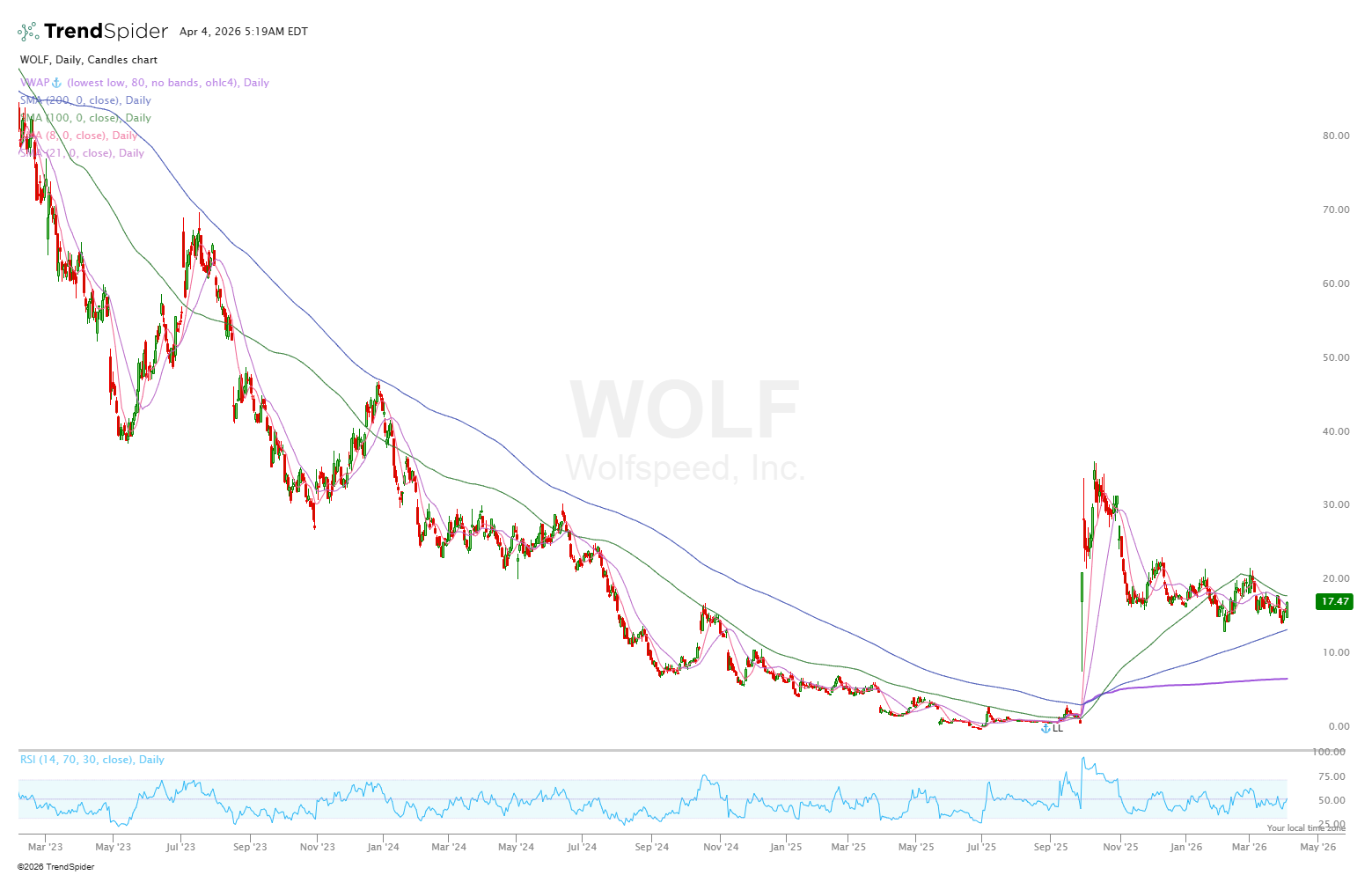
WOLF is the most important name in the SST SiC layer. It’s the US pioneer of silicon carbide…Here’s what a professor from Duke said:
“The timing of WOLF’s commercialisation could not be better. The world is racing to connect AI data centers to the grid, and this will be the enabling technology.” - Dr Subhashish Bhattacharya
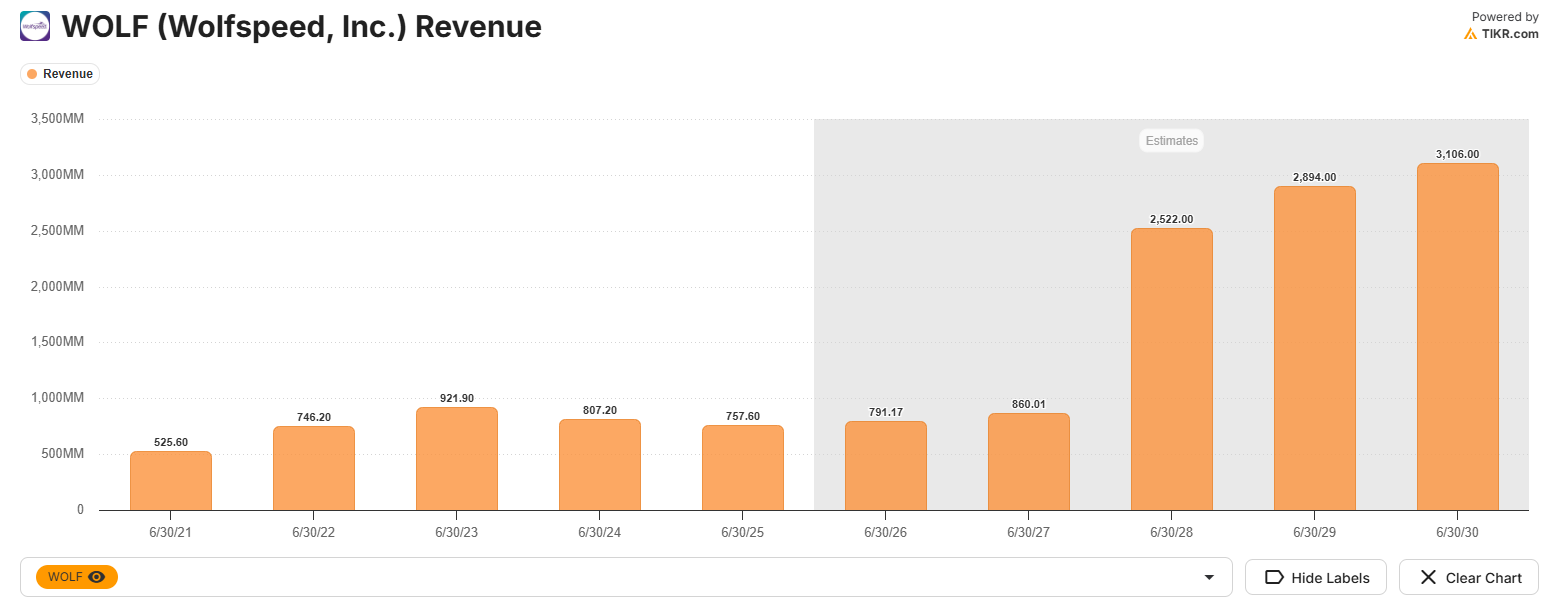
This still remains a very high-risk and investment stories aren’t just a play on technology. WOLF’s financials are pretty poor with net income rising, huge debt, and a lot of dilution.
WOLF just issued $379M in convertible notes with is dilutive at $20.14 per share meaning if WOLF trades above $20.14 at any point before 2031, noteholders can convert into equity. The other side to this is that proceeds are being used to redeem existing senior notes…making this more of a debt refinancing rather than a cash raise for continued operations.
“There is a transition happening from traditional transformers to solid-state transformers where silicon carbide is the perfect solution. That transition is starting to happen here. So we’re really playing in terms of energy generation, energy storage systems, solid-state transformers.” - WOLF CEO
It’s a messy capital structure, and a high-risk bet, but I think the reward is there assuming execution. It’s one of those speculative bets I’d be happy to take but position accordingly.
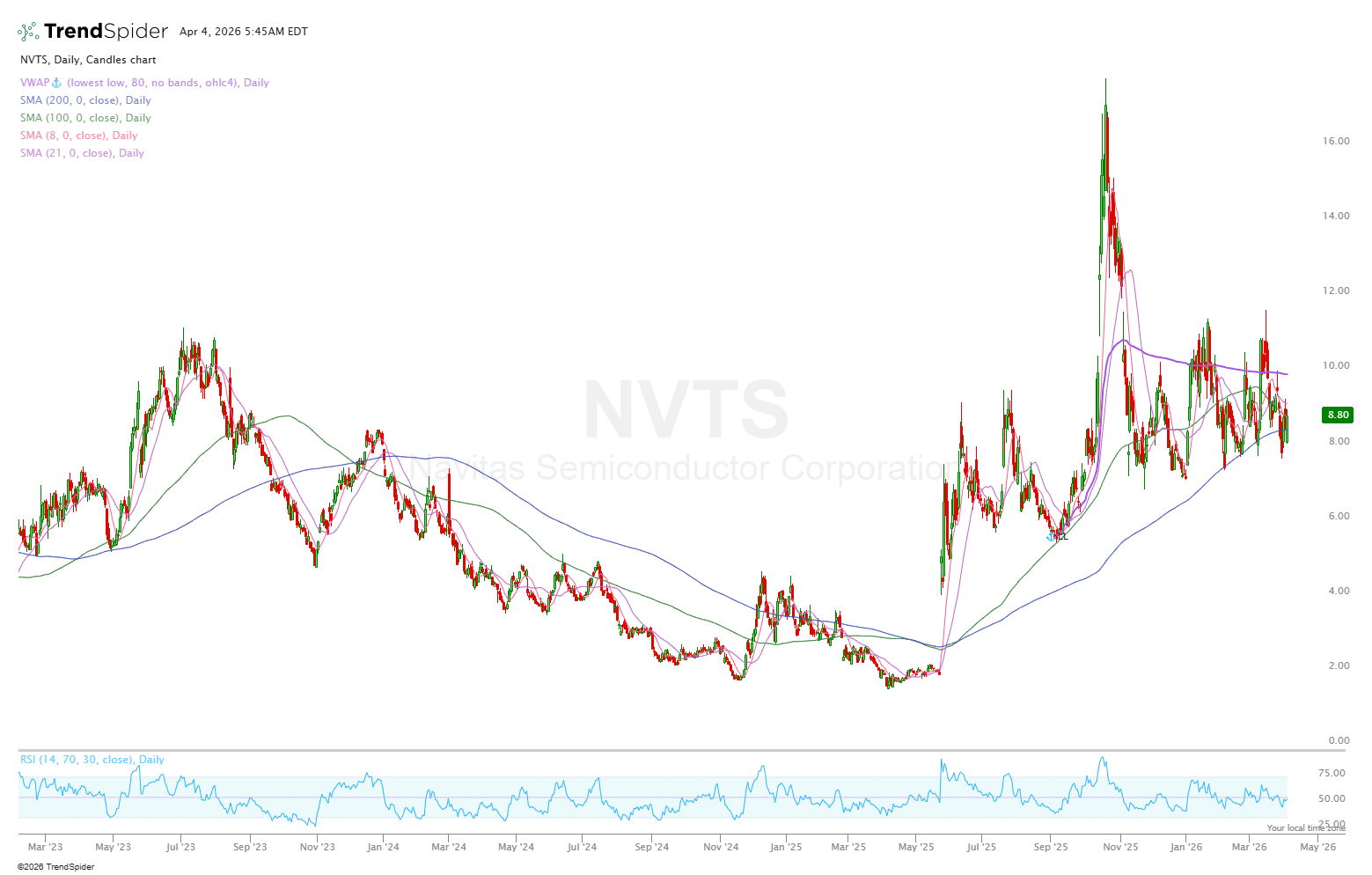
Navitas Semiconductor | NVTS | $2B
NVTS is probably the purest play on the SST thesis today and the financials also look far more solid than WOLF (though the competitive environment is worse), although the stock has moved 450% in the last year alone. That tends to be quite off-putting for some investors, me included, but the thesis is so intact for NVTS here.
Two very important quotes from the recent earnings call:
“You’re going to see first couple of megawatt SSTs, bundled with battery energy systems. Then you see high single-digit megawatt type of SSTs coming up.”
“You cannot deploy remotely half of what we’re trying to deploy with AI data centers with the grid we have today. So for me, AI data center and grid is the same thing.”
Despite the competitive environment being a challenge for NVTS, most competitors are either pure GaN or pure SiC. NVTS has both.
The part I’m slightly cautious about with NVTS is the lack of transparency around profitability timeline. Analysts currently aren’t estimating EBITDA profitability anytime in the next 3-4 years and management haven’t given any specific timeline so this is certainly something to be wary off.
Bottleneck 2: Grain-Oriented Electrical Steel (GOES)
This one is quite multi-faceted.
Grain-oriented electrical steel is the critical raw material used in most transformers. It’s a silicon steel alloy rolled and heat-treated which gives it very strong magnetic properties. Without it, you can’t build a power transformer.
And the vast majority of supply is controlled by a single US producer - Cleveland-Cliffs (CLF).
CLF has plants in Butler, Pennsylvania, and Ohio but none of these facilities currently have the volume to meet demand. That’s why China, Japan, and companies in Germany, India, and Poland also are big players in the market. Of course, the Japanese and South Korean companies are now subject to 25-50% tariffs making their product significantly more expensive to the US market and increasing the demand for CLF.
There are currently some ongoing petitions (Edison Electric, Natural Rural Electric etc) with the federal government about this monopoly trying to address this single point of failure in the domestic supply chain. If these petitions do dilute CLF’s position in the market then a bear case could be made but here’s why this is extremely unlikely:
CLF has had little economic incentive to invest further into GOES expansion. GOES is just one of many products and its business is driven by the larger steel industry rather than GOES. Prior to tariffs, companies outside of the US massively undercut CLF so they didn’t bother expanding their GOES presence. Today, there’s potential that could change though but they have to be very careful with the petitions against them.
Domestic capacity is a 3-5 year buildout process. Even if CLF committed capital today, the capacity likely wouldn’t come online until 2028/2029 by which point the transformer demand surge may be looking quite different.
I think the above should explain why CLF is an interesting stock, but not one where you should rely on GOES being the sole reason for its turnaround.
Secondly, this isn’t a piece on copper, but I think it’s important to understand that copper is used in transformer windings so it’s just as important as GOES in manufacturing of transformers. This is a dual impact bottleneck with GOES and copper. I figured a lot more people are unaware of GOES than copper though.
Stocks:
Cleveland Cliffs | CLF
ArcelorMittal | MT: Worlds largest steel producer based in Europe and a potential threat in the GOES space. However, MT currently is a supplier of non-grain oriented electrical steel.
POSCO | PKX
Copper miners
Favorites:
Cleveland Cliffs | CLF | $4.7B
CLF is a slightly complicated investment. It’s a large integrated steel company and GOES is one of its many product lines but the strategic importance of GOES is large. I like to think of CLF as being a bottleneck within a bottleneck - transformer supply is constrained by GOES and GOES is produced by one company in the US.
There are some clear risks with CLF:
Unprofitable
Adj. EBITDA fell massively
Lots of debt
A lot of exposure to the automotive sector
That’s a very brief look at the bear case. Here’s a look at some bullish assumptions though:
CLF’s analysts currently have FY29 EBITDA at $2.6B. If you’re looking for a 3x opportunity, then CLF needs to hit ~$14.1B market cap + net debt of $2.75B which means an EV of $16.9B. That means you only need an EV/EBITDA multiple of 6.4x for this to be a 3x from here.
Stocks like Nucor regularly trade in that range.
Copper
The other major material that goes into transformers is copper. You can’t build a transformer without GOES or copper. This isn’t an article on copper at all, and I won’t spend my time going into copper here.
But here’s a list of my favorite copper plays:
Trilogy Metals (TMQ) - in my portfolio
Global X Copper Miners ETF (COPX) - in my portfolio
Freeport-McMoRan (FCX)
Southern Copper (SCCO)
Teck Resources (TECK)
Coeur Mining (CDE)
Ivanhoe Mines (IVN)
Bottleneck 3: Circuit Breakers & Switchgear
Most of the narrative is about the transformers but the circuit breakers and switchgear are experiencing identical supply constraints. There are no pure play stocks on this bottleneck as every manufacturer that makes switchgear at scale is also a diversified industrial that also makes transformers.
Here’s some of the purer plays though:
Powell Industries | POWL
Mitsubishi Electric | MIELF
Legrand | LGRDY
Less pure play but still involved:
Hubbell | HUBB
Schneider Electric | SBSGY
Siemens Energy | SMNEY
ABB | ABBNY
Eaton | ETN
Nvent Electric | NVT
Powell Industries | POWL | $6.6B
POWL is a manufacturer of power control and distribution switchgear. When a transformer converts voltage, a switchgear controls what happens to that power next so it sits directly alongside the likes of ETN in this transformer bottleneck we have.
It’s a simple investment thesis on the shortage of equipment.
But the downside here is a company trading at 32x NTM PE, even higher than ETN for EPS growth below 14%. That is the general theme of this bottleneck right now. The good part is that this bottleneck has no signs of being solved for 5+ years so the pricing power these companies command, and the moat they have, should continue to translate into a premium multiple.
Here’s the other good part people miss:
POWL have $933M of backlog converting within the next 12 months (out of a $1.6B backlog). Q1 FY26 revenue came in at $251M and with this $933M of backlog converting across the next 3 quarter, annualized revenue comes in ~$1.3-$1.4B vs current estimates of $1.2B. So, I think the 14% estimates currently are going to be too low, and there could be some nice catalysts if POWL beat estimates quite comfortably.
Relative to peers like ETN and HUBB who also trade in the 26x-30x PE range, POWL is growing a lot quicker. Expensive, but compared to peers potentially slightly undervalued.
Bottleneck 4: High Voltage Cables
We’ve already touched on copper as a raw input. The other use case of copper in the grid modernization megatheme is the high voltage cable (HVDC). There are two different cable technologies at play in grid modernisation:
High Voltage Alternating Current (HVAC): This is the standard “workhorse” of the grid (overhead transmission lines, underground urban feeders, and inter-regional connectors). They work by transmitting electricity at the same alternating frequency as the generation source and are the primary subject of most onshore grid modernisation investment.
High Voltage Direct Current (HVDC): This is where the more severe supply constraint in the entire grid is. HVDC converts alternating current to direct current, transmits it at very high voltage, and then converts it back to AC at the end destination. The conversion process at either end is complex and expensive, but aside from that HVDC has some huge advantages over HVAC at scale. HVAC loses ~3-8% of power per 1,000 km whilst HVDC loses ~1%. There’s also some superior stability characteristics for submarine applications where HVAC is physically impractical.
The reason HVDC is the defining technology is mainly geography. Renewable energy is generated where the wind blows and the sun shines (offshore, remote desert locations etc). Consumption occurs near cities. This means that the distances involved make HVAC a lot more impractical and plus when using offshore environments and submarine cables, HVDC has to be used.
Here’s where it gets more interesting from an investment angle:
HVDC is one of the more technically complex manufacturing operations out there:
The insulation system (Cross-Linked Polyethylene) must be applied over the copper conductor for hundreds of kilometres without a single void. A single defect in the insulation can cause huge issues and would involve mobilising vessels, cutting the seabed cable, repairing the section, and reburying it. That costs tens of millions of dollars.
Subsea cable demand is expected to grow ~19% CAGR through to 2030 with demand for offshore wind cables set to double by 2030. Backlog is currently ~12 years now and most can’t expect delivery until the late 2030s.
However, getting your hands on the HVDC cables isn’t the only issue. The next issue is the number of vessels capable of installing it. There are only ~60-80 vessels worldwide that can handle submarine cable installation
Stocks:
Prysmian Group | PRYMF
Preformed Line Products | PLPC
Siemens Energy | SMNEY
GE Vernova | GEV
Subsea 7 | SUBCY
Nexans | NXRPF
Favorites:
Preformed Line Products | PLPC | $1.4B
PLPC’s core products are dead-ends, conductor accessories, vibration dampeners etc. This makes them a key player in the HVAC space and also the HDVC space (namely in the onshore segments). PLPC also manufacture fibre optic cable accessories which gives it some nice exposure to the data infrastructure buildout alongside the grid business.
PLPC is currently trading at 15x NTM EBITDA whilst expected to grow EBITDA ~16%. which means it’s fairly valued today I suspect. Here’s how I see some upside here though:
PLPC is set to grow ~16.1% CAGR through to 2029 which means by FY30 you’re looking +$1.3B in revenue. EBITDA margins for PLPC are currently 11.5% which is fairly low for an industrial hardware company with solid pricing power. I suspect when SG&A investment tapers off, and LIFO costs decelerate, PLPC can easily get +16% EBITDA margins.
You’re then looking at $224M in EBITDA in FY30 which would be a 23% EBITDA CAGR from today. That’s far quicker than the likes of HUBB for example which is growing EBITDA ~10% CAGR but trades at 18x NTM EBITDA.
A bullish case would have PLPC trading ~19-20x EBITDA on $224M in EBITDA in 2030 which gives you an EV of $4.48B. Add in det cash on ~$30M which gives you $4.5B. $4.5B divided by current outstanding share count of 4.9M gives you a share price above $900 implying around 3x upside.
Not bad. But realize that’s a bullish scenario.
Bottleneck 5: Interconnection
This is the bottleneck I’m perhaps most interested in personally as I don’t think it’s being appreciated enough right now.
Every new project (wind, solar, battery storage, data centers etc) must apply to its regional grid operator and wait for engineering studies to be complete before physically connecting to the grid. These studies determine what transmission upgrades need to be done to accommodate the project, and the developer must fund those costs.
There’s now a 4–5 year delay from application to operation and ~2,600 gigawatts of proposed generation just sat in the queue. Historically only ~20% of projects than enter this “queue” actually reach commercial operation.
The reason tends to be because economically it makes no sense. If an interconnection study requires a developer to fund ~$100M of grid upgrades to connect a $150M solar farm, the project withdraws.
The solution (and the investment case) relies on grid-enhancing technologies. These technologies extract more capacity from existing infrastructure which reduces the upgrade cost.
Grid enhancing does not solve the grid modernisation challenge but it does squeeze out every available megawatt out of the current infrastructure. This buys time and reduces project attrition whilst the physical buildout slowly treks on.
Stocks:
GE Vernova | GEV
Eaton | ETN
Siemens Energy | SMNEY
ABB | ABBNY
Itron | ITRI
Hubbell | HUBB
Amaresco | AMRC
Quanta Services | PWR
MYR Group | MYRG
Monolithic Power Systems | MPWR
Tantalus Systems | TGMPF
Badger Meter | BMI
Xylem | XYL
Shoals Technologies | SHLS
Stem | STEM
Enphase Energy | ENPH
Favorites
Itron | ITRI | $3.9B
ITRI is not a pure-play GET as I just described above. It doesn’t manufacture technologies that physically can increase grid capacity…but it does make meters, communications networks, and software that collect and transmit data that those pure play GET technologies (GEV, ETN) rely on.
ITRI provide smart metering. As the grid modernizes, and becomes more complex, the software layer managing it becomes a necessity. That’s the big picture theme for ITRI.
ITRI have a total backlog of $4.5B with $1.6B converting within the next 12 months (that 12-month figure is up $150M). More specifically to this bottleneck we are talking about, distributed intelligence endpoints are up 25% YoY and ARR is up 20% YoY as management structurally start to transition more towards a software business than a hardware business.
ITRI management have guided to $2.4B in FY26 revenue (1.5% increase on FY25) with FY27 guidance ~$2.6B which would be 8.3% increase.
Overall growth isn’t anything to get excited about but the business transformation from a hardware giant to an analytics/software giant is exciting:
20% YoY increase in ARR
22% increase in software, analytics, and services.
Acquisitions of Urbint and Locusview
The re-rating potential therefore occurs when the market starts to view ITRI as a grid software play rather than a hardware industrial play with lumpy revenue. I suspect that will happen over the next 2-3 years and that is why I own ITRI.
Shoals Technologies | SHLS | $1.1B
SHLS is a much smaller cap ($1.1B) which is where I like to invest a lot more. SHLS is the leading provider (45% market share) of Electrical Balance of System (EBOS) for utility-scale solar, battery energy storage, and EV charging infrastructure. It’s the connection between solar panels, the inverter, and the grid.
This makes them almost a monopoly in the critical infrastructure required for every new solar project. If you’re bullish on solar (which you should be), then SHLS is definitely one to look at.
FY26 estimates for revenue are $587M (24% increase on FY25) with EBITDA at $117M (18% increase on FY25), and net income at $70M (16% increase on FY25). This means SHLS trades at ~2.2x NTM sales (for 24% growth), and 11.2x NTM EBITDA for 18% growth which is quite attractive given the monopoly position in the market.
Bottleneck 6: Transmission Line Construction
This one is basic but an absolute necessity to include. Most of the stocks you may have heard of already, and most of them are probably still good buys. I’ll focus less on the theme here because the theme is simple, but more on the individual valuations of stocks.
Building new transmission lines is a political and regulatory challenge and although that can’t be fought…the companies that will win here are the ones that have the utility relationships, the workforce, and the operational scale to execute as soon as approvals are granted.
Stocks:
Quanta Services | PWR
MYR Group | MYRG
MasTec | MTZ
Primoris Services | PRIM
IES Holdings | IESC
Limbach Holdings | LMB
Dycom Industries | DY
EMCOR Group | EME
Comfort Systems | FIX
Sterling Infrastructure | STRL
Argan | AGX
Insteel Industries | IIIN
Favorites:
MYR Group | MYRG | $4.4B
MYRG’s stock has been incredible for the past year and I suspect it’s only still in the fairly early days at less than a $5B market cap. MYRG designs, builds, upgrades, and maintains overhead and underground transmission lines, substations, and distribution infrastructure. It makes it a simple pure play on the multi-year utility buildout.
It’s one of those stocks where the investment case is very simple.
Here’s a look at the valuation:
MYRG now trades at 1.1x NTM sales, 16x NTM EBITDA, and 31x NTM PE. That PE multiple is high but for 23% expected growth, it puts the PEG only ~1.35x which isn’t too bad. Assuming MYRG has an EPS of $18.50 in FY30 as per analysts, I suspect they should maintain a PE multiple over 20x which would mean you’re looking around $370 stock price on a fairly conservative multiple.
MYRG is a nice play on the theme. I don’t know whether it’s one of those I’d jump into today though personally.
Primoris Services | PRIM | $8B
PRIM is slightly more diversified than MYRG above. It operates across utility scale solar, battery storage, natural gas generation, pipeline construction, and communications infrastructure. That means PRIM captures all angles of the grid modernisation spending and not just through transmission line construction. This gives PRIM a genuine hedge in the market when solar bookings soften for example… they can lean into other areas.
MYRG is therefore a very pure play on grid transmission. PRIM is a more diversified infrastructure play. PRIM’s forecasts are $9.30 EPS in FY30 which would put the CAGR at ~10.6% over the next 5 years. That’s solid growth in this niche, but for a 25x EPS, it’s quite high.
Definitely one to watch below around the 200 daily MA, but I think the risk to reward based on today’s valuation isn’t skewed enough to the bulls.
Relative to plays like PWR, FIX, MTZ, and MYRG, PRIM trades at a much lower valuation. I suspect that’s because of the diversification, but also growth is slightly slower.
Bottleneck 7: Towers, Poles, Structural Hardware
I think this is the other bottleneck where there are some hidden opportunities people aren’t focusing on.
Every transmission line needs towers and poles. Every substation needs structural steel. Every conductor needs hardware to hold it in place.
I think this is where some of the most interesting small-cap opportunities sit.
We’ll dive into the specific stocks after this but the numbers in some of the leading stocks in this theme are evidence of this bottleneck. Valmont’s total infrastructure backlog jumped 15.1% from FY24 and customers currently already booking into FY27. And then there’s Arcosa which is fully converting facilities in Illinois and Oklahoma from wind towers to utility structures.
Stocks:
Valmont Industries | VMI
Arcosa | ACA
Insteel Industries | IIIN
Favorites:
Valmont Industries | VMI | $7.8B
VMI is a leader in engineered steel and concrete structures specifically for electrical transmission and distribution making them the dominant supplier for poles, towers, and related hardware that form the physical backbone of the grid.
VMI currently have a $1.5B backlog in 2026 which is up 22% YoY and it’s already booking orders into FY27 as capacity continues to come online. This infrastructure segment makes up ~75% of the total company. The other 25% is made up of irrigation equipment which is generally going to offer to receive a lower multiple in the market.
This irrigation segment is slowly on the decline, so I sense this 25% revenue split will become even less in the next 3+ years. VMI currently trades at 18x NTM PE with 12.5% estimated CAGR through to 2030. Reasonable but not cheap.
It’s hard to gauge because I don’t think from here this kind of stock is going to give you the opportunity at a 2x or 3x on your investment…but I do think there’s a nice 50-75% gain to be made. You’ve got to find what you’re looking for in your portfolio.
Arcosa | ACA | $5.3B
ACA manufactures steel transmission towers, utility poles, wind towers, and related structural products.
“During 2025, we maintained at or near record backlog levels for our utility structures, and the outlook remains very positive. Industry capacity is constrained, lead times are extended, and we are optimising pricing and focusing on operational excellence.”
For a hardware company like ACA, estimates are actually very strong with EPS set to grow to $5.75 in FY27 which means ACA trades at 17.5x 2027 EPS with EPS growing at a CAGR of 13.5%. In the construction and engineering space, I think that puts that at one of the cheapest valuations.
Insteel Industries | IIIN | $655M
IIIN is a $655M small cap with some nice asymmetric upside. It manufactures steel wire reinforcing products used in concrete structures. It’s not a direct play on this bottleneck like ACA and VMI are but I think it’s worth noting since every steel transmission tower and concrete utility pole requires a concrete foundation. As transmission line construction volume surges, the demand for IIIN’s product should scale alongside it as a secondary beneficiary.
The reason it’s not a purer solution to this bottleneck is because transmission infrastructure is a relatively small part of IIIN’s revenue today. The majority serves residential construction and non-residential commercial construction. This makes IIIN’s share price a lot more correlated to mortgage rates and residential construction cycles rather than the utility CapEx programme.
BONUS - Bottleneck 8: Grid Resilience
As I’ve tried to make clear in this paper so far, the grid modernisation cycle is going to be very slow. Transformer lead times are ~2 years. Permitting battles last years. The workforce is limited. The interconnection queue has ~2.7 terawatts sitting there.
This is what makes this theme as an investment so interesting. It’s a decade long theme.
However, the reality as we’re also aware is that the current grid has to keep running under the demands it was never meant to meet. This results in some nice parallel investment themes:
Backup power generation: PSIX, GNRC, CMI, CAT
Industrial battery storage: ENS, FLNC, BE, EOSE, TSLA, STEM
Distributed energy systems: AMRC, BE, ENPH
Favorites:
Power Solutions | PSIX | $1.5B
PSIX is a stock I have been watching for a while.
Its core product is a fuel-agnostic power system running on natural gas, propane, diesel, gasoline, and biofuels. Previously the end market was OEM’s but now its data center. Every new data center requires 1.5 to 2 megawatts of standby generation for every megawatt of computing load. This back up has traditionally been diesel, but PSIX’s natural gas offers far lower emissions and lower cost.
EBITDA growth for PSIX relative to the multiple it trades at is one of the most interesting parts about this stock. EBITDA growth is set to be 22.5% CAGR from 2025 to 2029 which for 11.8x EBITDA offers one of the most interesting valuations in this entire paper.
EnerSys | ENS | $6.5B
ENS operates in the industrial stored energy solution as they manufacture battery systems for data centers, utility substations, telecommunications networks, and defence applications.
Despite the run up, ENS only trades at 15x NTM PE today. Growth is much slower than PSIX, but there’s a lot less balance sheet risk and typical small cap risk for ENS.


Great read as always, so well written