

I’ve never been a huge biotech bull because of the complexities and risks but when I understood the following two things, my opinion changed:
All of investable biotech today is no more than $1.5 trillion relative to the semiconductor trade which is above $13.5 trillion. That means that even a small rotation out of the the semiconductor basket and into biotech could be very material. This last weeks price action is potentially early evidence of a slight rotation. Whether that is long term or not is a challenging prediction to make.
The potential for new drug discoveries using artificial intelligence is vastly under estimated by the market. Biology is becoming computational and that changes everything.
The wider healthcare industry has fought its way through some storms over the last few years. But we believe the above two catalysts are finally starting to converge at the right time today.
For the last 10+ years or so, healthcare has been innovating. It’s been chugging along with aging demographics, technological advances, and biological sciences advancements.
It may not seem like it in the stock market where everyone’s focus has been on the momentum trades of optics, robotics, and alike (until this week)…but if we zoom out a bit it’s clear the advancements here have been extremely material.
Cancer mortality rate is now ~145 per 100,000 vs 215 per 100,000 in 1980.
Reversal of prediabetes is now 51%.
Cardiovascular plaque reversal is now entirely feasible when once considered a “one-way progression.”
GLP-1s are increasingly viewed as the first longevity drugs.
AI is now permeating every stage of the healthcare cycle from diagnosis, to personalized care, to actual treatment. The gap between what is “biologically feasible” and what can realistically be done with capital, doctor skillsets, and the labour force is narrowing by the year.
The best part of this is that it’s a virtuous cycle that will keep accelerating.
New treatments unlock more new treatments.
Longer life expectancies lead to finding more diseases.
More diseases leads to more medical devices and more drug discovery.
Enormous value creation is set to take over the healthcare sector and I think we’re in the very early innings.
The AI Angle
Medicine is now moving from broader chemical intervention towards very precise biological programming.
The old drug discovery model was about designing a molecule, running a trial, and hoping it works.
It’s changing to something fundamentally different - closed loop systems where AI designs experiments, robots run them, data feeds back into the model, and the cycle repeats itself at a speed no human can match.
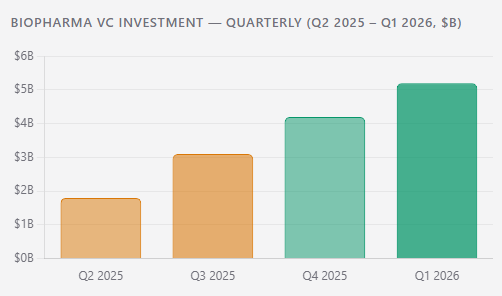
This means the bottleneck is changing from biology itself, to whoever controls the data, the infrastructure, and the discovery engine.
This shift creates three clear parts of the chain that are getting disrupted that make up the premise of this write-up.
All in MMMT’s personal portfolio (sizing differs):
Discovery: ABCL
Data & Infrastructure Layer: TEM
Blend of the Above & Commercialisation: LLY
I’ll be diving into them all below this as very mini deep dives but the wider thematic is the most important part I want to convey in this article and I think I’ve covered it above.
To sum it up quite nicely here I’ll say this:
The healthcare market over the next few years wins by:
Capital finally rotating to an undervalued theme and away from anything pure AI infrastructure.
Capital continuing to rotate into pure AI but the market starting to realize healthcare (especially ABCL, TEM, and LLY) is an AI trade now.
AbCellera Biologics | ABCL
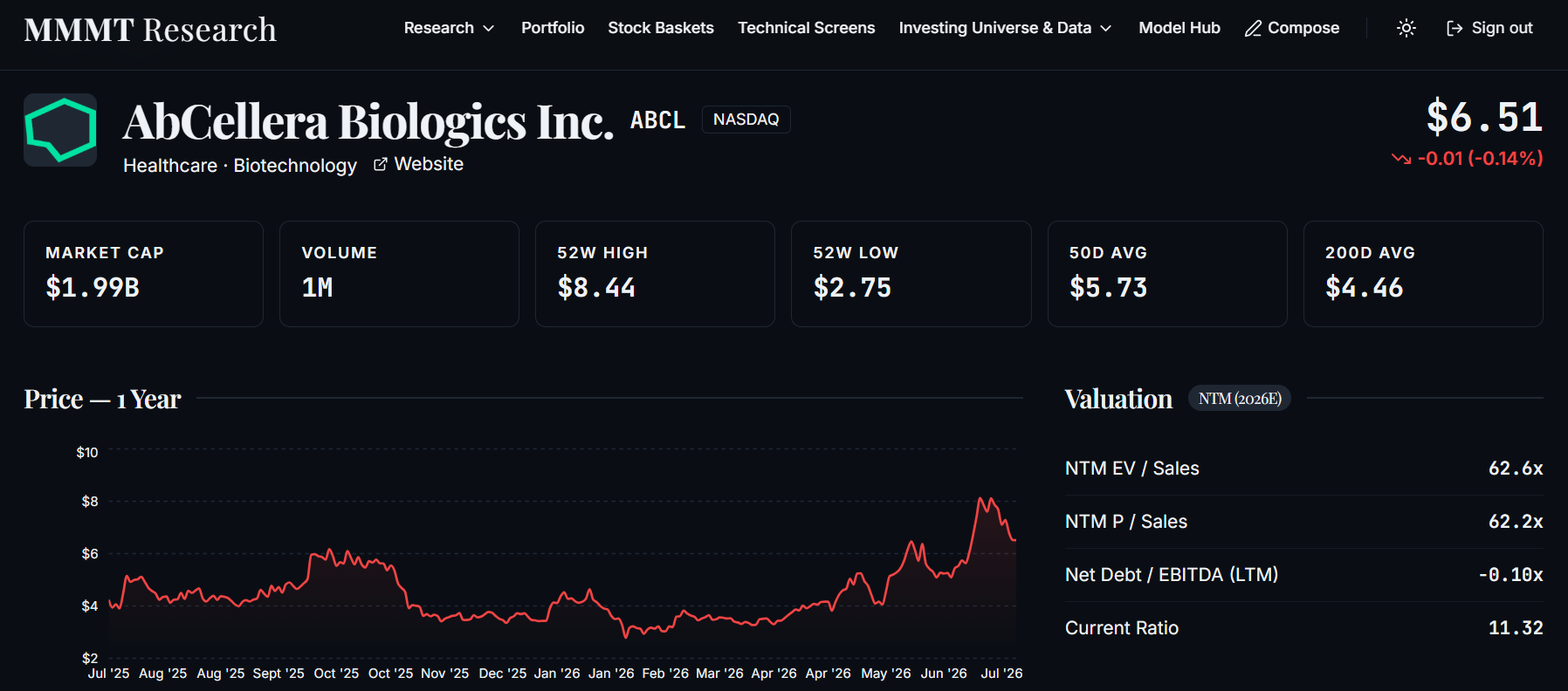
ABCL operates the abLighter platform - an AI driven system that finds therapeutic candidates in 45 days. It’s attempting to change the industry from essentially a numbers game (screen enough candidates and hope something works) to a precision game.
Here’s the core premise for ABCL: Your immune system already knows how to fight disease.
When it encounters a threat, it produces antibodies. Some of these antibodies lock onto and neutralize the threat and therefore have powerful properties within them that can make powerful drugs.
ABCL’s finds these antibodies rather than building them from scratch in a lab.
Partners (LLY, ABBV, BIIB, NVS etc) bring the end target - the protein involved in a disease that they want to treat. ABCL then runs the discovery using AbLighter. From there, if successful, the partner takes it through trials and ABCL earns as those trials progress.
That’s business model #1.
Business model #2 is the more exciting model with more upside (though riskier). It’s the proprietary pipeline and it’s where ABCL owns the asset itself and the economics flow entirely back to ABCL rather than through royalty payments.
ABCL635 is targeting NK3 for menopausal symptoms. It has Phase 1/2 topline data expected in Q3 which, if positive, will reframe the entire narrative on ABCL to a TechBio firm with its own drug pipeline.
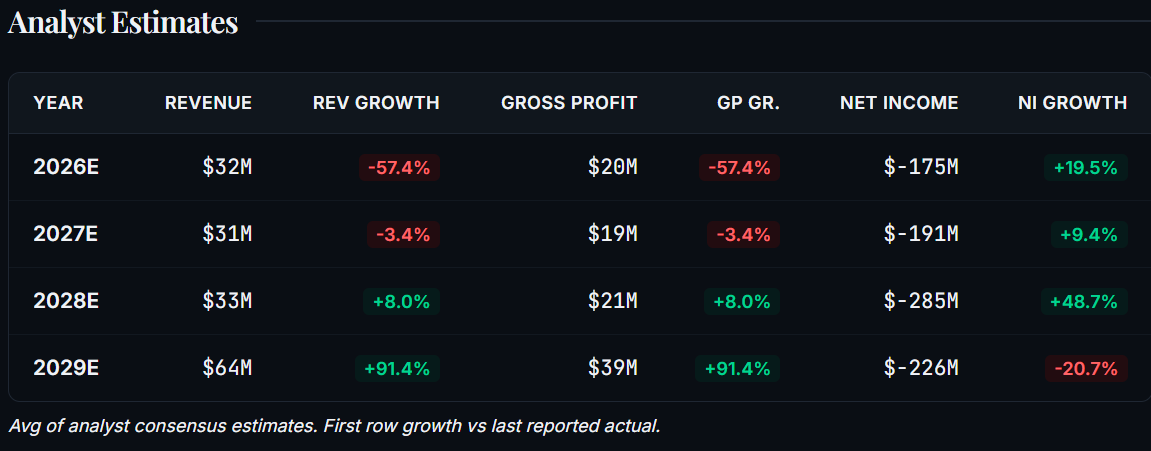
The downside risk with ABCL is more cushioned that perhaps it may feel for a small-cap biotech company. It’s currently sitting at $1.8 billion MC with $504 million in cash and committed government funding. So that’s ~30% of the entire MC sitting in cash with over three years runway at the current burn rate with a management team that has delivered so far on all timelines they have publicly projected.
Poor data on Phase II would most definitely threaten the stock in the near term, but the company would not be threatened too materially in the short term. The royalty stream from the 40+ partners continues and as long as these programs keep advancing, the $1.8B MC seems closer to a floor. It feels like a free call option on ABCL365 to an extent.
Tempus AI | TEM
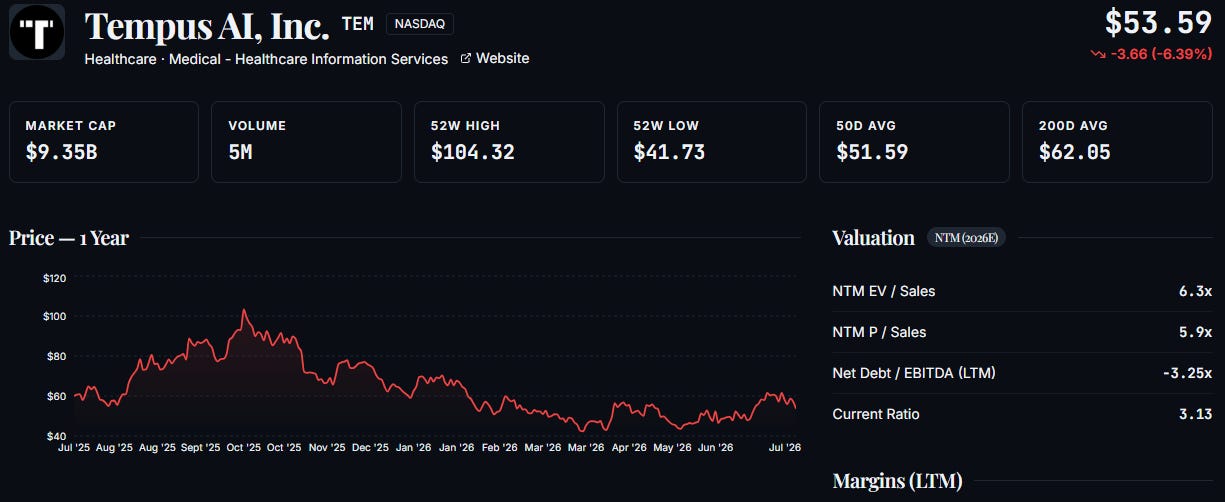
In a sentence, TEM is the data infrastructure that makes AI driven drug development possible.
The whole premise of AI in drug discovery is pretty straightforward: train a model on enough high-quality data and it can identify patterns that would take humans decades to find, right?
The main issue is that the data required to do this well (real patient records, treatment histories, pathology slides etc) is very difficult to assemble and very expensive to get a hold off.
TEM has this data because they invested huge amounts in their foundational years before anyone knew how valuable it would be.
And this data essentially is changing what is possible for pharma. TEM uses this data to actively tell drug companies things they couldn’t otherwise know before committing hundreds of millions of dollars to a trial. CEO, Lefkofsky, explained this pretty neatly:
He said that a pharma company came forward with 25-30 clinical trials to work through TEM’s network. TEM only took 13 of them because they estimated the other 17 would likely fail before generating any meaningful results.
It’s ultimately all about the data they own.
Here’s how the flywheel actually works in practice for TEM (I’ll make this section fairly concise compared to the complexity of it…feel free to skim over it. I’ll go into a bit more detail on the valuation section).
TEM’s different business segments are ultimately built on the data foundation. They have access to the data and the clinical context behind all of that data.
TEM sequences patients. I.e. they run genetic tests on cancer patients, reading the DNA, RNA of their tumours.
TEM pulls in connected clinical data. I.e. TEM pulls in patients medical history (treatment records, doctors notes, lab results, scans etc).
TEM generates molecular and diagnostic insights. I.e. TEM combines the genetic results with clinical history to produce data with background evidence.
TEM pushes those insights back to physicians. I.e. The treating doctor gets a smarter report, not just a list of mutations…actual guidance.
TEM gets more data. I.e. Every new test adds another patients genetic and clinical data to the database.
TEM’s models improve. I.e. More data makes the AI predictions more accurate.
Pharma pays to access the data. I.e. Drug companies then pay TEM to interrogate this dataset to understand why drugs work in some patients and not in other patients.
This revenue funds more patient sequencing. I.e. The pharma licensing money subsidises the cost of running more genetic tests.
Repeat endlessly.
This is the foundation that Tempus is built on. They’ve now done this so much to the extent they have 500 petabytes of data across 45 million patients.
Take a second to truly appreciate this foundation. I know the path from here isn’t straightforward but just understand how far ahead they are from any companies now that are trying to replicate this business model.
It’s years/decades.
Data will be the moat for years to come. The companies that invested heavily at the right time (i.e. 10 years ago) will be the ones that truly reap the rewards over the next 10 years.
Valuation:
Of course it all comes back to valuation at the end of the day.
Aim #1 is always to own a quality business. Aim #2 is about owning a quality business at the right price.
If one of those isn’t investment worthy, there is no trade.
Here’s why I think TEM is so undervalued:
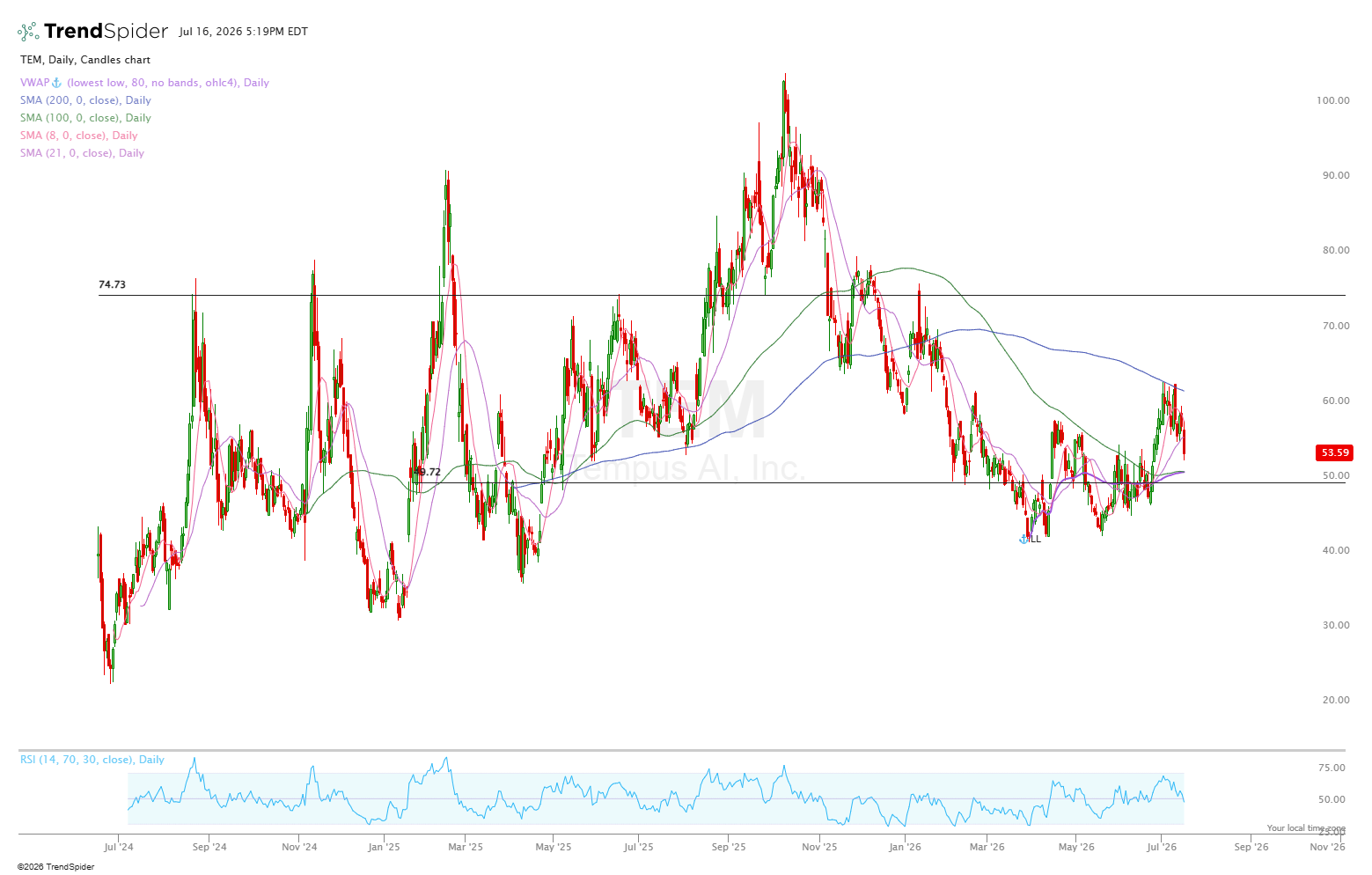
At ~6.5x sales, the market still prices TEM like a diagnostics lab for the most part… i.e. Guardant Health (GH) trades at 15.9x NTM sales today.
The way to think about TEM’s valuation is to split it out into two separate businesses.
Diagnostics: I think $2.4 billion in revenue by 2028 for diagnostics is feasible if volume continues to steadily compound and ASP moves closer to $2,000. That assumes ~26% CAGR from 2025.
At a 22% operating margin (already operating at 65% gross margins), that’s ~$530 billion in operating profit which means operating profit for that business would be growing at ~25% CAGR. Put it at 1x PEG (25x multiple) and we have a $13.25 billion business there.
Data & Applications: This is where it gets slightly more interesting for me here. My estimates put us at $820 million in FY28 revenue. This is a SaaS like business so +30% margins are very likely (and perhaps still conservative).
As a SaaS like business with +30% margins, I think a 30x NTM PE isn’t overly bullish at all. 30x PE on that gets us a $7.4 billion business which I think is an absolute base case.
Combined that’s an EV of +$20 billion vs $10.3 billion today.
Eli Lilly | LLY
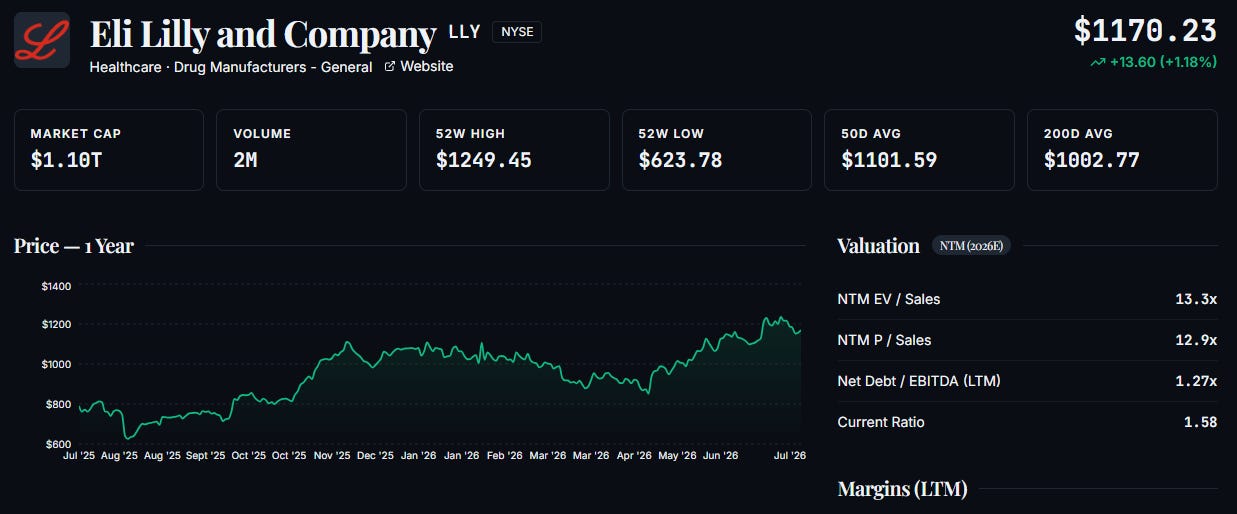
LLY was once (and still is) a GLP-1 story.
