

For the first time in history, biology is heading towards a place where luck, guesswork, and long testing cycles are no longer a thing.
As Jensen Huang says:
“Biology has the opportunity to be engineering, not science. When something becomes engineering and not science, it becomes less sporadic and exponentially improving. It can compound on the benefit of previous years.”
That idea alone is set to create some of the most important AI companies in the entire world.
I hope that opening got your attention about my view of this theme. I’m going to outline in this article:
Why this theme is set to be revolutionary
The potential monetary inflow into this theme
How to invest in this theme
Why Digital Biology Is Set To Be Revolutionary
The fundamental bottlenecks in medicine today are:
It’s slow
It’s expensive
It’s highly uncertain in the lab
It’s even more highly uncertain in living systems
It’s why traditional biology and drug discovery has been constrained by the complexity of biology. Hypotheses, data analysis, and eventually failure rates of +80% after years and huge costs.
The digital biology approach inverts this.
Specialized AI models trained on molecular, preclinical, clinical, and patient data can analyze billions of hypotheses instantaneously in parallel.
And then think about the next layer…agentic systems can then read literature, formulate questions, design experiments, interface with robotic labs, analyze results, and iterate this Design-Make-Test-Analyze loop over and over again. Productive wet lab teams pre-AI may be able to fully explore ~1,000-2,000 molecular hypotheses per year but an AI native setup can explore an order of magnitude more whilst feeding every outcome (success or failure) back into the model.
The nature of biological data is itself is arguably the most valuable data in the world. Previously failed testing programs were just treated as a sunk cost but with AI those failed outcomes turn into a goldmine. The models are able to internalize why something failed under specific conditions which offers the edge in avoiding that same mistake again.
The end patient and the lab still remain the ultimate end judge (and will be the new bottleneck), but the time, cost, and attrition of reaching this stage is set to compress massively.
Science → Industrialized feedback loop.
I think the most important part of this entire feedback loop to understand from an economics point of view is that once the percentage of successful trials starts to rise, the compounding loop from there becomes quite aggressive.
Breakthrough trials → approved drugs that generate cash flow → cash flow used to build specialized compute → more data platforms, robotics, and talent → more breakthrough trials.
And the faster these trials become successful, the faster this loop starts snowballing.
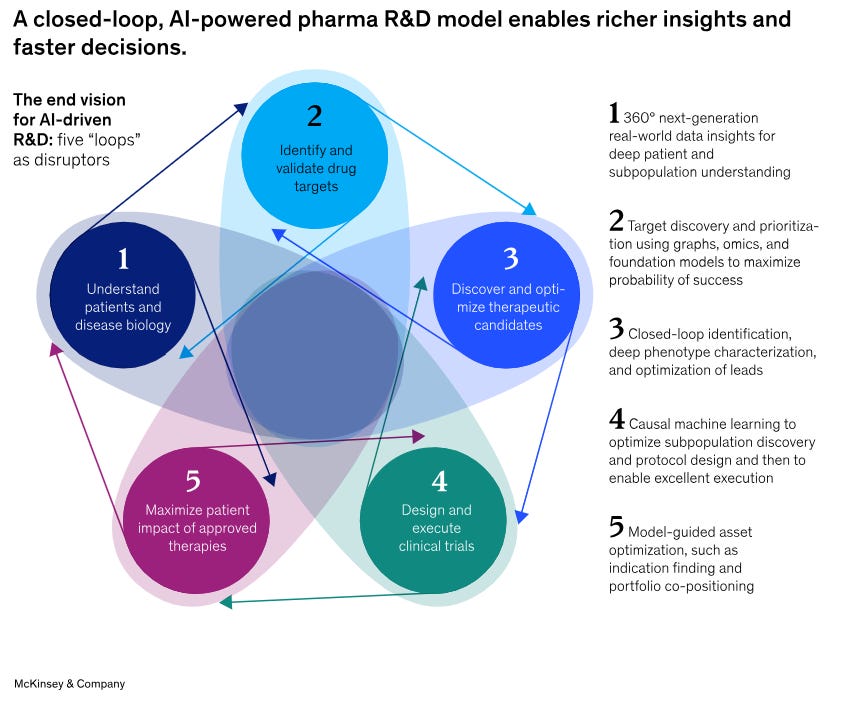
Trials will become more successful because of better data analysis and speed of iteration but also because aging and disease will change from a metaphysical concept to a set of defined, measurable, targetable engineering problems.
It essentially becomes a computational problem rather than a science and lottery problem.
The loop reinforces itself in the sense that better models yield better medicines which yield more capital and knowledge.
And eventually in a world where the algorithms become a commodity, the scarce assets (the proprietary biological data mainly) become extremely valuable.
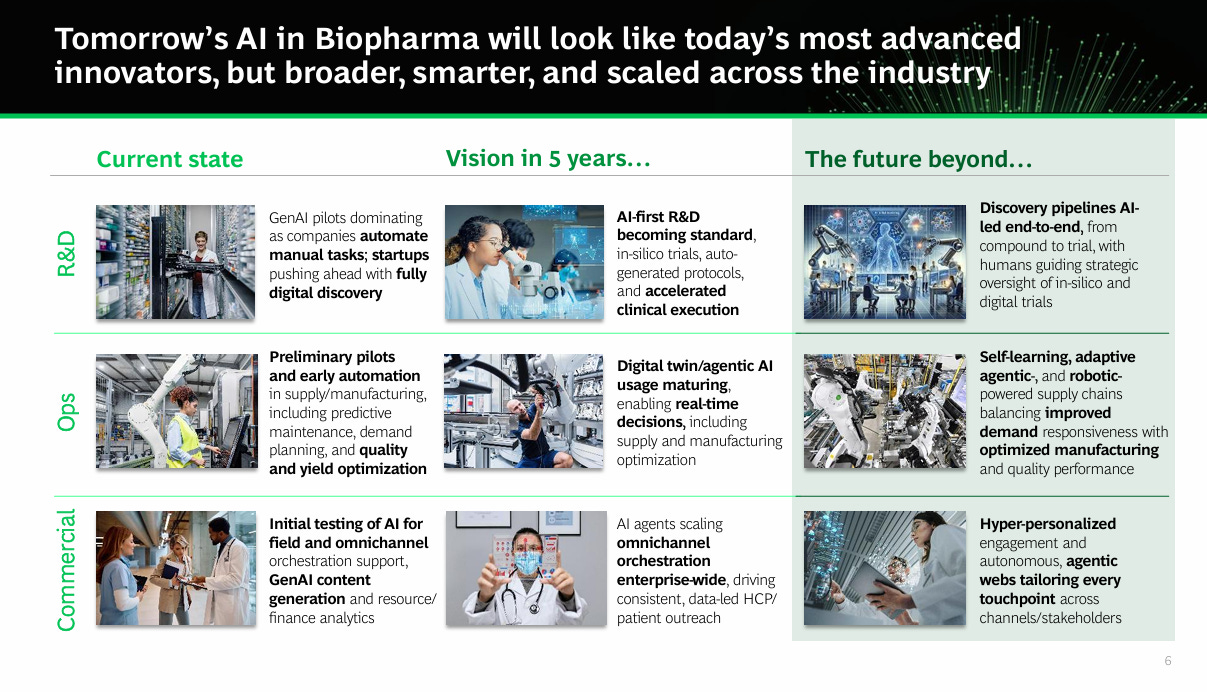
I want to make it clear therefore that digital biology is set to do far more than accelerate existing pharmaceutical research and development.
It’s set to completely redefine the model for creating medicine. That market today is worth ~$1.8 trillion today. I suspect the end market will be worth multiples higher than that quite soon.
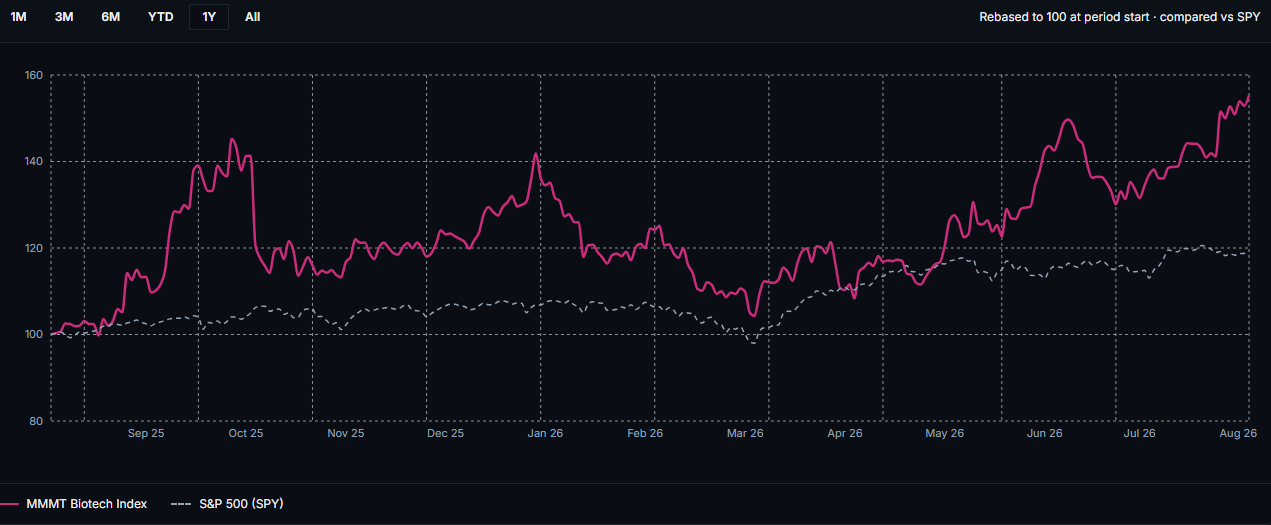
Just a quick note:
I’ve been working very hard on a web-app as you all know so far. We’re currently in beta testing and have a development team working on the final stages for this version 3 set to be released soon.
It’ll add a whole new dimension to my service over the next couple years. You can access the site here to have a look.
Here’s what it’s in the app:
Guided Valuation Model (EV/Sales, EV/EBITDA, P/E, or MMMT Valuation Model) for every stock in my universe - see screenshot above.
This allows you to input your assumptions (or follow my assumptions) and come out with a target price.
Stock Baskets: As well as showing my personal portfolio as evidence of my track record, I’ll be showing you concentrated stock baskets of the best themes in the markets.
These aren’t ETFs. These are 5-10 stock baskets for all themes in the market with individual stocks and weightings.
I think of it as a way of introducing you to other high conviction plays I have that I don’t necessarily personally own due to capital. I also think it’s a great way to increase your exposure to a theme that you may like more than I do.
This is all on top of daily notes, live portfolio, technical screens, and research notes.
A Thought Experiment On Just How Big This Market Can Get
This is hard to model but I’m going to do my best to make the assumptions as clear as I can.
Note: These are a thought experiment. Do not take these are market forecasts.
Short Term
The first way I think about this is looking at the current biotech market today and the effects of a rotation out of AI hardware and into biotech changes the market size today.
The top 15-20 AI hardware / semi names have a combined market cap in the $13-15 trillion range right now.
The biotech market is currently valued at ~$1.25 trillion.
Now the next step is where assumptions come in. I think it’s highly likely one of these two happen:
Investors and institutions see potential slowing of the AI infrastructure play and rotate capital elsewhere…of which some goes to healthcare and biotech. If that’s the case I think a fair assumption is ~2.5% rotation from AI infrastructure directly into biotech (I think this is already happening in the early stages).
Investors and institutions start to see biotech as one of the purest AI plays out there over the next decade that may create some of the most important companies worldwide (just like I stated in my opening). If that is the case I think we’re looking more towards a +6% rotation out of AI infrastructure and into biotech.
At 6% rotation out of a $14 trillion market means we’re looking at $840 billion in capital.
At 5x inelasticity (fair for the biotech market) that leads to ~$3.5 trillion of amplified buying power.
If ~40% of that gets concentrated into the top 10 names like LLY, TMO etc there is a $1.4T incremental market cap impact on that group of multi-billion dollar companies.
And then on the mid cap to smaller cap names we’d likely have ~$2.1 trillion impact but the current market cap of this range of stocks is no more than $200 billion so the multiple uplift could be in the range of 8-10x.
That’s purely just a thought experiment to evidence how large potential capital flows may impact a smaller, more inelastic market in biotech today.
When you combine these shorter term capital rotation forecasts with the below assumptions, the numbers get quite staggering.
Longer Term
Forecasts today have the biotech market generating ~$1.7T in annual sales with a market sitting ~$1.25T and 2030 forecasts at $2.2T.
Those assumptions are based on the current environment of ~8-9% of drugs entering Phase 1 actually making it through to approval. It’s also based on ~$2.6 billion in spend per successful medicine, and ~10-15 year total timeline. Most of that capital spend is unfortunately taken up by failures rather than successes.
If the thesis plays out like I outlined in the first section and we see the industrial feedback loop work smoothly by spotting early failures, and feeding back data into better models…then the same R&D spend becomes far more productive.
Conservative Assumptions
A conservative take would be to say Phase 1 to approval success goes from 8-9% to ~12% and then gradually towards 15% and time compresses to ~5-8 years. That alone would increase new annual launches by ~75-100% and cut the cost per drug down to sub $2B.
If the same R&D budget (which actually could be increased substantially if clinical outcomes become less of a lottery) produces ~2x the amount of approved drugs per annum, the drugs reach cash production several years earlier and fewer dollars are burnt in Phase 2 / Phase 3 trials and also fewer dollars are held up in projects lasting many years.
Over time my numbers point towards a 2x in earnings and free cash flow which can re-value the market from ~$1.3T to $2.6T, excluding multiple expansions.
Multiple expansions is the easier argument to make. A sector that runs like a compounding production system on some of the most valuable data in the entire market with rapidly improving ROIC will be deserving of a multiple at least 1.5x higher than today.
The narrative changes from a high risk lottery bet to a engineering bet.
A 1.5x increase in the multiple then takes us to ~$4T.
A reminder that’s a base case.
A reminder also that this is excluding what I said above with capital inflows from other areas of the market.
Bullish Assumptions
A more bullish case (which I suspect will happen but just further down the road) assumes the loop industrializes.
Phase 1 approval rate jumps to ~18-20% with compressed timelines ~4-5 years in bio-marker rich niches of biotech. Because of this cost per approved drug reduces to ~$1B and annual launches can therefore head towards ~2.5-3x the rate today.
At this point, the main bottleneck will become the end judges (the humans) and the scale and speed at which we can run trials and manufacture drugs at scale. Discovery becomes faster but unless clinical execution and manufacturing can ramp up there is still a clear constraint.
Current forecasts suggest $2.2T in annual sales by 2030. A 2.5x in approvals in an ideal world means a 2.5x in sales but that won’t be the case as the more drugs approved likely means a lower % of blockbuster drugs. What is likely does mean though is that there will be a faster flow of well branded assets that reach patients earlier, with more years of protected / patented cash flow ahead of them.
That means the net present value rises before we even consider an increase in sales.
So valuation impact then comes from:
More approved assets
Cheaper produced assets
Longer NPV per assets
If earnings therefore increase ~3x based on above assumptions and the multiple increases ~2x we’re looking all of a sudden at a $7.8T market cap.
Most of this value won’t be spread evenly among names. But I think it’s becoming clearer and clearer those 20-30 names that either are:
Pure plays on drug discovery
Pure plays on specialized compute
Pure plays on manufacturing
Pure plays on the platforms
Pure plays on commercial reach
I’m going to lay out the investment picture here now. I’ll dive a little deeper into my 4 favorite names and list ~20 more that I like today.
How to Invest
If I were to create an ETF on this theme, here’s what it would look like (click on the link to download the spreadsheet).
