

I’ve been publicly bullish on the uranium and nuclear market for a while now. CEG has been in my portfolio for a long time…LEU and SMR since 2025.
This piece is a look at the entire uranium and nuclear stack and the best way to play this theme.
Here’s a TL:DR overview of exactly what’s in this nuclear and SMR piece:
Nuclear is back from 2011-2020 slump because decarbonization, energy security, and AI need dense, 24/7, carbon free power.
Uranium prices will likely stay propped up and even rise to +$100 again as the utilities keep under-contracting uranium (as they have for the past 10-12 years). Add this to huge demand vs supply imbalances and I remain very bullish on the uranium market for the next decade.
The best way to invest in the nuclear theme is by understanding the entire stack (metal → fuel cycle → technology).
Some of the biggest bottlenecks are in the conversion and enrichment process of the fuel cycle.
The physics behind nuclear has always been there.
It’s just been a numbers game combined with political and public appetite, lower natural gas prices, and a history of Western projects that ran into huge cost overruns that made nuclear not worth it over the last 3 decades. Hence we saw nuclear go from generating ~17.5% of global electricity in 1996 to 9% today.
But now we’re in the middle of decarbonization goals, reliable domestic power needs, and AI’s power demand… the physics of nuclear actually starts to make sense.
Nothing else in the entire grid can pack in so much carbon-free power into so little land, and run that 24/7. Solar and wind can compete on speed and cost per installed kilowatt but with land use, capacity, and the need to be online 24/7… nuclear trumps everything.
Despite this, the numbers behind the installed base of nuclear isn’t there yet at all. The world has 400 GW of operable nuclear today but new Western builds remain very scarce relative to China. The “nuclear renaissance” as we call it seems visible in policy, cheques, and contracting…but isn’t close to being visible in actual completed plants.
But the part of the nuclear market that is showing forward demand perhaps before anything else is the price of uranium.
An update on my Web-App
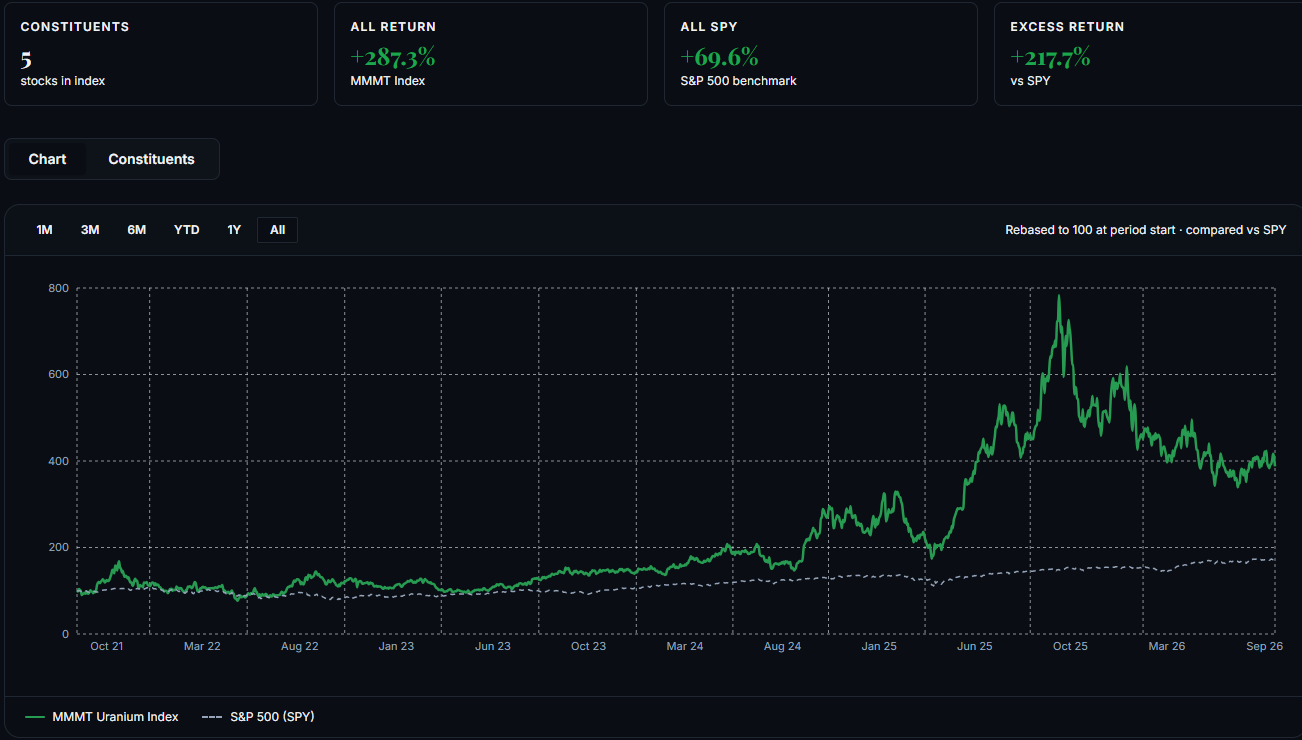
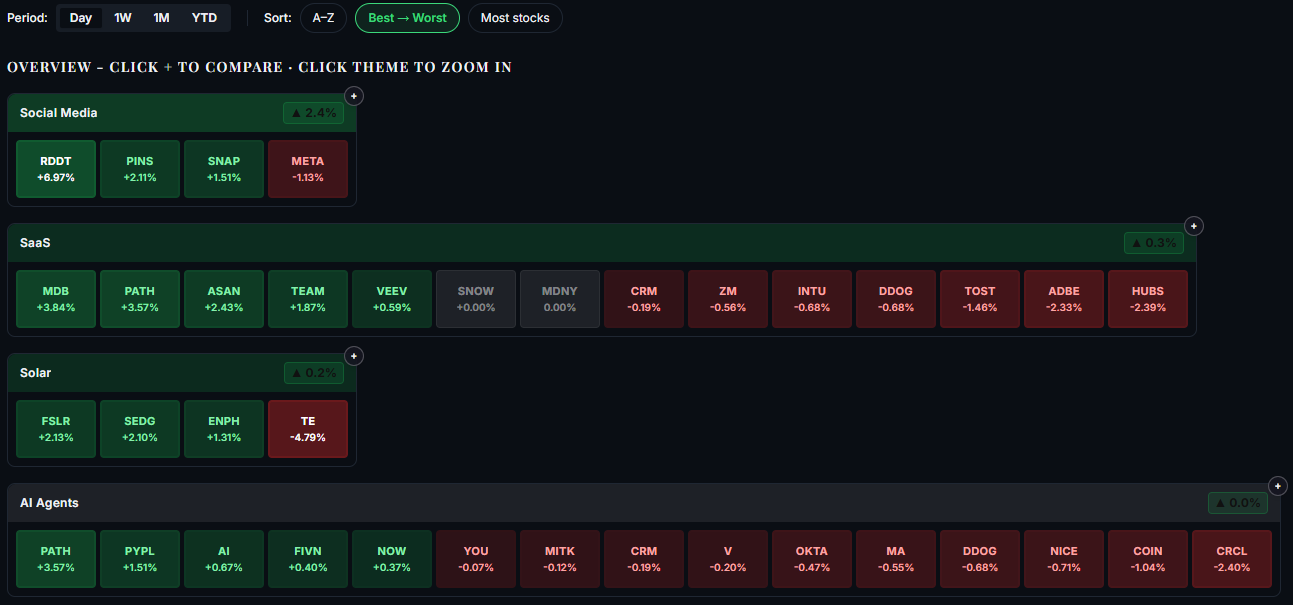
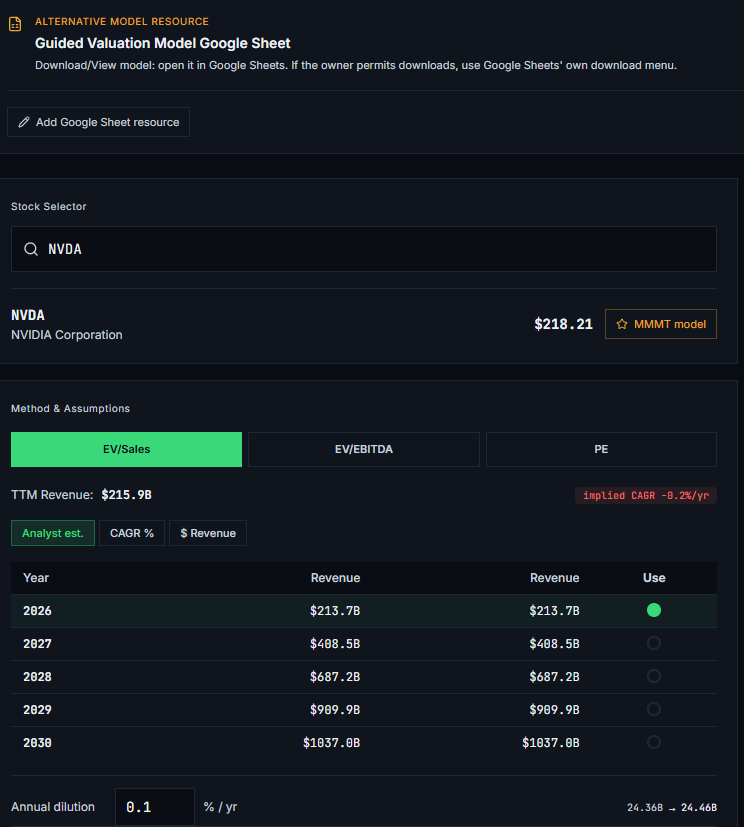
Before we move on…just a quick note on my web-app which is ~3-4 weeks away from full deployment.
Some incredible features all paid subs will have access to:
Full investing universe broken down by theme
How I’d structure a concentrated ETF by theme
A guided valuation workflow (or a view of all my personal models)
My portfolio and watchlist and the ability to create your own portfolio and watchlist on the app
All my daily notes
And much more
Uranium Prices
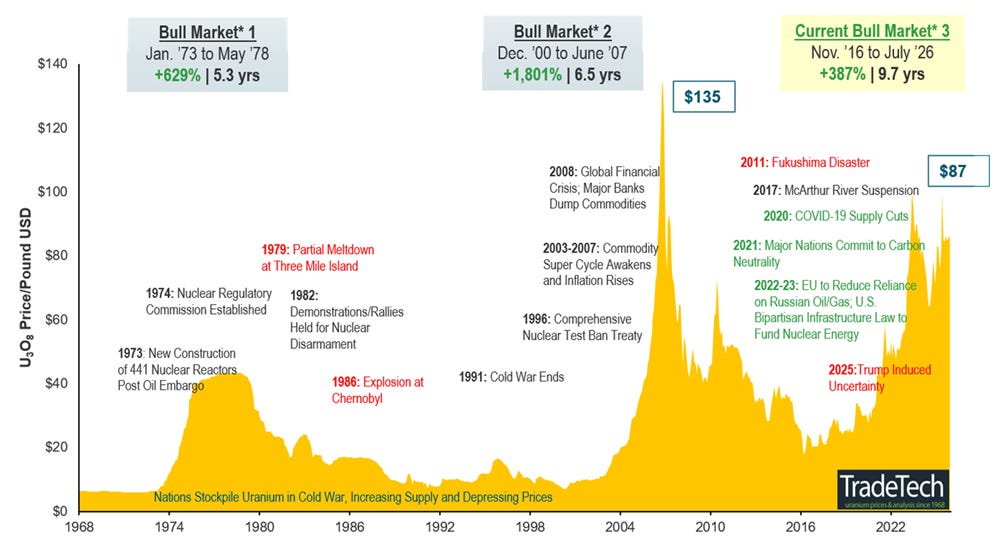
A core factor to understand if you’re bullish on nuclear stocks is why uranium prices are elevated and why they can keep going higher. We’re currently sitting at ~$89 with $136 being the high in June 2007.
Here’s why I forecast uranium prices to keep rising:
We’re burning far more uranium than mines produce.
The buyers who keep reactors running have not locked in enough uranium for the decade ahead. Global reactor requirements sit near 69,000 tonnes of uranium per year. Current mine output is 60,000 tonnes per year.
Utilities have compounded the problem by under-contracting for years. Nuclear operators have at most 174 million pounds covered for 2026-2035 against ~360 million pounds of anticipated need. That’s 186 million pounds of no contract and no assigned supplier.
This 186 million pounds isn’t any speculative demand. It’s fuel for reactors that already exist. There will be a time when that book has to be filled and buyers will hit the market together competing for a scarce supply. In that sense, under contracting is just concentrating a future wave of buyers.
Demand is massive.
The World Nuclear Association sees reactor requirements (total volume of uranium that all operating reactors worldwide need to purchase each year as fuel) rising from 69,000 tonnes of uranium today to ~150,000 by 2040 as a base case (upper case is +200,000).
On capacity, that’s 400 GW today to 746 GW in 2040 (base case) and 966 GW if governments get more aggressive on nuclear targets.
Kazakhstan still accounts for ~2/5ths of world production.
Kazatomprom (historically supplied ~40% of all uranium) has approached peak output with production set to decline over the next 15-20 years.
Not many new mines have been built recently and a project still takes a decade or more from discovery to delivery. Supply simply isn’t keeping up with demand.
The Opportunity
From an investment standpoint, the structural shift that matters is who’s buying nuclear, and how.
The original nuclear renaissance was focused on huge contracts with utilities and governments with 10+ year timeframes. That’s changing now.
Most of the new demand that is emerging doesn’t necessarily need 1,000 MW and most importantly it can’t wait 15+ years. An industrial site swapping out gas heat does not need a gigawatt reactor. It wants a few hundred MW it can add in as the plant grows. Same with a retiring coal plant for example. The demand for 1,000 MW+ units is much less now.
The demand is being fragmented into 50 to 300 MW blocks and this is exactly one of the core catalysts behind the next-gen nuclear and SMR’s.
An SMR is a nuclear reactor built much smaller than a typical plant (usually under 300 megawatts vs 1,000+ for a conventional unit).
The idea is to repeat one design many times rather than one huge gigawatt station. That should in theory mean shorter build times, lower upfront costs, and the ability to add units as demand goes.
It’s how nuclear gets sold to hyperscalers and industrials instead of only to state utilities.
Small Modular Reactor TAM
The International Energy Agency counts private SMR plans at ~25 GW with forecasts at 40 GW by 2050 as a base case. With policy support, funding, and good execution it sees these numbers closer to 120 GW.
Here’s where it gets slightly more interesting down the road:
Some reports suggest that if factories learn to develop SMR’s on a budget, and at scale, SMR’s have the potential to address 700 GW of industrial demand in North America and Europe. That would be in the region of $500 billion to $1.5 trillion in investment.
To put that into perspective, the world has about 400 GW of nuclear running today. So 700 GW of just North American and European industrial SMRs is almost 2x the entire global existing fleet. That’s roughly a 17x increase from the IEA’s base case assumptions in 2050.
Realize that is an upper-bound opportunity / an extremely bullish case rather than a forecast.
The Numbers:
The SMR market is currently valued ~$6-7B with the IEA seeing a market ~$25B by 2030.
This makes the valuations of pre-revenue companies (you’ll see below) pretty uninteresting at the moment given most are +$4B.
But here’s a thought experiment on where the market can go a 1-2 decades down the line:
At a mid-cycle build cost of ~$6,000-8,000/kW, and IEA current base case estimate of 40GW by 2050…the total construction bill for that fleet of SMR’s would be ~$240-320 billion. IEA’s more bullish take of 120 GW puts us ~$670B of cumulative SMR investment by 2050.
Note this excludes the extra bullish case of potential 700 GW.
The Timeline
The timeline for the uranium/nuclear trade is the biggest bearish case for me. It’s improving year on year…but nuclear is still a 3-5+ year story with SMR’s being a 5-7+ year story.
Aside from the technology advancements, and uranium supply of course, policy is the main thing that can compress the timeline.
On May 23, 2025, Executive Order 14300 told the NRC to change how it licenses and oversees reactors such as with stricter timelines in months, rather than years…and a change of process rules that tended to be hurdles for new builds.
Washington is backing this regulatory push as well. So far, the DOE has allocated $17.5B in loans to improve supply chain issues. We’ve also seen $2.7B in loans for domestic uranium enrichment (more on this below).
None of this makes nuclear a 2027 or 2028 story necessarily…but it does help alleviate some of the clear bear cases we’ve seen over the last decade…essentially that the US will talk about nuclear for decades without actually building anything material.
How to Invest
Let me take you through the nuclear roadmap quickly because understanding the roadmap is key.
A reactor developer sells a license, some engineering, and potentially some royalty on modules. The dollars are actually the uranium in the ground, the conversion, the enrichment, the heavy forging, the vessels, the constructions, and at the end the power contract.
In other words, the listed developer is the thinnest, and most binary part of a huge industry.
They’ll probably be deserving of the highest multiple just like Agility (CCXI) or Unitree in the robotics space will be deserving of the highest multiple, but whether that translates into the best (and safest) investment returns vs the actuator/bearings plays, or perceptions plays in robotics is the more important question.
It’s exactly the way to think about it in the SMR market too.
The way to think about the investment potential here is via a stack. Not through 1-2 pure play SMR tickers.
The Underlying Metal (Uranium)
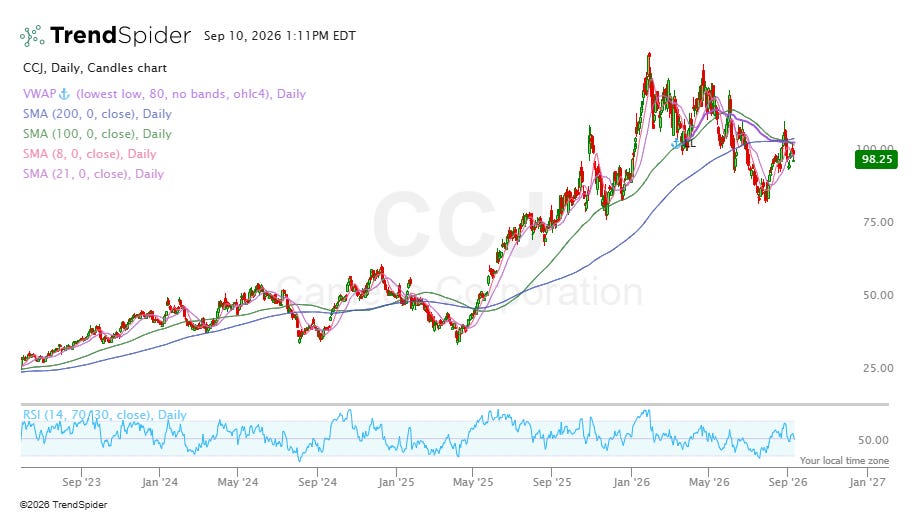
Cameco | CCJ: CCJ is the blue chip of the group operating McArthur River and Cigar Lake. It sells significant portions of output on long-term contracts at fixed or base-escalated prices meaning it’s a de-risked way to play the more general uranium theme. You also pay up for the safety of this with a stock trading at 73x NTM PE.
Denison Mines | DNN: This is a pre-production developer making it far riskier than CCJ despite sharing similar geography. Construction began in March making it the first new larger scale Canadian uranium mine in decades. Their target production date is mid-2028 so it’s a slightly higher risk way to play the underlying layer of the theme but one that has a big catalyst coming in the next 2 years.
Uranium Energy Corp | UEC: I think of UEC as a similar story to CCJ just with slightly higher risk in that production hasn’t reached full capacity yet and they do not hedge uranium prices meaning investors have purer exposure to uranium spot prices.
NexGen Energy | NXE: NXE owns the Arrow Deposit that by a lot of metrics is the highest grade uranium deposit in the world. It has a grade of 2.37% U3O8 (most uranium mines operate in the 1% range). The forecast numbers in terms of mine life, capacity, and total production are impressive but first production is realistically not till 2031-2032 so it remains another higher risk way to play the uranium theme.
Energy Fuels | UUUU: UUUU operate out the White Mesa Mill in Utah which is the only conventional uranium mill operating in the US. The big story is that UUUU is pivoting into rare earths to produce dysprosium, terbium, samarium, europium and gadolinium. This makes it a uranium / rare earth hybrid play.
Fuel Cycle
This is where some of the most interesting companies sit…but most of them aren’t US public companies aside from the two mentioned below.
Firstly, understand that there is a key conversion from the underlying metal (mining) → conversion → enrichment → fabrication.
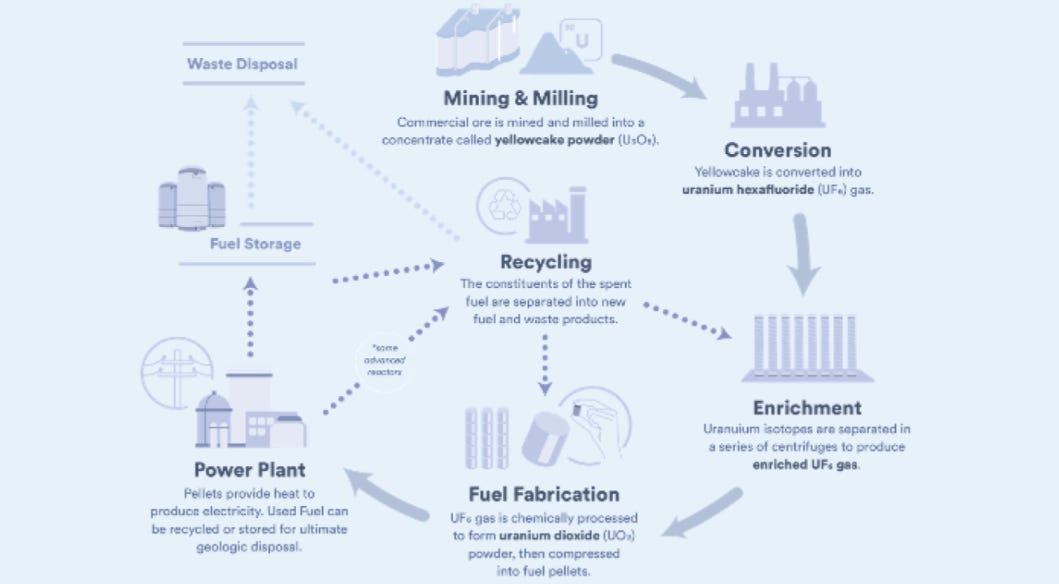
The conversion and enrichment stages of the nuclear fuel supply are the ones with the tightest bottlenecks.
Conversion: Raw uranium (U3O8) is what comes out of a uranium mine. After ore is crushed and chemically processed you have a dry powder that is roughly 80% uranium by weight. It’s useless as a fuel though and it’s in the wrong physical form for enrichment. It therefore gets converted to Uranium Hexafluoride (UF6) which is a gas that centrifuges can use for enrichment.
Enrichment: Natural uranium is ~0.7% U-235. Conventional reactors need 3-5% and advanced SMR’s need 5-20%. The industrial process used to achieve this is a process called gas centrifuge enrichment which spins UF6 at 50,000 rpm so the heavier U-238 is separated from U-235.
There are active mines (~40 globally), active nuclear reactors (+400 globally), but there are only 5 companies that make up ~95% of the entire conversion and enrichment markets. That’s one of the reasons why conversion prices have jumped ~400% and enrichment prices have jumped ~300% over the last 18-24 months.
The only Western conversion providers are:
Cameco (CCJ) is a conversion provider.
Orano (French) is a conversion provider.
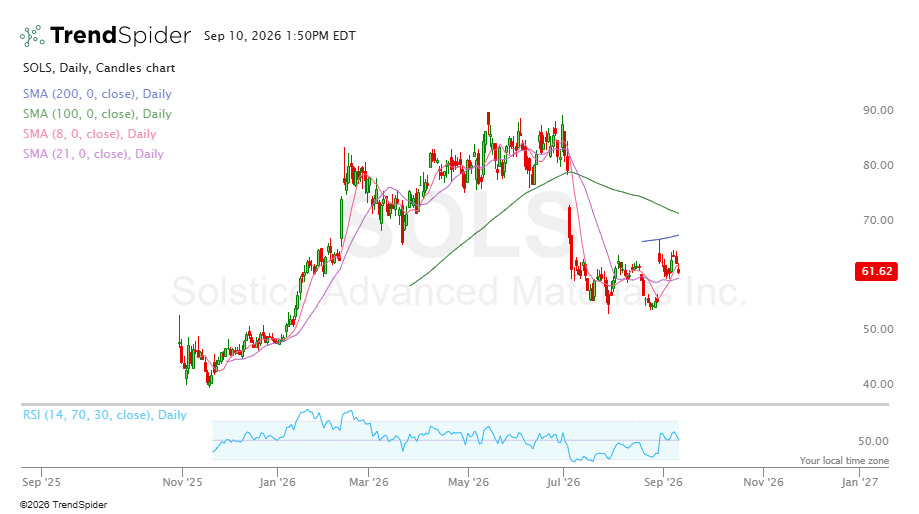
Solstice Advanced Materials (SOLS) is a conversion provider.
Enrichment is mainly state dominated by Rosatom (Russia), Urenco (UK), Orano (France), and CNNC (China). The remaining Western capacity falls to Centrus (LEU), Cameco (CCJ) and Silex Systems (SILXF).
Solstice Advanced Materials | SOLS: SOLS owns Metropolis Works in Illinois which is the only conversion plant in the US. CCJ is the other conversion play (I wrote about it above in the underlying metals section).
Centrus Energy | LEU: LEU is the only Western company currently producing enriched HALEU at commercial scale in the Western world. The total backlog now stands at ~$4.5 billion through to 2040 with a $900M DOE task order and new supply agreements with Oklo and X-Energy. Advanced SMR’s physically cannot be built without HALEU.
ASP Isotopes | ASPI: ASPI is a complex name in the enrichment layer. It uses Quantum Enrichment which is a laser based isotope separation technology. The issue and complexity with ASPI is that its main business is actually specialist isotope production. It makes ASPI a slightly more diversified holding company with a high-upside laser enrichment option.
Silex Systems | SILXF: This is a higher risk bet on the enrichment process getting disrupted. It has a SILEX laser enrichment process that exploits the quantum mechanical properties of U-235 molecules by firing a laser to get them to react differently and allow separation in far fewer stages than the centrifuge process. If this process materializes, the energy consumption per SWU will translate directly to lower fuel costs (enrichment is ~30% of total nuclear fuel costs). Silex are working with Cameco on commercializing this technology.
Lightbridge | LTBR: LTBR doesn’t sit cleanly in this layer but it’s closer here than others. It’s trying to replace cylindrical rods by using a spiral-twisted metallic alloy that conducts heat far better than conventional ceramics. This ultimately increases power output and increases margins. It’s still completely pre-commercial but in August 2026 they were selected for DOE’s Launch Pad programme which can provide an accelerated regulatory pathway.
Nuclear Engineering
BWX Technologies | BWXT: BWXT is an underrated play in my opinion. It has quite a defensible niche in the stack in that it is the only large commercial nuclear equipment manufacturer in North America. It manufactures nuclear reactor components for defense (US Navy and aircraft) and for SMR. It has a backlog of $7.3 billion.
GE Vernova | GEV: Another blue chip, and arguably the leading play in the SMR niche as well. It’s building BWRX-300 which is technologically the most advanced Western SMR project today. It also acts as a large, and very diversified energy infrastructure company so you get a defensible energy play with a built in SMR option for the upside. It won’t have the upside potential of some of the pure plays but GEV at 44x PE is historically on the cheaper side.
Fluor | FLR: FLR are the EPC contractor (the firm you hire to take a reactor design and actually build a working power plant behind it).
Pure SMR Plays
This is where the potentially outsized upside is more likely but it’s also where you have to respect the timeline the most. I have a very small position in SMR that I’m in no rush to currently build out. My only aim over the next few months/years is to bring my average cost down on SMR as much as I can and then wait. It’ll likely be a bumpy ride as a stock that won’t hold up in a market downturn, but with the size of the position I have that’s completely fine for me.
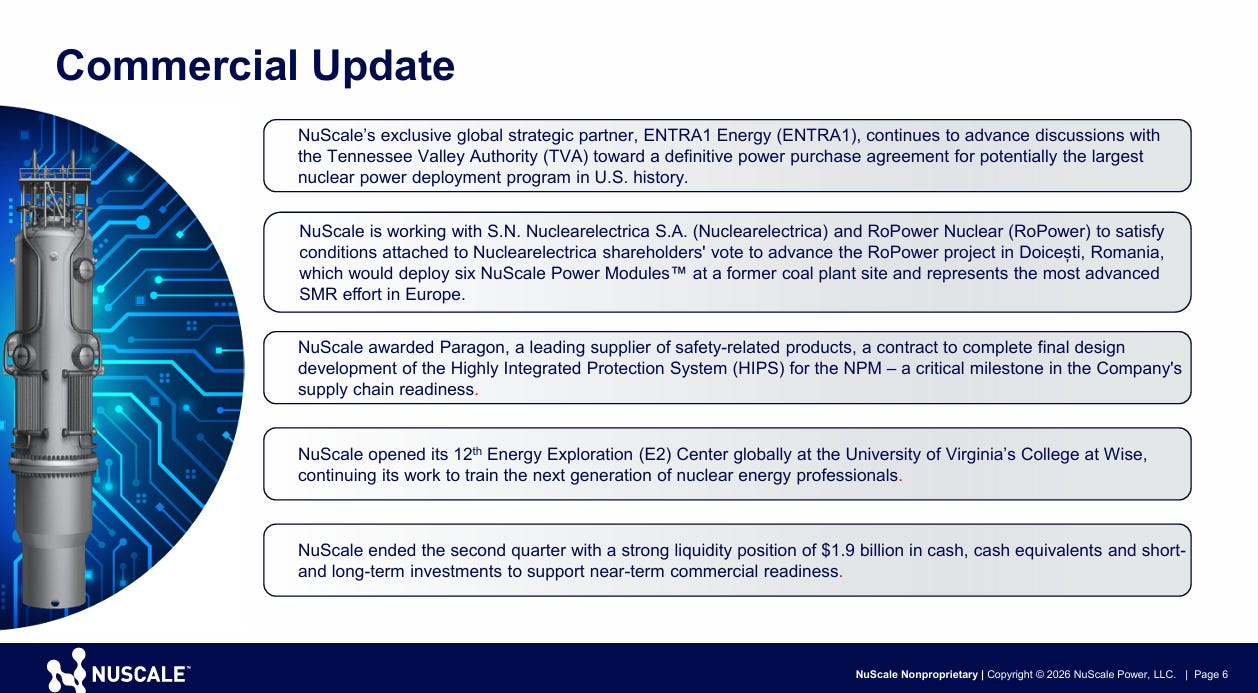
NuScale | SMR: Commercializing a light-water small modular reactor of ~77 MWe and it already has US NRC certification. TVA and the Romanian Doicesti project are the two large catalysts right now to watch.
X-Energy | XE: Developing Xe-100 which is ~80 MWe. It also has TRISO-X-Fuel meaning the business can generate revenue from reactors and from fuel. Only recently public and pre-construction.
Oklo | OKLO: Building Aurora Powerhouse which is a sodium-cooled reactor. Commercial operation is targeted for ~2030.
Nano Nuclear Energy | NNE: Developing KRONOS. It’s earlier stage but has been awarded a NRC construction permit which should improve regulatory approval time.
