

Last week was an important week post NVDA earnings and Jackson Hole. As a result we saw a slight rise in the DXY, a slight rise in US 10-Yr yields, and a rise in 2-Yr yields.
So what does all this mean and what is the market telling us?
Macro Take
Let’s start with the bond market.
Warsh came out hawkish at Jackson Hole. This is the kind of speech that, in theory, should reassure bond investors that the Fed is serious about the inflation fight. Core PCE is still at 3.3% (well above 2% target) and yet 10-Yr yields rose.
The reason is unclear but I think there are two ways to read the reaction.
Either:
Traders don’t believe the Fed actually has the stomach to hike enough times to bring inflation sustainably below 2%.
Or aggressive rate hikes slow growth and slow growth means lower tax receipts which means bigger deficits. Bigger deficits mean the Treasury has to issue more debt regardless of what the Fed is doing at the short end.
Point number 2 is the clear bear argument here. Interest expenses are escaping control. I think watching the 10-Yr is an important consistent check in over the coming weeks.
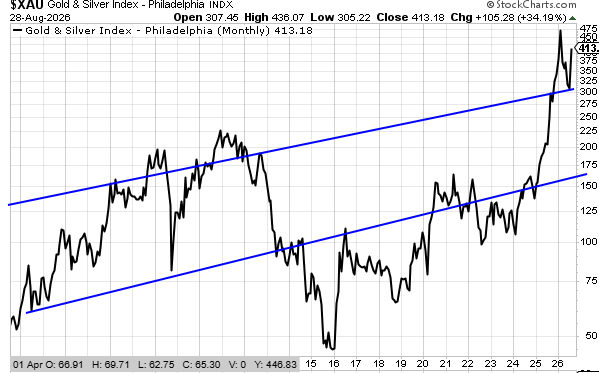
What this means for Gold & Silver?
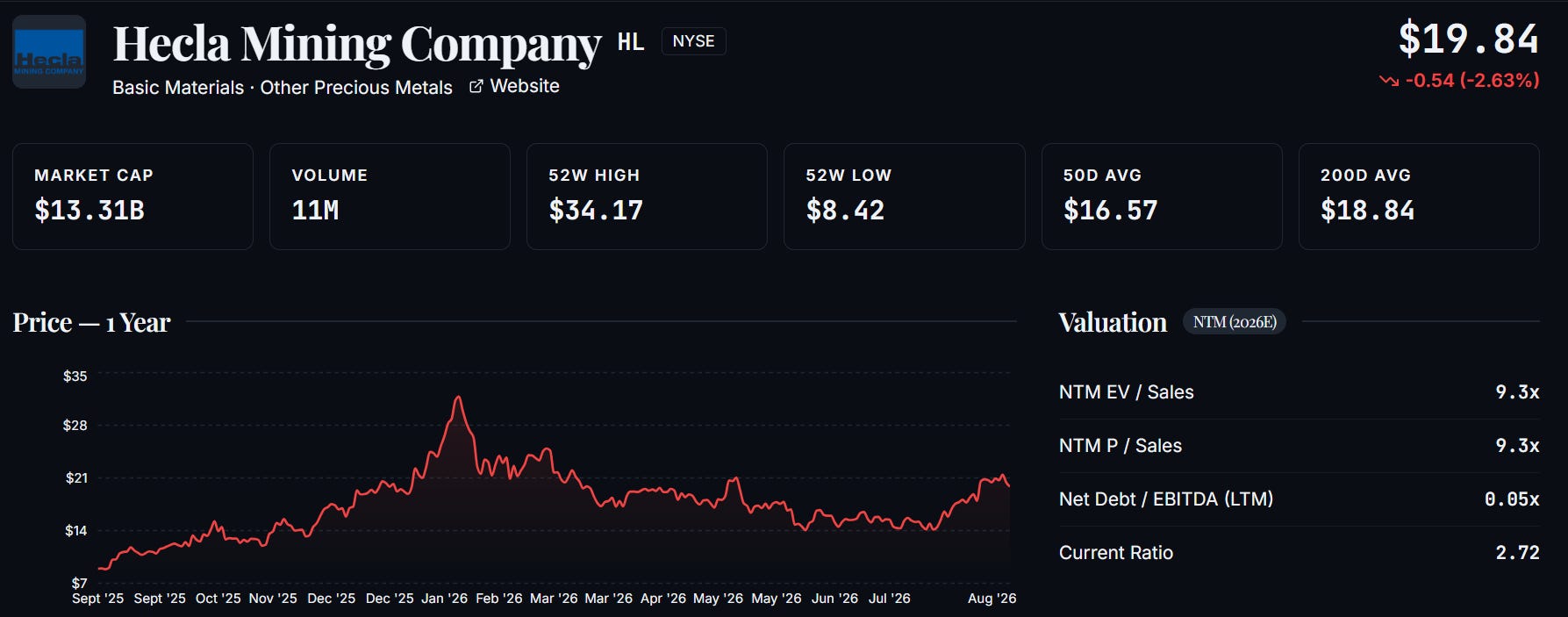
Paid subs will know that I’m very bullish on silver. Part of that reason will be explained below (macro). Part of the reason is because I think the market massively underappreciates the silver demand needed in the AI buildout relative to silvers supply.
Warsh’s hawkish speech initially triggered a selloff in precious metals. That seemed like the obvious move (tighter policy/stronger dollar → sell gold/silver).
But longer term if the Fed hikes aggressively, one of two things will happen:
Growth slows, the economy softens, tax revenues fall, and deficits widen. That is bullish gold/silver.
Inflation stays sticky, confidence in Fed’s credibility weakens, and foreign investors question whether holding US Treasuries at current yields is worth the risk. That is bullish gold/silver.
That’s why the bond market is moving upwards. Investors are demanding a higher premium to hold US government debt and that has historically been a catalyst for gold and silver.
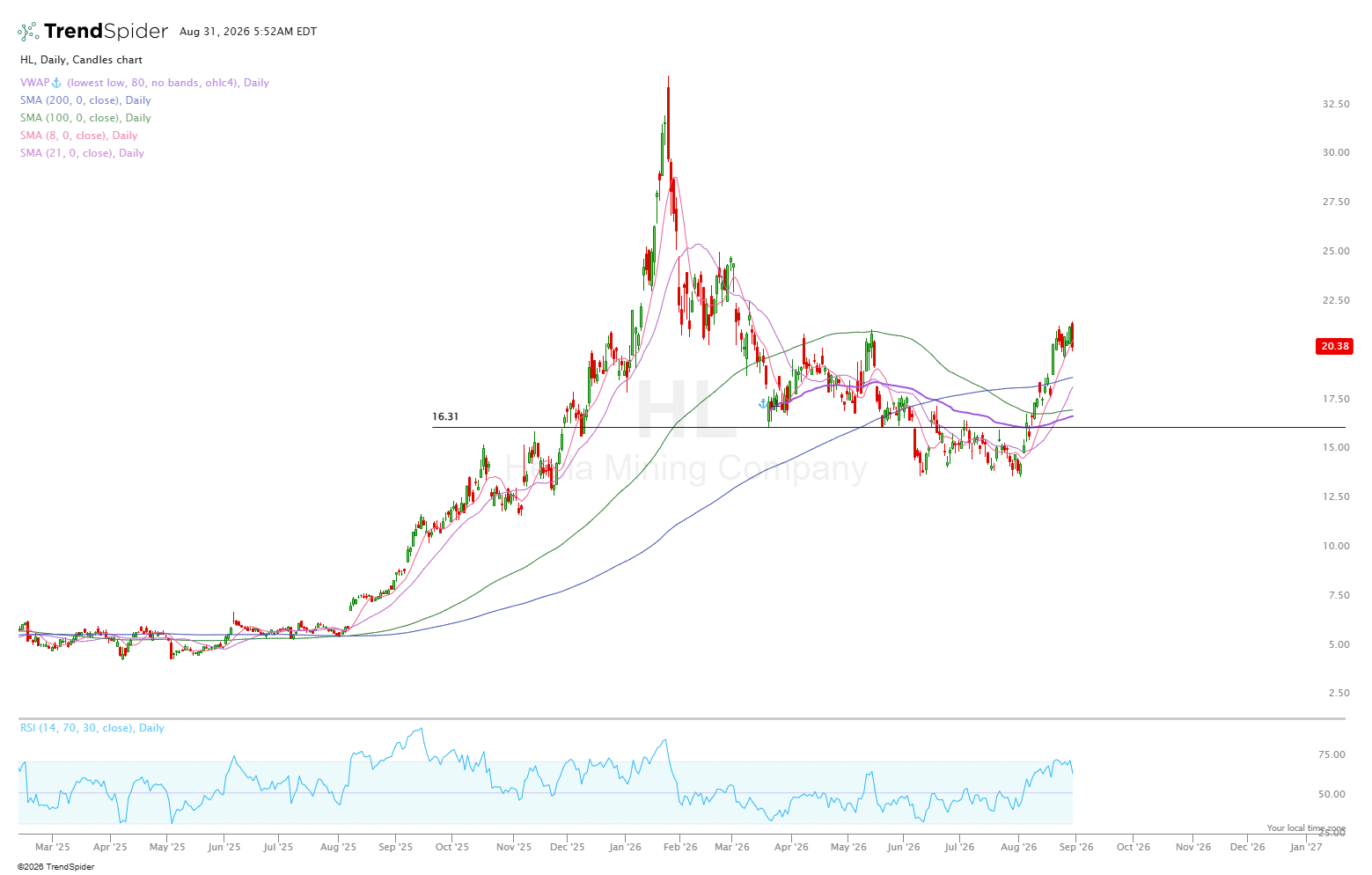
Hecla Mining (HL) is one of the silver positions I hold. It’s currently sitting nicely above the 200D, 100D, and 8 and 21 daily MA’s and above the key support we have at $16. Structurally, it looks like we have a nice floor in either at $16 or ~$12.50.
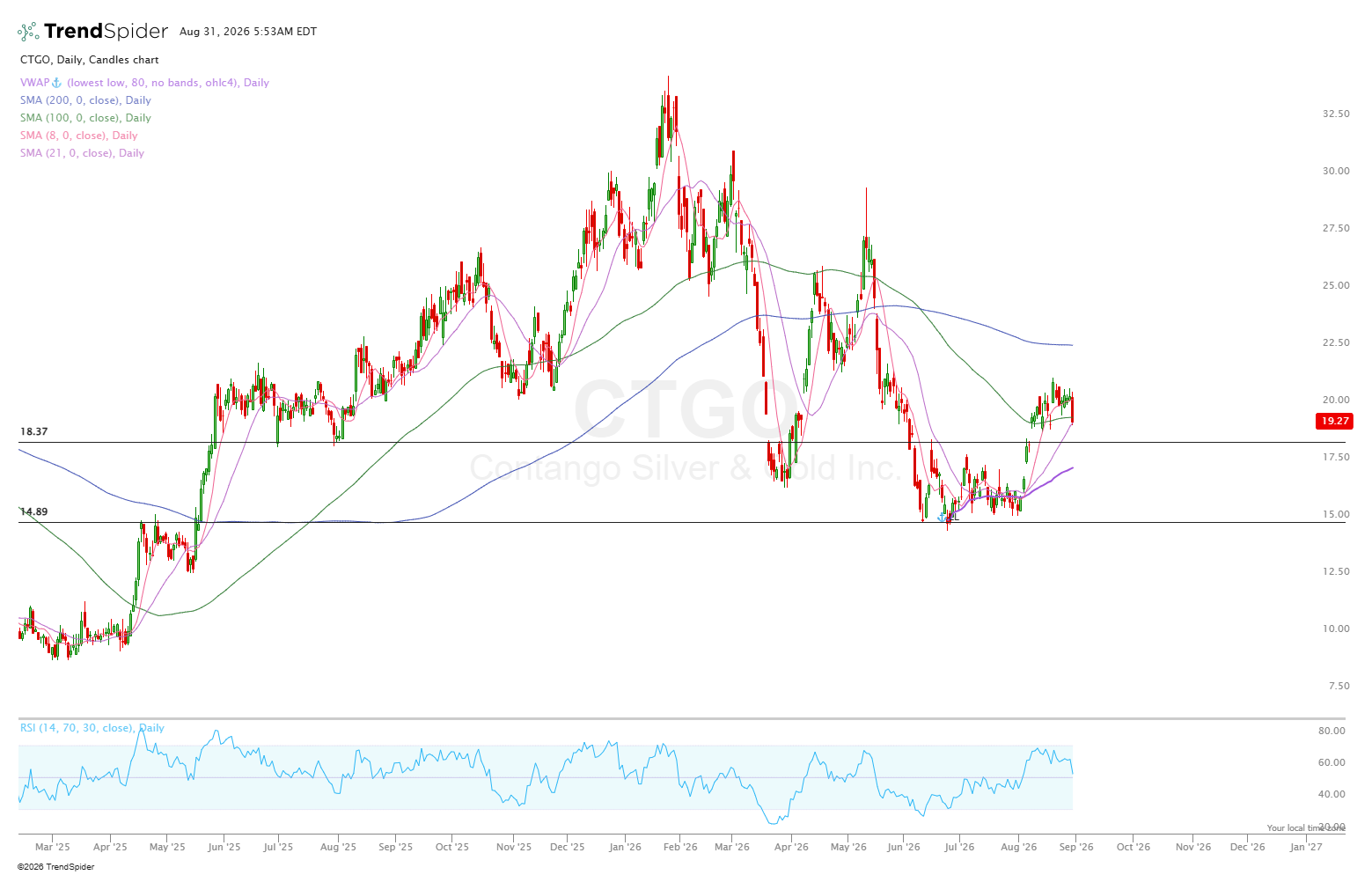
Contango Silver & Gold (CTGO) is the slightly higher risk silver play that I own. It’s predominantly a gold miner right now but it’s also a future silver story too through Kitsault Valley. Kitsault is still in exploration/drilling phase making this a gold miner with a silver option attached.
Micro Take
The whole market right now seems to be a battle between the more bearish macro takes, the oil markets, and the more bullish micro takes we’re seeing across the AI/semiconductor market.
Here’s a breakdown of some of the more important narratives we’ve seen over the last week from earnings calls, management commentary, and institutional research:
Nvidia (NVDA) had a huge Q2 growth estimate and FY28 forecasts were 70% vs original Street estimates of 44% (despite being capacity constrained still).
Nvidia (NVDA) projected $1.3T of hyperscaler spend in 2027. That’s vs the original forecasts of $800B and probably more important than anything else in the market right now. There are so many different angles to focus on right now in the market that it can get confusing if you let it get confusing. It’s incredibly important to zoom out sometimes and understand that upward revisions in total CapEx keep on rising. $1.3T in 2027 is a huge uptick vs previous numbers and making bearish arguments on the supply chain is therefore weak.
Chinese optics names like Innolight (300308) put out incredibly strong numbers with last 2 quarters revenue growth figures up 192% and 175% respectively with forecasts for H2 to be even higher.
SK Hynix (SKHY) CEO said memory shortage is expected to continue through to at least 2030. We also had Sandisk (SNDK) CEO state that “we see structurally massive demand for NAND until 2030.”
Goldman Sachs forecast memory is set to be ~40% of the semiconductor dollar amount for humanoid robots.
Elon Musk said SpaceX (SPCX) could reach ~$3.5T in annual revenue by 2033.
The AI infrastructure has (a while ago) entered a phase that requires a different analytical framework to perhaps what most investors are applying.
The easy instinct is to look at capital spending numbers like the $1.3T figure, the GPU orders stretching years into the future, the memory shortage through to 2030, and then mention the world “bubble”.
The important metrics are:
Is earnings growth looking sustainable?
So far there is absolutely no solid data points pointing against this. Earning are continuing to beat across the board and trends are only heading one way.
Is supply outrunning profitable demand?
Yes. Anthropic is heading towards $120 billion in ARR whilst losing market share. Innolight is growing optics revenue +180%. These are not the result of price cuts.
The part of this that a lot of investors are still missing is what happens when intelligence inevitably gets cheaper. The intuitive bear argument is that open source models and efficiency improvements will eventually compress margins and reduce compute demand as cheaper alternatives enter the market.
The historical evidence from every prior tech revolutions suggests the opposite.
When the cost of a resource falls dramatically, consumption tends to rise faster than the price decline. It’s known as Jevons Paradox.
Cheaper intelligence doesn’t shrink the compute market. It expands the number of tasks worth computing in the first place.
Frontier models and cheap open source models aren’t competing for the same fixed pool of use cases - they’re together expanding what’s economically worth automating.
What’s Mispriced?
This is a section looking at the potential opportunities I’m seeing at the moment. I’ll split them by how I see the risk profile (high risk → low risk).
I’ll tend to aim for at least 3+ opportunities in every article I publish here…but that depends on what the market is offering.
You’ll also likely see overlap week to week. I am not a trader that changes his mind every few hours, days, or even weeks. If I see an opportunity, that opportunity sometimes stays around for weeks.
Aeva Technologies | AEVA (High Risk)
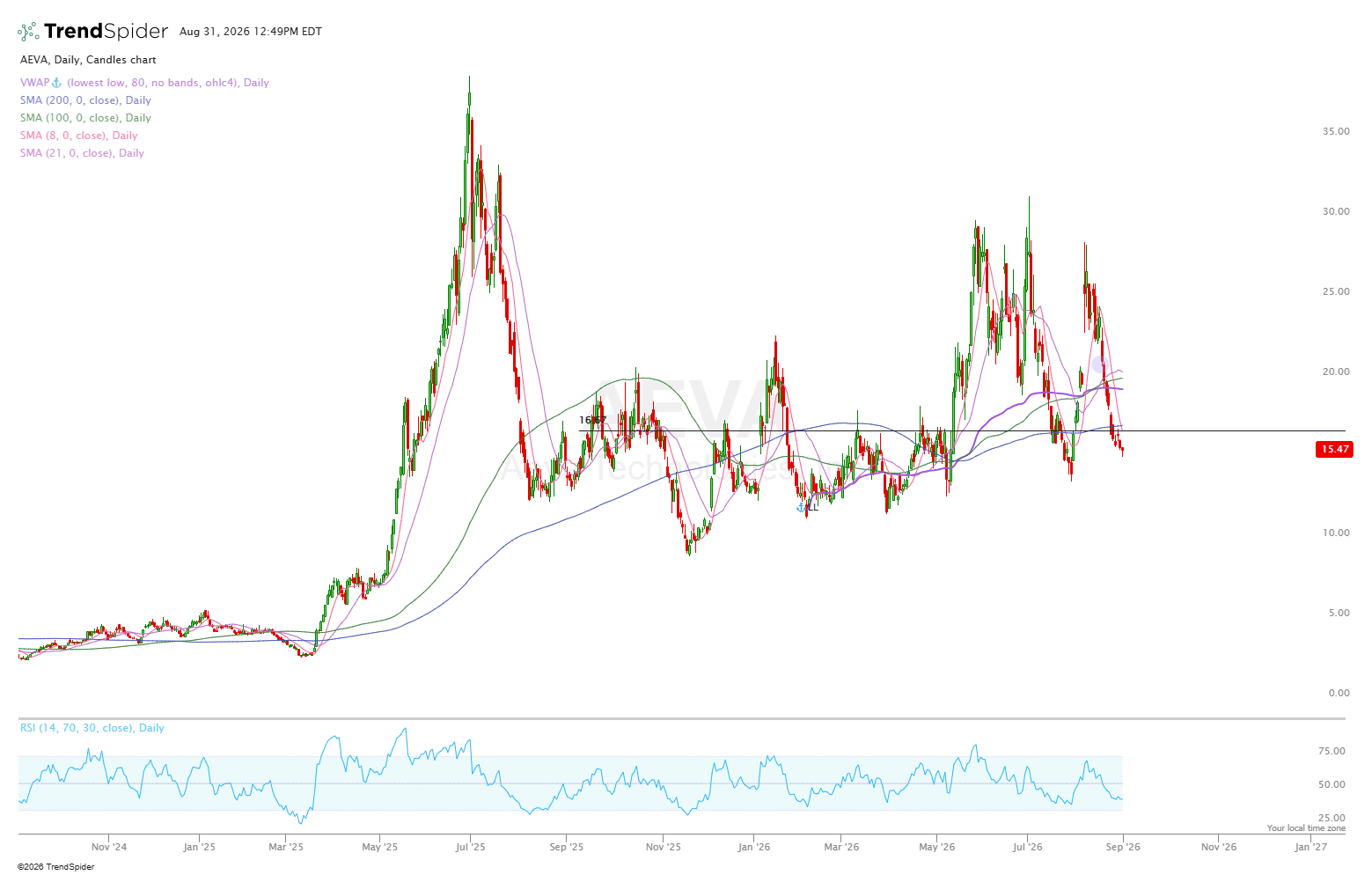
I wrote the following note to subscribers about AEVA on August 10th.
“It’s very hard to gauge the potential of this segment of the business right now but here’s my initial thoughts on a potential entry:
Management have said that they’ll be deploying “millions and millions of units” likely giving them “multiple hundreds of millions” annually in revenue. Conservatively, I think we can put this as ~$300M by 2029 and maybe $400M by 2030 given H2 2027 is when we see the initial ramp up with production ramp in 2028. These are pure assumptions by me based on the limited commentary we have from management but I’m just trying to model it out broadly.
The perception business is still pre-scale. Analyst estimates suggest we’re looking at ~$233M in revs for this segment. So if we wake some assumptions on 2029 revenue based on this, I think $522M in revs for perception (as per analysts) + $300M in revs per optics business.
Given the guess work required here, I think a risking factor in the 60-80% range is good.
60% * $822M in revs = $493M in revs.
80% * $822M in revs = $657M in revs.
Share dilution estimates:
Current share count: 69.7M
SBC is unavoidable at this stage. 3-4M shares per annum vesting over 3 years = potential 10-12M in shares.
At ~$125M annual cash burn and $180M in cash currently the runway isn’t too long. Likely we’re then looking at 2 raises (assume $125M each ~$25-$35 per share → another 12-14M shares).
Warrants and options (another 10-12M shares).
2029 estimated share count is therefore ~100M.
$657M in revs by 2029 would be 171% CAGR and given the potential photonics TAM I think a 10-12x sales multiple is fair (looking at LITE, AAOI, OUST multiples now).
10x sales * $657M in revs = $6.5B / 100M share count → $65 per share.
Given this is more of a venture style bet I wouldn’t be looking at less than a 3x opportunity which means a $21 share price could be a potential entry point.”
I since messaged very regularly on AEVA updating on no entry given the technicals showed no signs.
AEVA remains in that basket of a potentially very good opportunity here but until we see some consolidation on the chart or a reclaim of the $16.50 support level, I will hold off buying.
An opportunity nonetheless… and one to watch here at sub $16.
