

Brief takeaways:
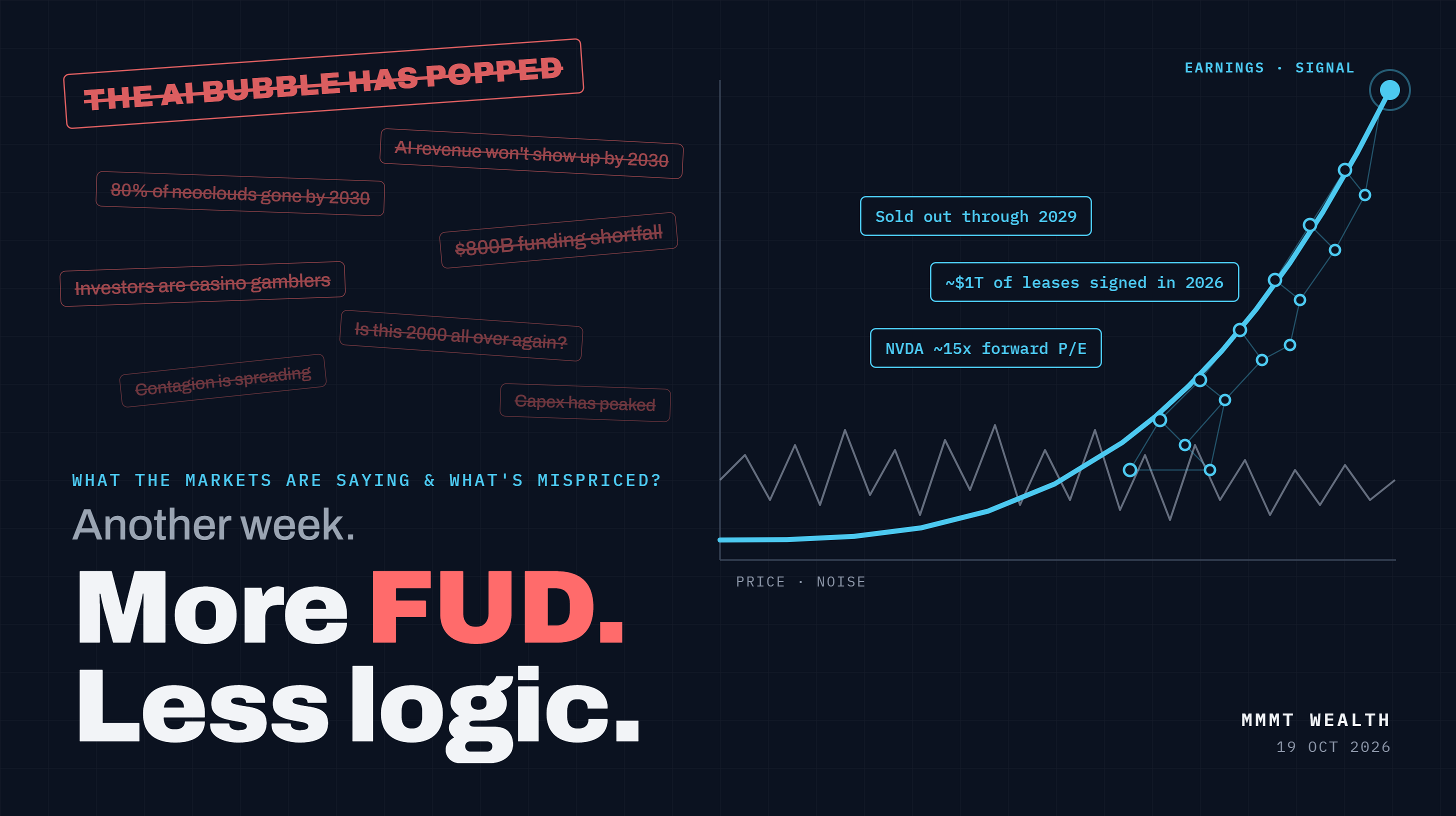
This isn’t an AI bubble bursting. It’s a hedge fund deleveraging event. Crowded AI positions were forced to all sell at once. The S&P 500 is still less than 3% from all-time highs.
Listen to the companies and not the media or research notes. Lumentum is sold out through to 2029, ASML sees shortages to 2028, and Marvell is targetting a 10x in revenue by 2031. That’s not what a demand problem looks like.
There’s no bubbles in valuations either. Earnings are growing faster than prices and multiples are shrinking (NVDA is at ~15x Fwd PE). We’re only 2-3 years into a decade long buildout.
Another week. More FUD. Less Logic.
The loudest (and laziest) call in the market and on X right now is that the AI bubble has burst.
It lacks any proper evidence beyond a red week and completely ignores what companies are actually telling us. It also conveniently forgets that the S&P 500 is less than 3% away from all-time highs.
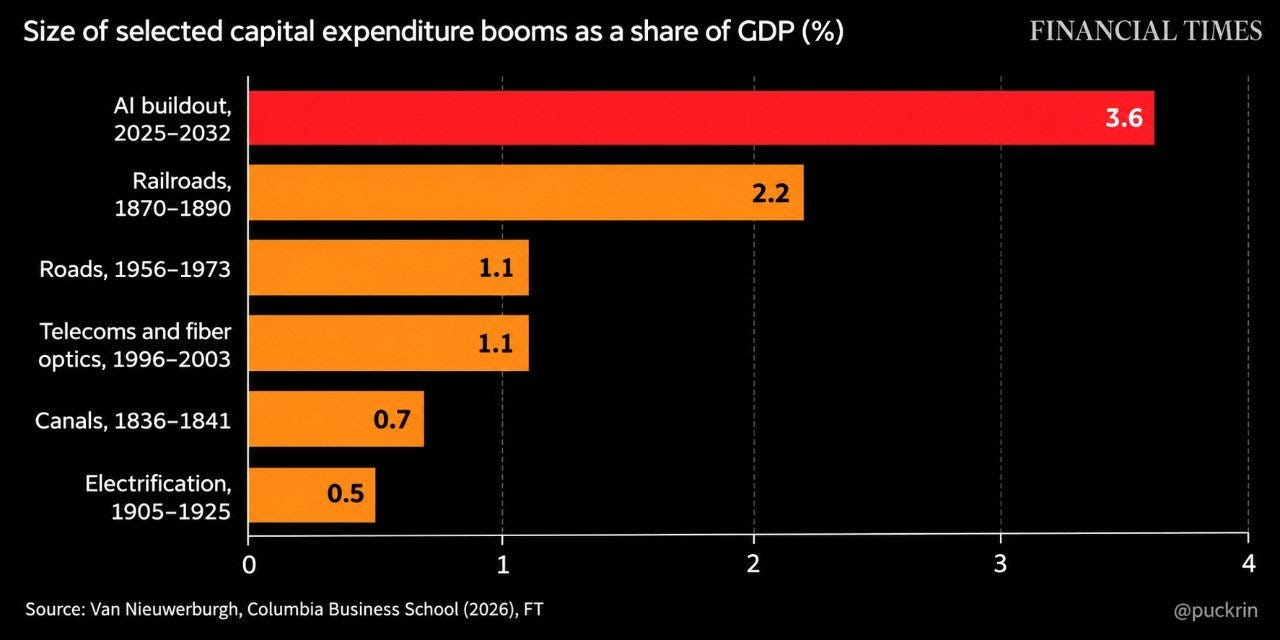
Last week was one of the noisiest weeks in the market I’ve ever experienced. If you read the headlines you’d assume that the AI trade is finished just 2 years into the buildout. For comparative purposes…other infrastructure buildouts in history rarely last less than 7 years. The fibre buildout lasted ~8 years and the railway buildout lasted ~15-20 years.
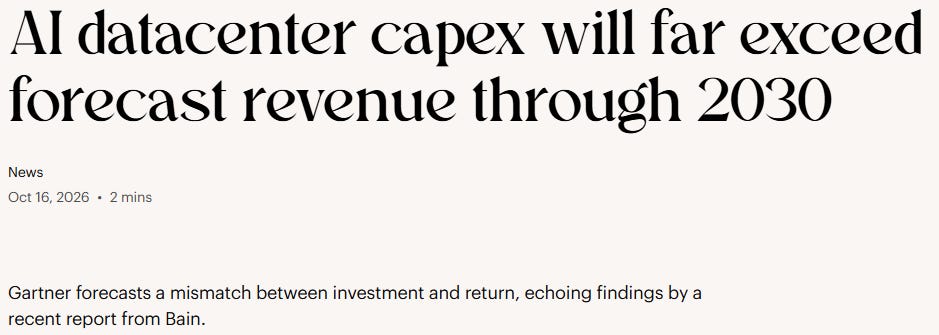
Yet, the FUD was real. CoreWeave (CRWV) sold off. Barclays told clients the best of the AI trade may be behind us. Gartner said AI data centres will generate less than half the revenue needed to justify the spend by 2030, and Bain said the industry will come up $800B short.
Let’s look at what actually is happening and try show put some logic to all of this:
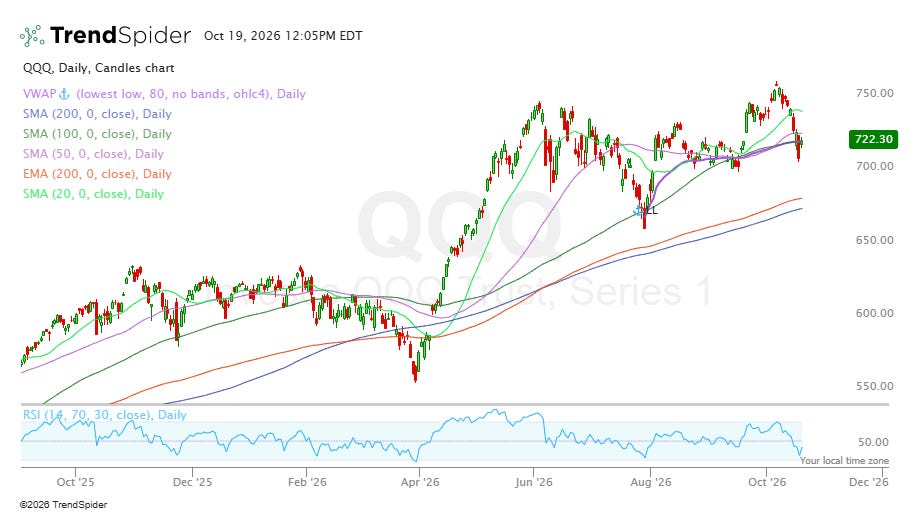
The S&P 500 (SPY) closed Friday less than 3% away from all-time highs (+12% this year).
The Nasdaq (QQQ) is up 15% YTD.
Hyperscalers (which are the companies supposedly as per media headlines set to stop paying for compute)…are now within a few percentage points away from highs.
Lumentum (LITE) is sold out through to 2029. The CEO has also said that “to a large degree, commitments are non-cancellable.” and that no customer has slowed, delayed, or asked to renegotiate an order since interest rates rose.
ASML (ASML) expects shortages through to 2028 with AI chip demand extending into 2030.
Marvell (MRVL) is targeting a 10x in revenue to $70-90B by 2031.
This is absolutely no sign of a bubble bursting. This is narrative from companies doing the actual selling and this is who you should be listening to.
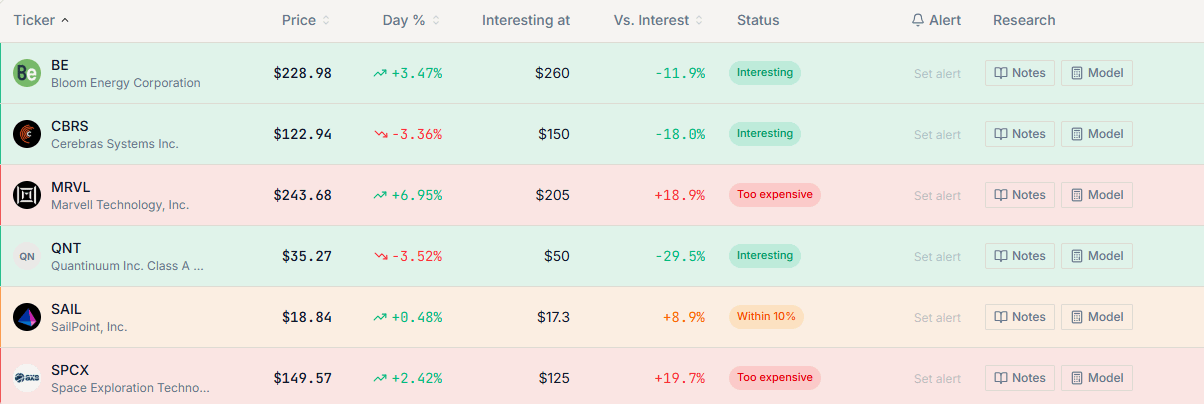
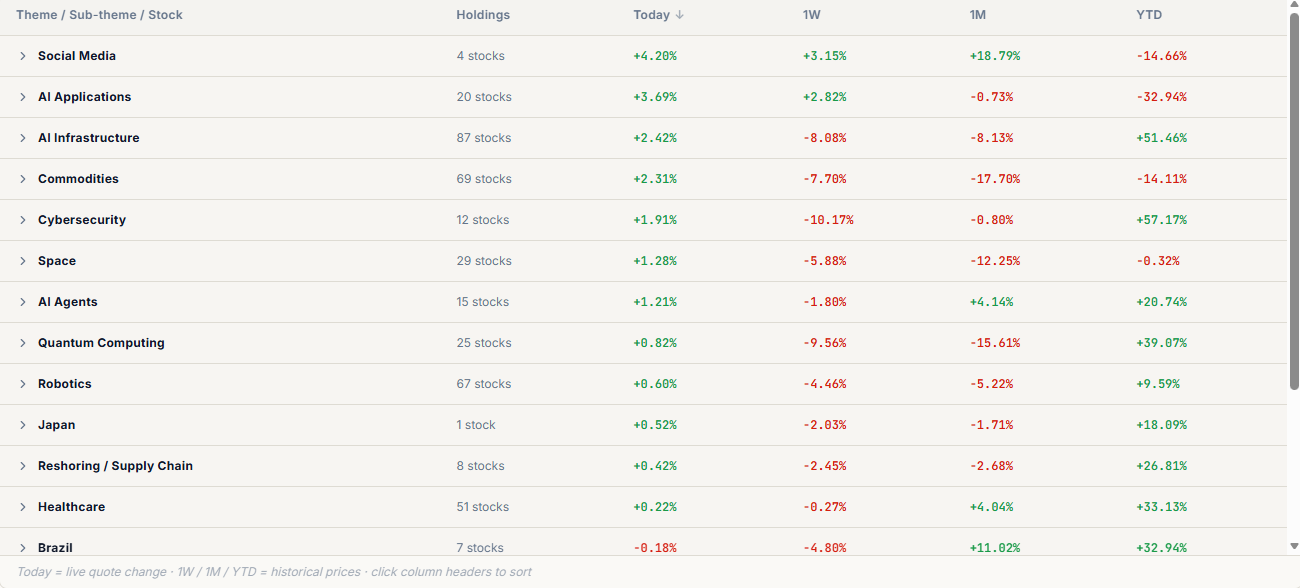
On November 1st I’m releasing my web-app to all subscribers (free & paid though paid will have far more use).
Here are a few snips and teasers from the site:
Model your own stocks or just follow my models.
Create your own watchlist.
Track investment themes and the AI supply chain.
Track all my daily notes and my stance on individual companies.
Track my valuations.
So what did happen last week?
Hedge funds were massive net sellers last week. They were forced to sell the same crowded positions at the same time. That’s very different from an “AI bubble”.
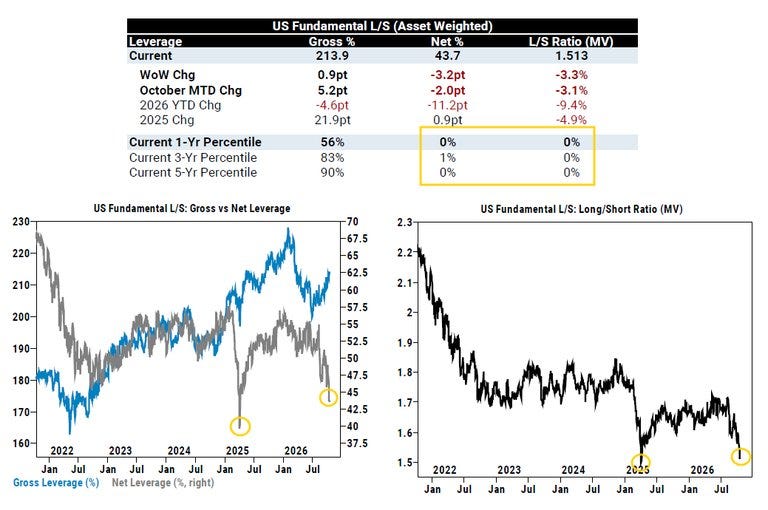
The main issue came because everyone is in the same trade (AI infrastructure and/or AI winners). So when everyone is in the same trade…there are no buyers when the trade turns against them.
And plus when hedge fund positions start falling…we see the following:
Very limited ways to hedge trades at the moment. The “AI trade” is semis, optics, energy, software. So a pure index put isn’t a good hedge at the moment. Hedging via Brazil or alike is probably the best bet…hence why I’ve done that.
When losses all show up at once because the entire AI trade is down…margin terms tighten which forces more selling.
Put those together and you essentially get a big deleveraging event. The purest AI names fell the hardest whilst the index, Europe, Brazil, and some other markets all held firm. It’s evidence that some of the biggest hedge funds in the world, despite seemingly being diversified by ticker count…actually weren’t diversified at all outside of the AI trade.
The unknown is how long this deleveraging actually lasts which is impossible to tell. Whilst we’re in this near-term deleveraging…fundamentals don’t matter. But over the course of a 3-5 year period fundamentals do matter and that should remain every retail investors focus.
The next catalyst / reminder for this demand is over the next 10 days through to November where we’ll see all hyperscalers (META, AMZN, MSFT, GOOGL) report.
Are We In A Bubble?
No.
Earnings are rising way faster than prices.
Multiples are shrinking.
Example: NVDA now trades ~15x NTM PE (it’s lowest PE since 2015). Some estimates put us ~13x NTM PE as well.
An AI bubble would see the opposite happening (rising multiples and falling earnings growth).
I touched on this in the introduction section as well but it’s important to realize exactly what you’re reading here.
We are in year 2-3 of the AI buildout.
Previous infrastructure cycles ran for 7-15 years.
Actual spend is ~$1 trillion so far today. We have forecasts for ~$10 trillion.
The Risk:
The main risk I see to the above is an oversupply of data centres (not demand for compute). That sounds a bit counterintuitive so let me explain:
Data centres are getting built faster than most can comprehend. Industry estimates puts that close to $1T of locked-in, long-term leases signed in 2026 alone. The issue is the chips (in particular memory) to fill them can’t keep up at the moment.
This creates a risk that by the end of 2028 or mid 2029 we have ~10 GW of fully built data centres with no chips to put in them. That will lead to a slow down in new orders which could be a clear risk the market reacts to.
The positive to take from that is another reinforcement that this isn’t a demand problem. Demand for compute still far exceeds supply. It’s just a mismatch within the supply chain itself and understanding the dynamics of this for your investments is key.
The pricing power will remain with those players who are constrained (memory and optics). Less pricing power will be with those data centre developers and/or some infrastructure suppliers.
This is why I think a “bubble” is a 2030-2031 story and not a story today. We’ll start to see the first cracks show up when supply overtakes demand in a small part of the supply chain. That could be 2028.
From there, we’ll likely see developers cutting prices to fill space or lease growth slowing (maybe in 2029/2030)…and from there there can be legitimate, and more evidence based discussions around an AI bubble.
Until then, it’s just all noise, FUD, and engagement farming on X.
Macro Update
The S&P 500 remains close to record highs with earnings growth ~29%. That earnings growth is not the issue. The issue is everything beneath this:
Credit: July’s selloff was purely equity but this selloff saw credit crack as well. Once credit cracks that leads to more deleveraging.
The 10-year remains ~5.1%. I remain of the opinion that this is only a small part of the story and understanding why yields move is much more important. High yields alone do not automatically mean you should go bearish on the market. An investment boom simply raises the “neutral” rate. If businesses expect high returns from AI, they’re willing to borrow at higher rates and the equilibrium shifts up.
Barclays have argued this case many times. They’ve argued that AI-driven productivity could force the markets to reprice long-run Fed expectations and pus the 30-Year Treasury to +6%.
However, high yields do create a more challenging environment for the much more rate sensitive plays like housing and small caps.
Commodities
We remain bullish on gold & silver miners, copper, solar, and scandium.
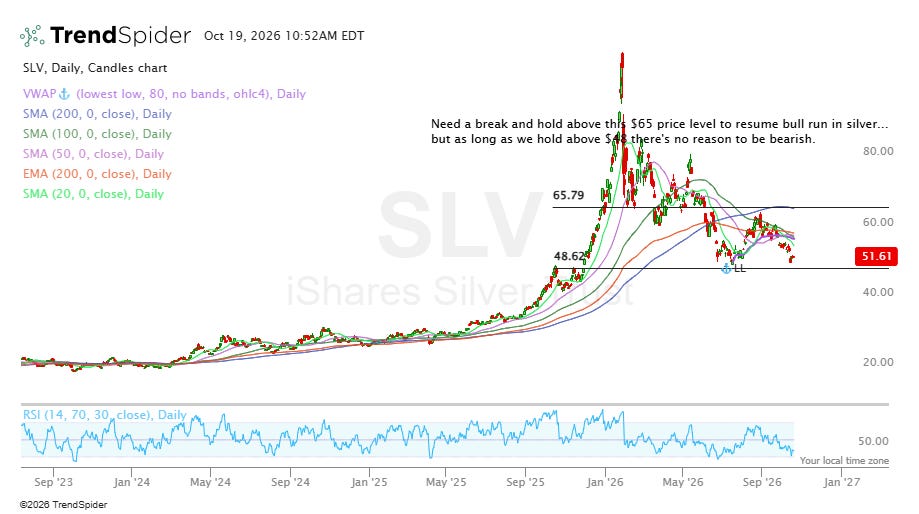
I’m going to focus on silver today because it’s been hit the most (along with solar) but structurally we still remain bullish.
Here’s my silver bull case in a few bullet points:
AI Buildout Demand: Silver has the highest electrical and thermal conductivity of any metal. As AI moves from training to inference, and agents drive constant token demand, the focus moves to cost per token which means efficiency needs to be stellar. In other words, any electricity or heat lost across the system will come under more and more scrutiny. Silver helps reduce electrical and heat loss across the system. It’s also a very small fraction of the entire build out meaning a rise in silver prices won’t affect buyers materially.
Other Demand: Silver was added to the 2025 US critical minerals list likely because of its role in drones.
Supply can’t respond: We’re currently in the fifth straight year of a structural deficit that we can’t get out of. About 80% of silver is mined as a byproduct of lead, zinc, and copper so supply can’t rise easily.
Crypto
Bitcoin’s price action last week told us a lot. Whilst the entire AI trade struggled, BTC held firm.
That’s a strong counter for believers that BTC is “too volatile” or “too risky”.

It’s also a positive sign for higher beta equities as BTC has historically been a proxy for higher beta equities.
The main opportunity still remains tokenization and regulation which keep moving faster than people think. In fact, Morgan Stanley last week put out a tokenized asset forecasted market size of $3 - $10 trillion by 2030.
We’ve also recently seen Stripe purchase OpenRouter which is a sign for what’s likely to come.
Think about why a payments company would be buying a token routing company. This is the new economy we’re entering.
What’s Mispriced?
This is a section looking at the potential opportunities I’m seeing at the moment. I’ll split them by how I see the risk profile (high risk → low risk).
I’ll tend to aim for at least 3+ opportunities in every article I publish here…but that depends on what the market is offering.
You’ll also likely see overlap week to week. I am not a trader that changes his mind every few hours, days, or even weeks. If I see an opportunity, that opportunity sometimes stays around for weeks.
Last week we touched on:
Securitize | SECZ - No position
Coinbase | COIN - Large position
Cerebras Systems | CBRS - No position
Bloom Energy | BE (Medium Risk)
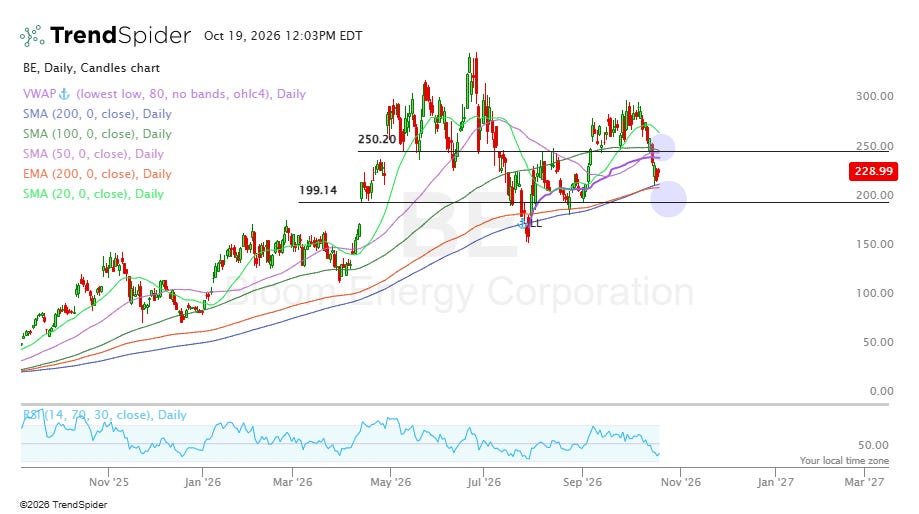
Power is the biggest constraint on AI over the next 2-3 years and if you believe that, then Bloom Energy (BE) is the cleanest play on the solution.
The reality is that the US grid is running out of capacity. From 2028 onwards, reports suggest that over half of new US data centres will have to generate their own power on site. Here are the key advantages to understand:
Permitting: Fuel cells produce a fraction of the emissions of turbines or engines. This is often the difference between a fast standard permit and years of major source review. For example, Oracle’s Project Jupiter hit permitting delays and then they redesigned around Bloom. Nebius did the same.
Labour: Fuel cells don’t need much labour like pipe welders or boilermakers (extremely scarce in the current buildout).
Market Share: Bloom has almost the entirety of all fuel cell orders.
Speed to Power: The economics makes Bloom the best route. Today, it’s all about speed to power. A power plant for 1GW data centre costs ~$5B and that can generate returns ~$100B in inference revenue.
For the next 2-3 years (minimum), BE is the solution to the bottleneck.
