

Each quarter, I try to publish Investment Opportunities.
It’s not a Deep Dive into specific companies or a detailed review of a specific theme. But it’s a concise look at the opportunities in the market right now, the data backing up why the opportunities are there, and much more.
This report focuses on what I’m calling the Big 5 at the moment:
AI x Biology
Financial Revolution
Commodities
Photonics
Energy
Note: These themes change and Q1 27 Investment Opportunities will unlikely be the same as these. I also own more themes in my portfolio than these five here, but these are the ones I am most excited about right now.
A Look At The Macro
We’re in the early innings of a technological revolution
I’ve spoken about this week in week out in my What Markets Are Saying & What’s Mispriced? series. You can see recent editions here.


We are entering a period where everything is converging. Here’s a couple of examples of what I mean by that:
The space theme & compute
AI & crypto
AI & Materials Science & Biology
People are fully aware of the above, and yet markets and investors still get spooked by illogical headlines, doomsday articles targeting clicks, and the AI bubble and 30Y yields.
In response:
AI Bubble: We currently have an SPY PEG at 30 year lows. We have CapEx spend as a percentage of GDP at levels not seen since 1998 but importantly the earnings are growing at a completely different rate to what we experienced with other productivity booms like the railroad, the internet, and electrification.
We also have:
Oil on the verge of coming down.
Real GDP growth likely to head above 3%. Anthropic’s bull case indicated a world where we see 15.4% GDP in 2030. Almost all of that divergence is from 2027 onwards so we’re just on the verge now in Q4 2026.
30-Year Yields: Yields are elevated but doomer headlines on X fail to discuss why yields are rising. Yields can rise because of strong growth and that’s exactly what is happening. People also underestimate how much sensitivity these hyperscalers actually have to yields. Corporate interest is at lows relative to GDP.
The Big 5 Themes
AI x Biology
In our view, AI could have the most impact on biology/medicine/drug discovery out of all industries.
Relative to today, the addressable market for biology/drug discovery seems almost infinite because of the flywheel that we’ll see.
More data → Better drug discovery models → Better therapeutics, diagnostics, and longevity medicines → Longer life expectancies → More diseases discovered → More data
This was always the flywheel but AI compressing this cycle majorly. The reasons for this compression is twofold:
Genome sequencing: Sequencing has made biological data cheap to generate but without AI it was always slow to reach. Interpretation that took years of manual analysis now happens in days.
Drug development timeline: AI is set to cut drug development timelines by ~40% or more. The important part to understand is that failed drug data is now just as valuable as successful drugs. This wasn’t the case before AI.
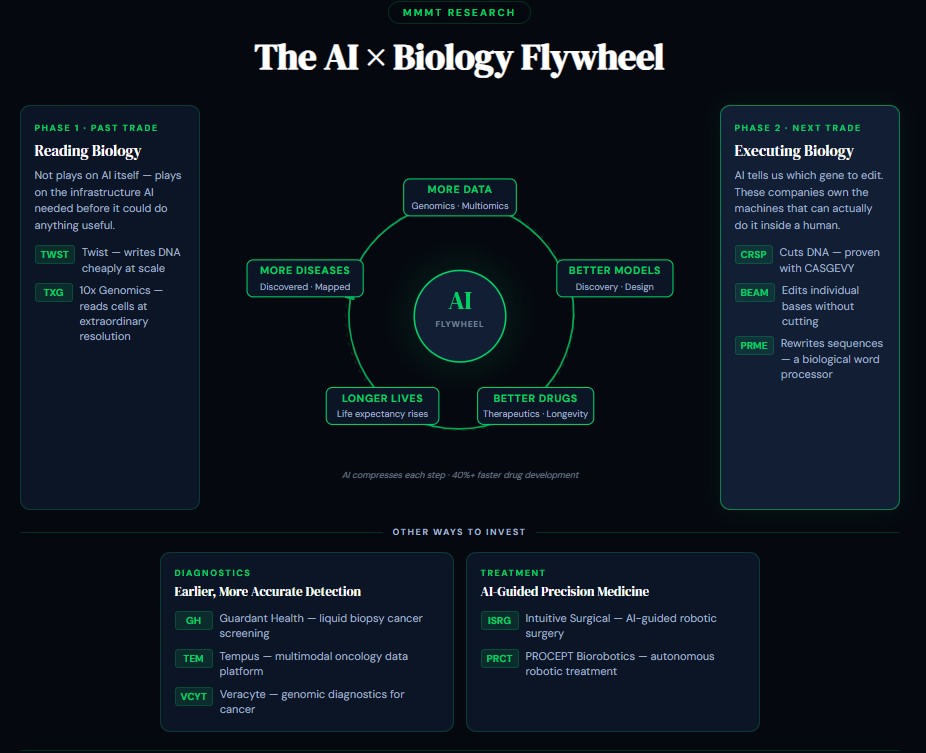
Phase 1 of this AI x Biology theme was the evidence that AI could integrate into biology. That’s why companies like Twist (TWST) which made it fast to write DNA, and 10x Genomics (TXG) which let scientists read genomics at extraordinary resolution, became early beneficiaries.
Both were plays on AI entering the biology world, not necessarily on AI delivering results.
Phase 2 will be all about the output:
Which gene shall we edit?
Which protein shall we express?
Which nucleotide shall we change?
And there are only a few companies with machines that can do this which in our opinion are CRISPR Therapeutics (CRSP), Beam Therapeutics (BEAM), and Prime Medicine (PRME).
CRSP cuts DNA at a specific site.
BEAM edits individual bases.
PRME rewrites sequences.
Other Ways to Invest:
Diagnostics: Detecting disease earlier and with more accuracy because of AI (combined with multiomic signals)
Guardant Health |GH: GH is building a proprietary data layer for AI capturing epigenomic data at scale. It also has software “apps” on that data that can flag things like tissue biopsy misses, like a lung tumor, or the origin of an occult cancer.
Tempus | TEM: TEM is the data layer behind AI drug discovery with its data licensing segment growing 36% last quarter. It’s winning $100M+ multi-year deals from pharma such as AZN, GSK, MRK, and BNTX.
Veracyte | VCYT: VCYT sells genomic tests that tell doctors how aggressive a cancer is and the best treatment. Each test adds to GRID (VCYT’s database) of genomic and slide data that researchers use to find new biomarkers that AI tools can learn from.
Treatment:
Intuitive Surgical |ISRG: ISRG is turning its surgical robots into an AI data platform: its Case Insights AI analytics tool is the second layer of a five-layer AI stack that runs surgeon supervised autonomy. Now trades far more reasonably but still far above 1x PEG.
PROCEPT Biorobotics | PRCT: Another surgical robot but trades far more reasonably than ISRG.
Note: Numbers are forecasts in the above section may not be realized. Not all companies are held within my portfolio. You can see my portfolio at beta.mmmtwealth.com
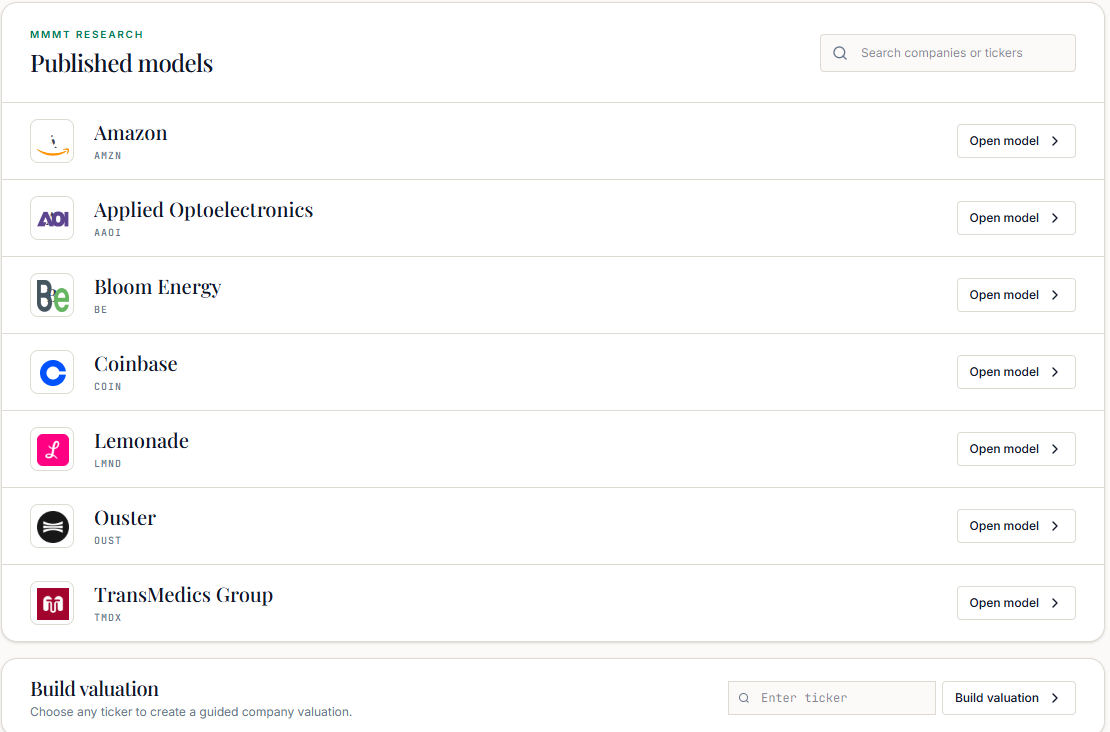
The New Website…Coming Soon
Before we get into the rest, I want to show you some snips of my new website which is in the final stages of production and testing.
You can use it how you see fit.
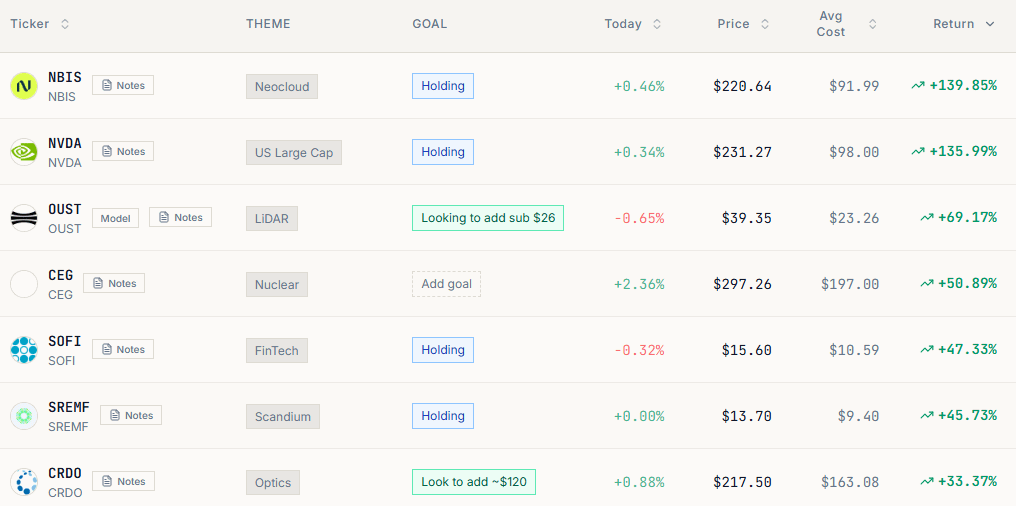
Want to just follow my portfolio, watchlist, entries, and exits? Easy:
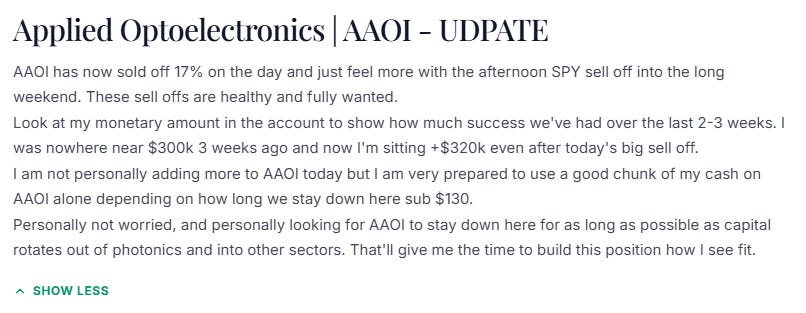
Want to follow my daily notes in a simple or detailed way? Easy. Every note I write gets summarized by an agent so you can read it in seconds or minutes…however you prefer.
Want to model your own stocks or view my models? Easy:
And lots more.
October will be an exciting month for MMMT Research. Join us now whilst prices are cheap.
Financial Revolution
The applications for crypto are a lot more understood in today’s agentic driven world than they were even 2 years ago.
5-10 years ago prices of Bitcoin and Ethereum were based far more on speculation rather than application.
That’s a very different story today. Crypto finally has its use case which is always on, programmable infrastructure that agents can use.
This is the big convergence of AI and crypto.
Agents operate continuously across applications, without sleep, and outside of business hours. If they want to act economically (which they will), they need financial infrastructure that’s always on, that’s programmable, and that’s machine readable. Our existing financial system is the complete opposite (business hours, KYC gates, intermediary approvals, and settlement windows).
A personal finance agent that is negotiating your mortgage rate at 3am, can’t use SWIFT. But it can use USDC on Base. Or an AI treasury manager reallocating idle corporate cash can’t route through a traditional brokerage. But it can interact with an on-chain lending protocol.
This is why crypto, after years of speculation, now has a clear purpose.
Two markets are opening up here: Programmable dollars through stablecoins and programmable financial assets through tokenization.
Stablecoins: This is the foundation everything described above is getting built on. Before stocks can move on-chain, or before agents can transact in milliseconds, a digital dollar needs to work. That’s stablecoins.
Tokenization: A share of stock sitting in a brokerage account currently does nothing. It just sits there idle. Tokenization will change this. That same stock sitting there could serve as collateral, a lending asset, or a hedging input…all on programmable rails. Tokenized US Treasury funds have now reached ~$15 billion (vs ~$31 trillion in outstanding Treasuries which is ~0.05% showing you how large the greenspace is ahead).
The investment thesis here is a little more complex. Big picture, it’s clear stablecoin volume is increasing, and tokenization is happening. But that rise doesn’t necessarily mean every play in the stack accrues value.
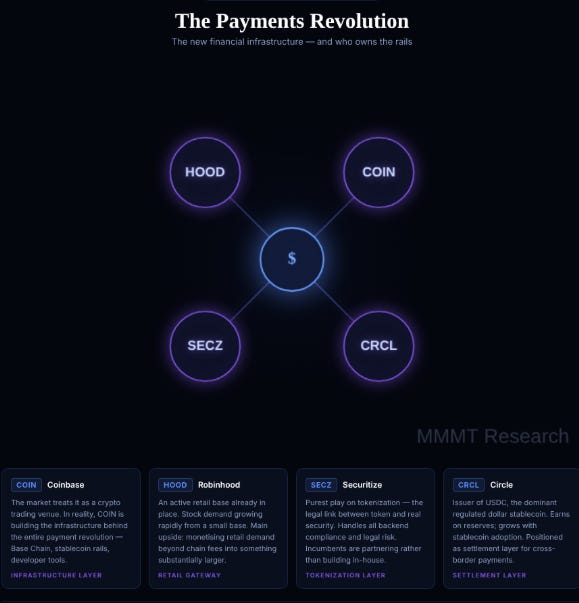
The question becomes about what layers monetize it the best. Here’s what we think:
How to Invest:
Coinbase | COIN: The market still treats it as a crypto trading venue with the stock moving in line with BTC and ETH prices. COIN is building the infrastructure behind the entire payment revolution. The only main unknown to me is exactly how much of the economics move to COIN’s earnings vs how much accrue to the apps built on COIN’s infrastructure. I think the next 3-5 years where we’re still building the infrastructure will be very bullish for COIN though.
Robinhood | HOOD: HOOD has a major benefit in that it has an active retail base already. Their tokenized stock demand is growing rapidly, albeit from a very small base of ~$30M per year which is immaterial relative to $5.8B in forecasted FY26 revenue. The main upside for HOOD is if they can monetize this retail demand into something a lot more than just chain fees.
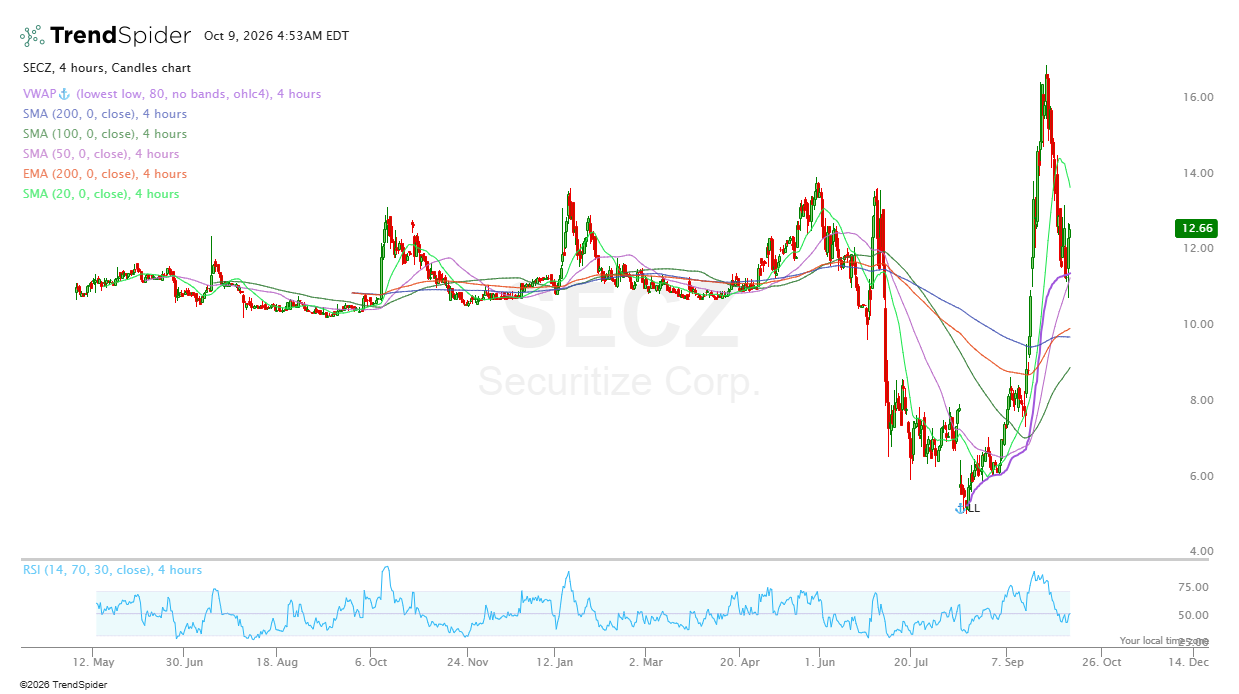
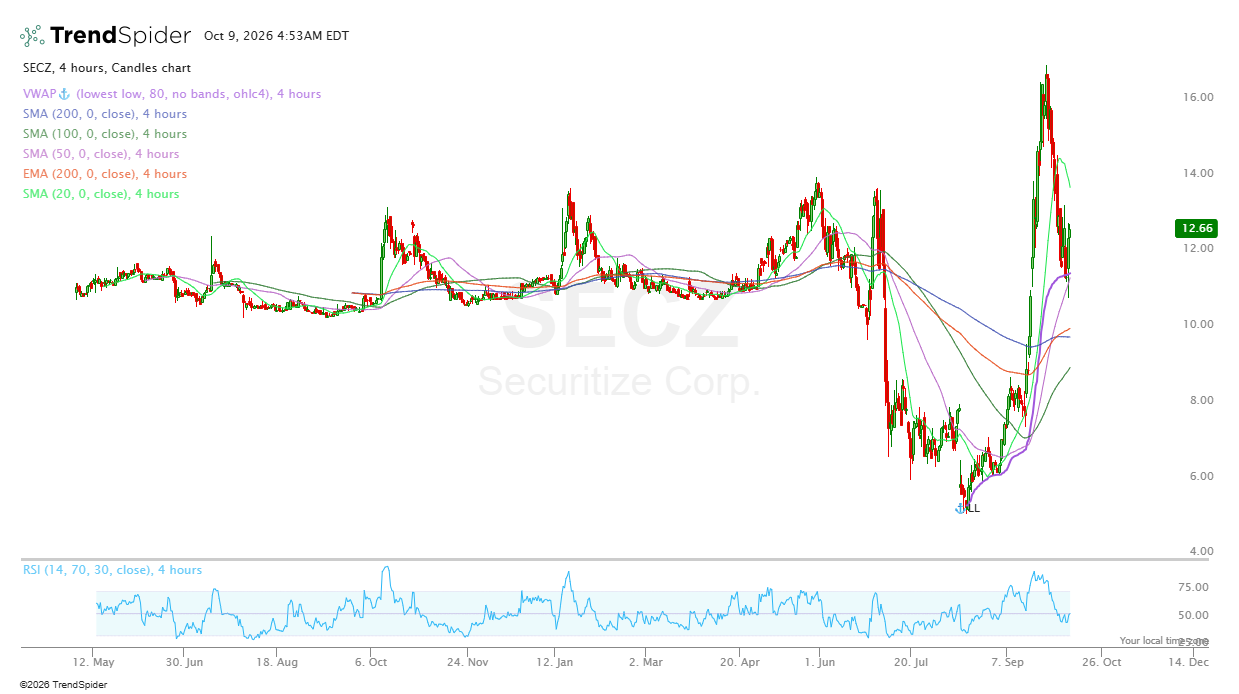
Securitize | SECZ: This is the purest play on tokenization out there positioned as the legal link between token and real security. It takes care of all the backend tokenization compliance and legal risks. So far, incumbents are partnering with SECZ and using their expertise rather than building in house which is a bullish sign. We think a lot of the value accrues here.
Circle | CRCL: CRCL is the leading expression of stablecoins as its the default regulated stablecoin. The risk for me with a company like CRCL is if own bank-issued stablecoins (like SOFI is doing with SOFIUSD) capture the reserve income themselves rather than sending it to CRCL. It’s feasibly something that is a risk to CRCL. On the other hand, CRCL could continue to be the default universal dollar standard and that in itself would value CRCL well above its current $20B valuation.
Commodities
Breaking this down into:
Copper
Silver
Scandium
Copper:
The copper thesis is dead simple:
Copper demand is set to rise 13-14 million tonnes by 2040 whilst supply is only expected to grow by 4 million tonnes.
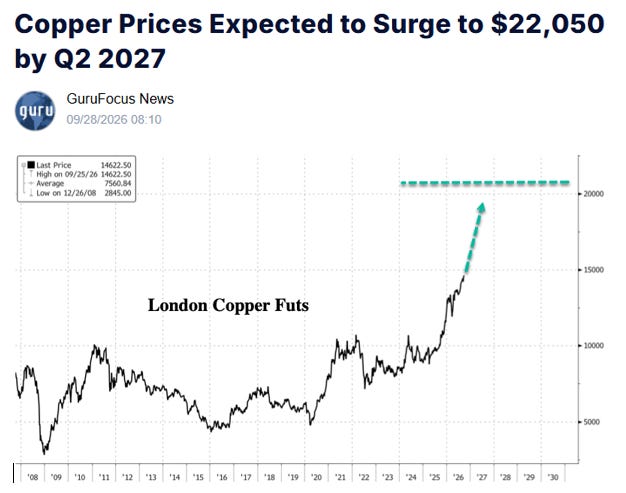
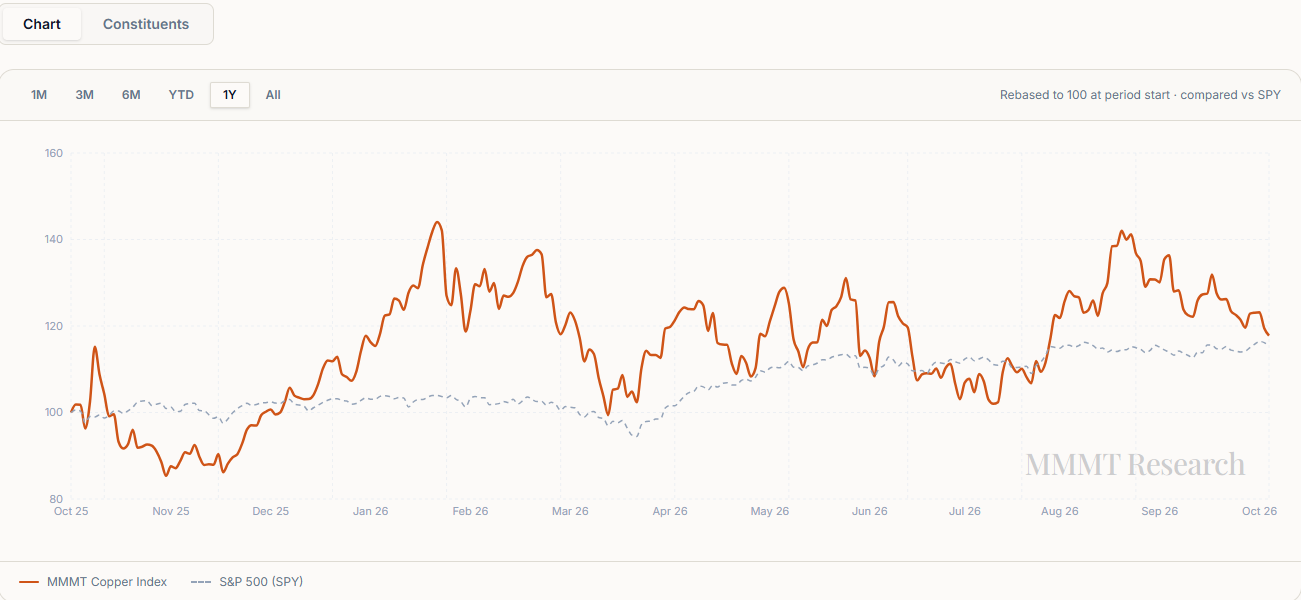
Mine output fell 1.1% in the first half of 2026 and this isn’t being fixed by new mines that take ~15-20 years to bring online.
It really as simple as that. Copper is a way to expose yourself to the physical AI buildout, give you some exposure to the commodities, and play the long term supply demand imbalance.
Personally invested in Global X Copper Miners ETF (COPX) as my lower risk play and Trilogy Metals (TMQ) as my higher risk, higher reward play.
Silver:
There’s a few reasons to be bullish silver in our opinion:
US M2 (money supply) was $1.5 trillion in 1980. Today, it’s $21.9 trillion (a 14x expansion). If you scale the 1980 peak of $50 an ounce for silver by that factor then you’re left with a money-supply adjusted high of ~$700. At $59 per ounce today, with stronger fundamentals than in 1980 (next points), we think silver prices are materially undervalued.
Industrial demand for silver rose 4% in 2024 (to record highs) and this was before the AI infrastructure buildout really started. Silver has the highest electrical and thermal conductivity of any metal so it appears in connectors, switches, relays, semiconductor packaging etc. As AI shifts from training to inference more focus moves to efficiency and this is where silver comes in.
The World Silver Survey said we’re in a structural deficit of 148.9 million ounces in 2024. Making this deficit up is not easy since ~80% of all silver is mined as a by-product of lead, copper, and zinc. The market is already tight (just like copper) and it’s only getting tighter.
Personally long iShares Silver Trust (SLV), Hecla Mining (HL), and Contango Silver & Gold (CTGO).
Scandium:
Scandium remains the underrated metal in the AI buildout and even with SREMF rising over 1,000% over the last year, I still remain bullish.
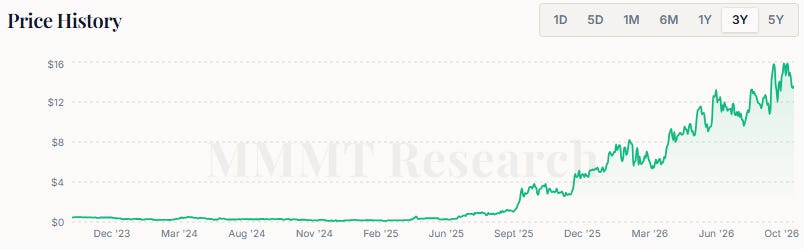
The main demand drivers for scandium remains:
Solid-oxide fuel cells: To understand the demand for SOFC’s, understand that Morgan Stanley is forecasting Bloom Energy (BE) to be 20% of the entire fix for America’s data centre power shortage through to 2028.
Aerospace & Defense: Scandium gives metals like aluminium a strength to weight ratio ~4x better than steel.
5G/6G: Scandium is in all microchips within cell phones which allow for 5G and 6G wireless communication.
Scandium is still priced in line with prices set in China. It’s only now, through SREMF, that the true value of scandium will start to become a lot more transparent.
Photonics
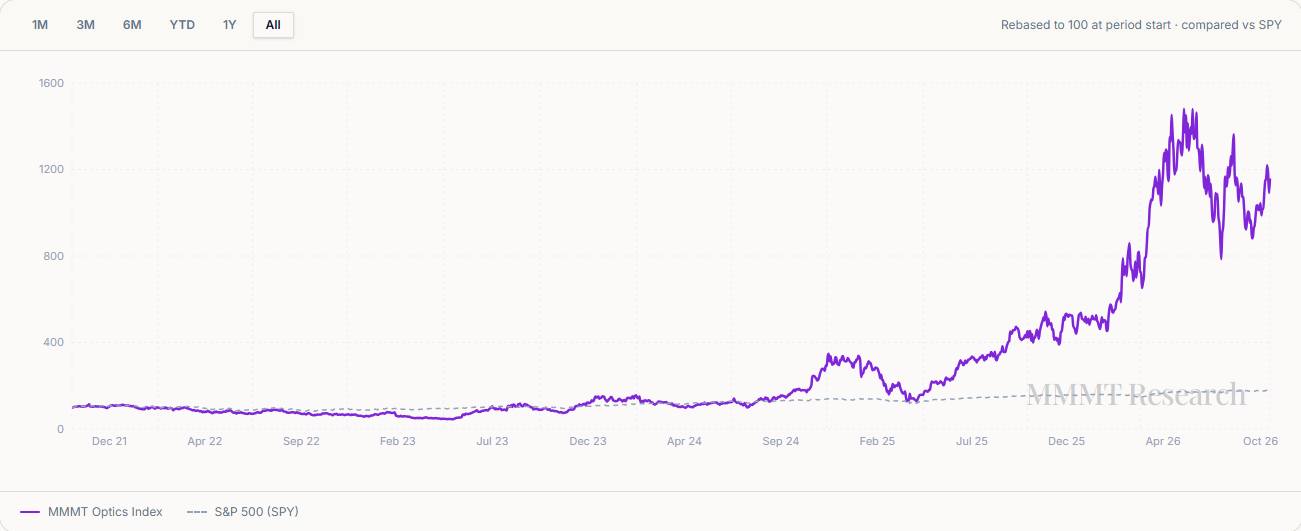
On 06/10/2026 we had the Marvell (MRVL) investor day where we got the first photonics piece of visibility through to 2031. For reference, forecasted revenue for MRVL in FY26 is $8.2B and management just forecasted a $80B midpoint in revenue for FY31 (57.7% CAGR).
We’ve also had:
Citibank TMT: “Lasers and optical fibers are being positioned as the “next HBM.”
Goldman Sachs upgraded their forecast for the global optical module market to ~$150 billion by FY28 compared to $68 billion in FY26.
Lumentum (LITE) said “we’re completely sold out. There is no end in sight.”
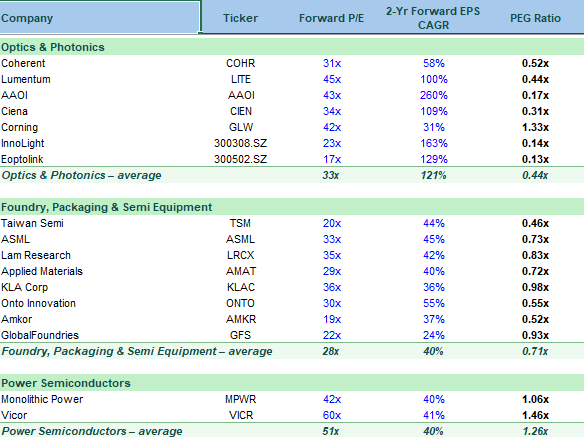
A report out from Jefferies suggested that as AI systems get larger, a smaller share of the cost will go to GPUs and a larger share will go to networking. I.e. in today’s rack networking makes up ~8.6% whilst in more futuristic multi-rack systems networking will climb above 22%.
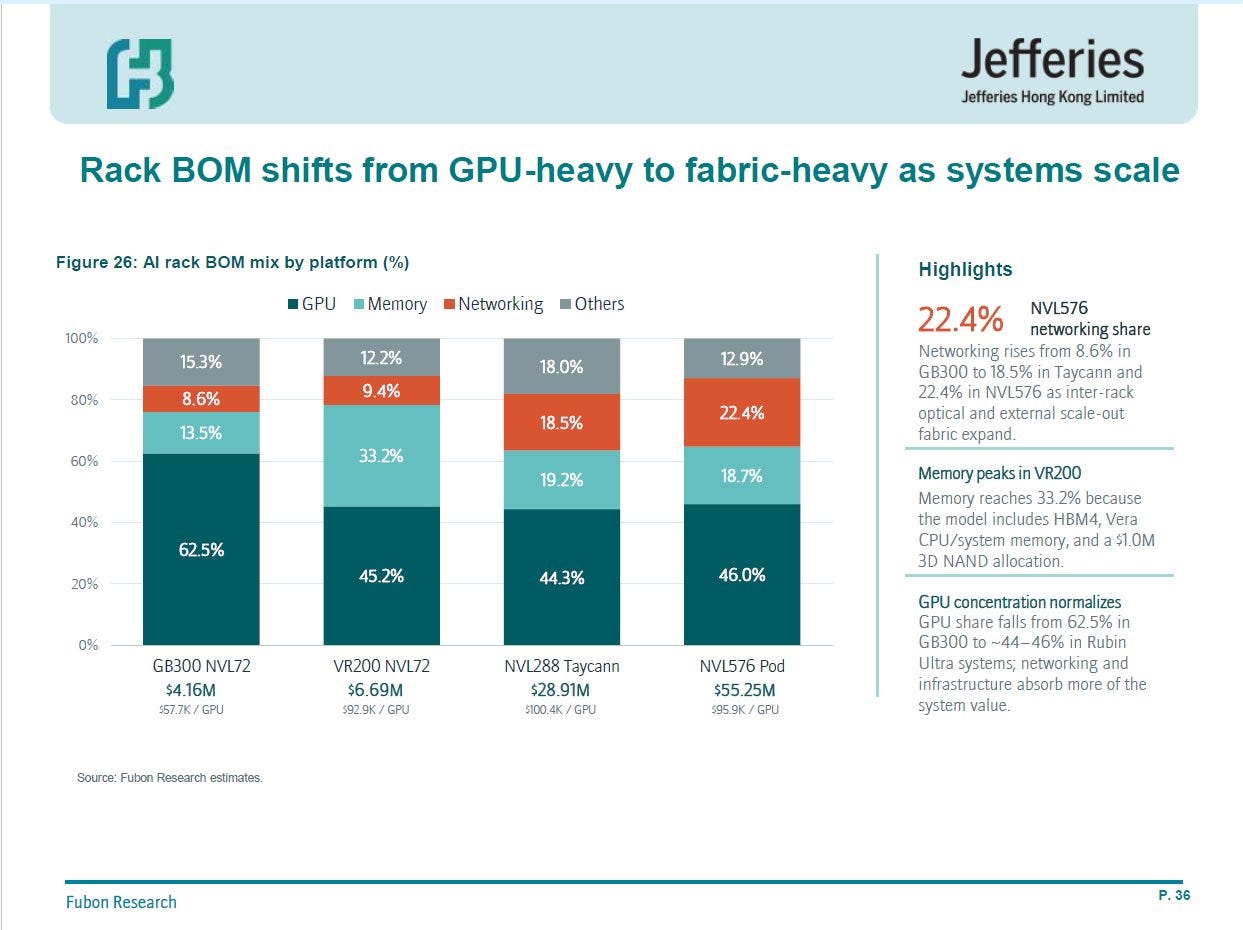
It’s more evidence that the next 2-5 years will see value accrue to the optics world.
How to Invest:
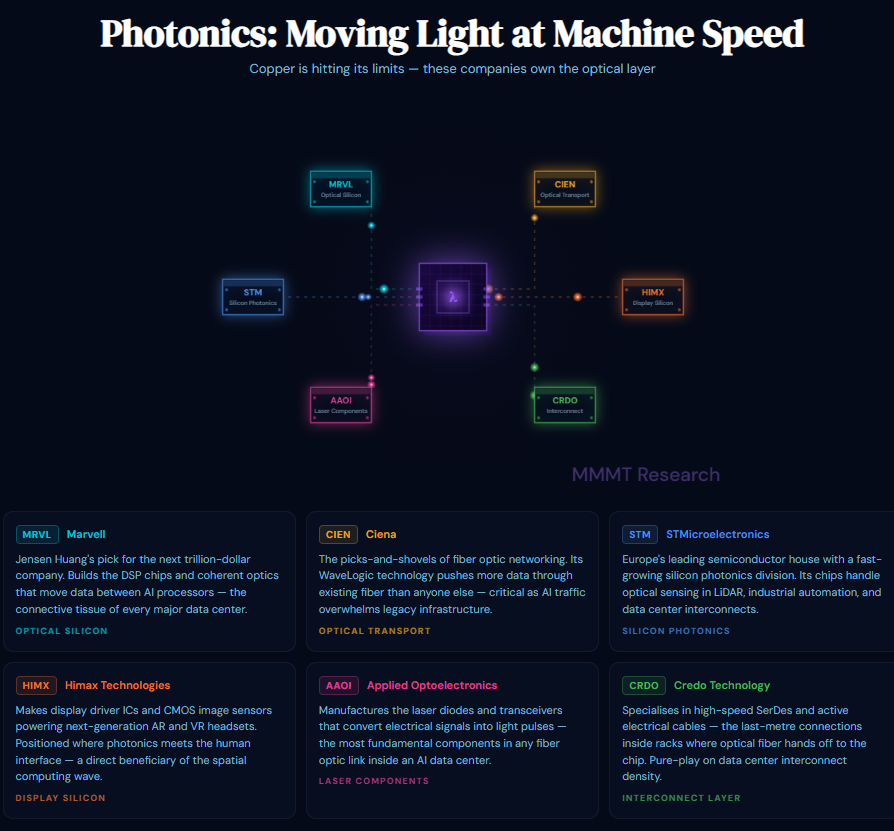
Marvell | MRVL: MRVL is the “connective tissue” of every hyperscaler date centre that Jensen Huang famously called “the next trillion dollar company.” Given their $80 billion FY31 forecast, I think there’s a good chance of this.
Ciena | CIEN: CIEN’s WaveLogic technology encodes data more efficiently so that you effectively can multiply the amount of data/information a cable can carry without physically adding more fibre cables.
Applied Optoelectronics | AAOI: This is a clean play on the markets laser shortage. AAOI manufactures the laser diodes and transceivers that convert electrical signals into light. Out of almost all stocks I know, it’s demand is the highest by far as they work towards a forecasted $471 million / month in just transceiver revenue by H2 27 (vs $455 million in FY 25 total revenue).
Credo Technology | CRDO: CRDO is a pure play on the last metre of the data centre - the high-speed connections inside server racks where the optical fibre hands off to the chip. It’s also a play on copper not being displaced by optics as quickly as many are forecasting.
Himax Technologies | HIMX: HIMX is an overlooked name in the optics world. Its precision optics technology is central to TSMC’s next-gen CPO platform which is a solid position. Management have also guided to $100 million in CPO revenue in the first year of mass production (FY26) with a much more material ramp up in 2027-2028.
STMicroelectronics | STM: STM is a slightly riskier one in that it’s got a lot of exposure to the automotive world…but it’s also got a lot of potential in the photonics world with a multi-billion dollar contract with AWS to supply optical chips to its data centres.
The Power Bottleneck
The US grid runs at roughly 50% utilisation. Most of the infrastructure is built…it’s just sitting idle and will be for 5+ years.
What’s keeping most of this energy stranded is the absence of storage. Plants run inefficiently because demand is lumpy - they spin up and down rather than running flat out which drives up the cost of every kilowatt-hour they produce.
Battery storage changes that by absorbing surplus energy when demand is low and discharging it when demand peaks allowing plants to run more consistently and spread fixed costs evenly.
But storage alone isn’t the answer. Solar paired with storage can be deployed in the next 12-24 months vs grid connection queues which have 5+ year waitlists. On-site solar is the only route to new power at speed and it’s at a cost ~90% cheaper than 2010.
And then nuclear is the longer-duration answer with an unmatched baseload.
Solar:
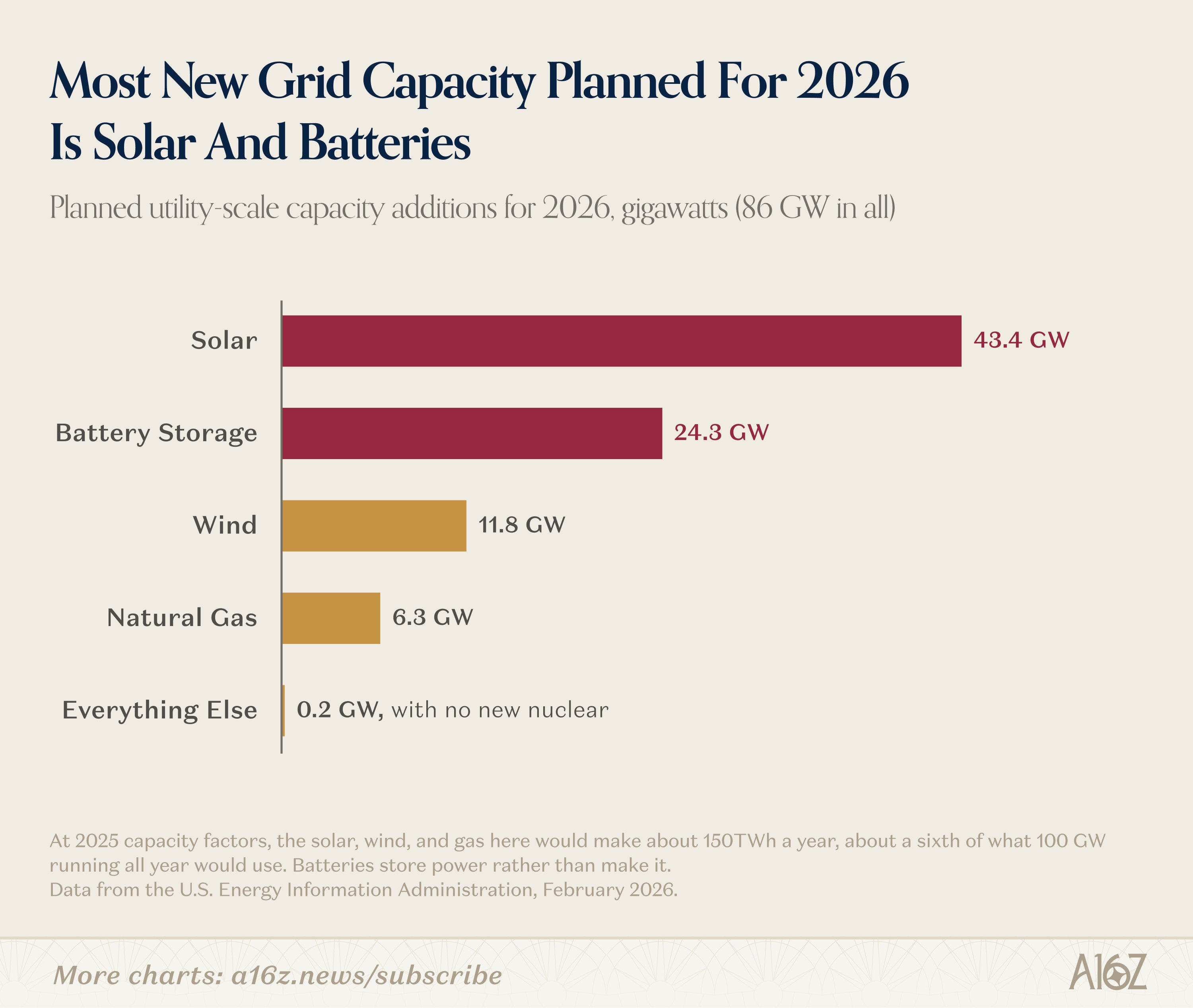
We’ve heard for years that solar is the answer to everything…along with nuclear. And so far, that hasn’t materialized like many forecasted until now.
But the physics behind solar still makes complete sense and I think the future relies on a combination of:
Behind-the-meter energy (Bloom Energy | BE)
Solar with batteries
Nuclear (probably further down the line than the above).
The reason BTM and solar work best is purely because of speed. Despite the grid upgrade still being a worthy investment…grid connection queues are now 5-8 years and with turbine companies like GE Vernova (GEV) with orders ~5x their current capacity…the only possible route is to figure out how to get power quickly.
On site solar plus battery energy storage can generate power in ~18-24 months. It’s also by far the cheapest power source (one of the reasons investing in the pure solar plays has been a horrible investment in the last 5-10 years). Prices have fallen ~90% since 2010 and with energy demands set to continue to soar for years to come it seems like one of the few ways to meet the demand at a reasonable cost is via solar.
Along with a lot of different sub-niches of the AI trade, I think the solar inflection point is in 2027-2029 with 2026 being a more difficult inflection point year because of policy changes in China.
If you’re bullish solar, you have to be bullish on battery storage.
How to Invest:
Investing in the solar theme isn’t easy. Some of the purer panel manufacturing plays have struggled as the product is just a commodity where China is setting the price.
We’d look in the picks and shovels plays:
Nextpower | NXT: NXT is still in its building phase but what it’s building across the solar stack is quite exciting: trackers, inverters, batteries. It recently acquired Prevalon Energy making it a key player now in the battery storage niche as well as a less-commoditized play on solar as well.
Shoals Technologies | SHLS: SHLS makes the electrical balance of systems that every solar project needs. SHLS also has battery storage with ~$20 million in revenue in the last quarter.
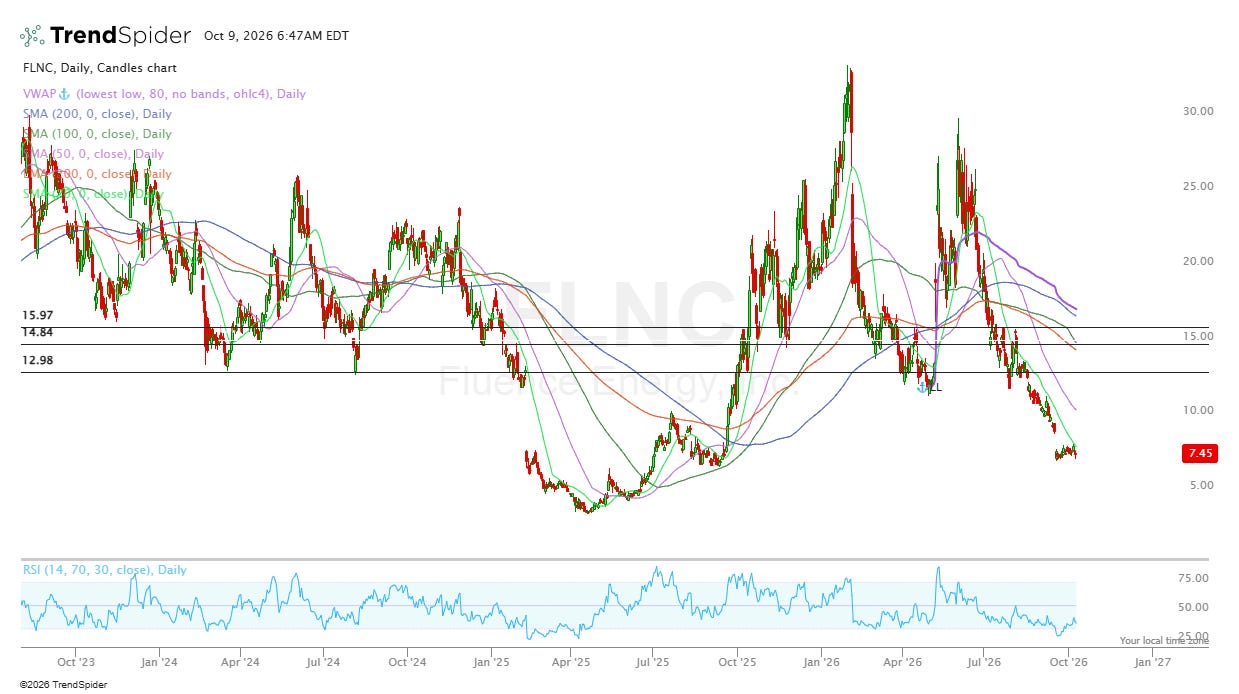
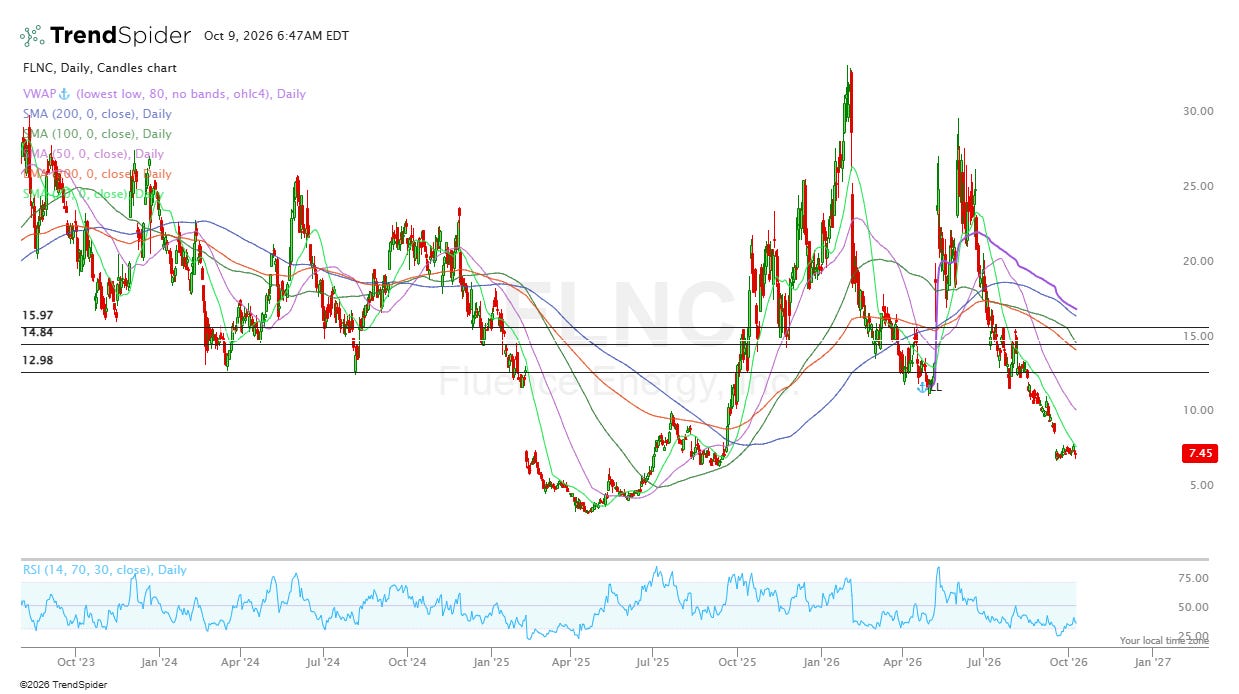
Fluence Energy | FLNC: This is the largest pure play on battery storage with a $2.9 billion backlog. The underlying thesis is still intact but there’s been some real recent struggles as management cut FY26 guidance by $600 million due to welding issues at their Houston facility. The stock now trades sub 0.5x sales and is likely great value if management can execute. It’s hard to call a bottom here…and FLNC certainly isn’t a stock I’d be interested in owning during a downturn but it’s interesting to look at here if you have a strict place to cut your losses. That’s what I’m doing right now.
Nuclear:
Referring you to my recent piece on nuclear here:
