

In this article, we’re taking a look at the MMMT high conviction baskets for Q3 2026 with a look at the underlying thesis and the stocks within them.
Part 1 and 2 have already been released:


Part 3 focuses on:
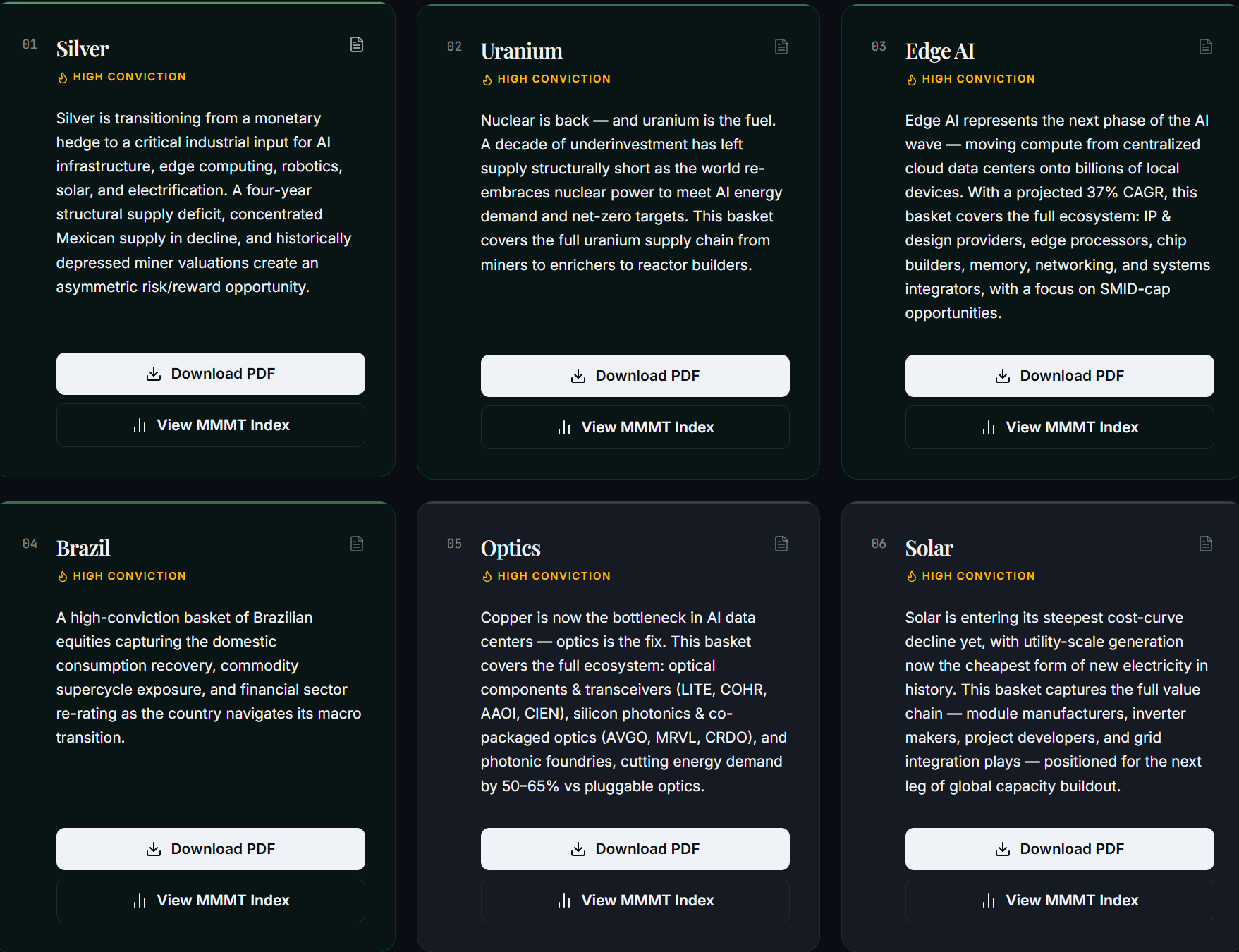
Uranium
Brazil
Application Layer
Uranium
The MMMT Uranium index is currently down 19% over the last year.
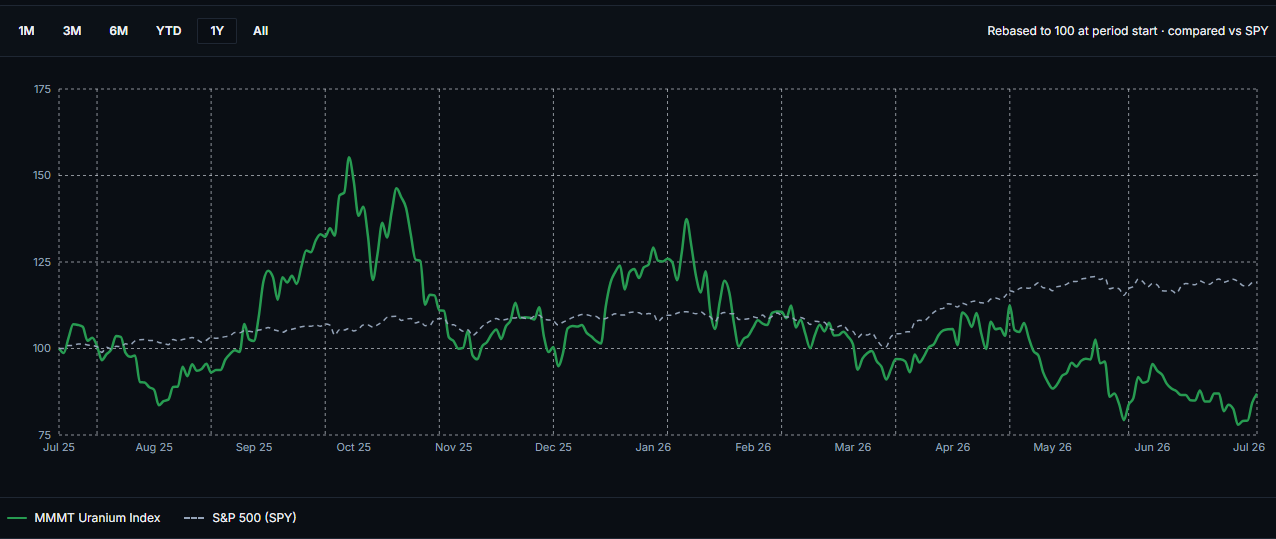
That makes it a slightly worse performing basket to hold than the likes of Global X Uranium ETF (URA) which is down 6% over the last year at the time of writing it.
As I try and make clear, the point of these baskets is to find a slightly higher beta way of holding the underlying theme rather than just buying the standard ETFs.
In Part 1 and Part 2, my baskets far outperformed the respective ETF’s so it’s no surprise that we have at least one or two baskets underperforming, especially in sectors that have been struggling over the last year.
Also, it’s worth nothing that my uranium basket is much higher beta than other ETFs because I have included SMR (a small modular reactor play) as a 15% holding.
This is also a play I own in my personal portfolio that I am down on a lot, but currently sized reasonably as to not materially affect the portfolio at all. I still have a lot of conviction in the SMR thesis…the time frame to start producing revenue is likely just a long time away which makes it a far riskier hold during market downturns like today.
Maybe the timing on this thesis has been slightly wrong, but the thesis I believe in.
Uranium Thesis
The supply-demand thesis for uranium is as clear as any commodity thesis I know.
Annual reactor demand globally runs ~200 million pounds of uranium.
Primary mine supply is 130 million pounds.
That’s a structural deficit ~50 million pounds per year that is currently getting filled from finite buffers like secondary supplies, enrichment underfeeding, and inventory drawdowns.
But here’s where it gets more clear cut:
Only ~65% of the uranium that reactors need annually is currently covered by long-term contracts. Utilities have been deliberately undercontracting for years…running down existing supply rather than committing to new supply at higher prices.
That ultimately worked when inventory was comfortable but it no longer works now with supply at record low and time between signing a contract and receiving delivery at record high of 2-3 years. That means it seems inevitable that there will be a buying wave upcoming and with that the price will move in unison.
The Basket
This basket in particular is quite concentrated amongst higher beta names, hence a reason why it’s underperforming vs the index.
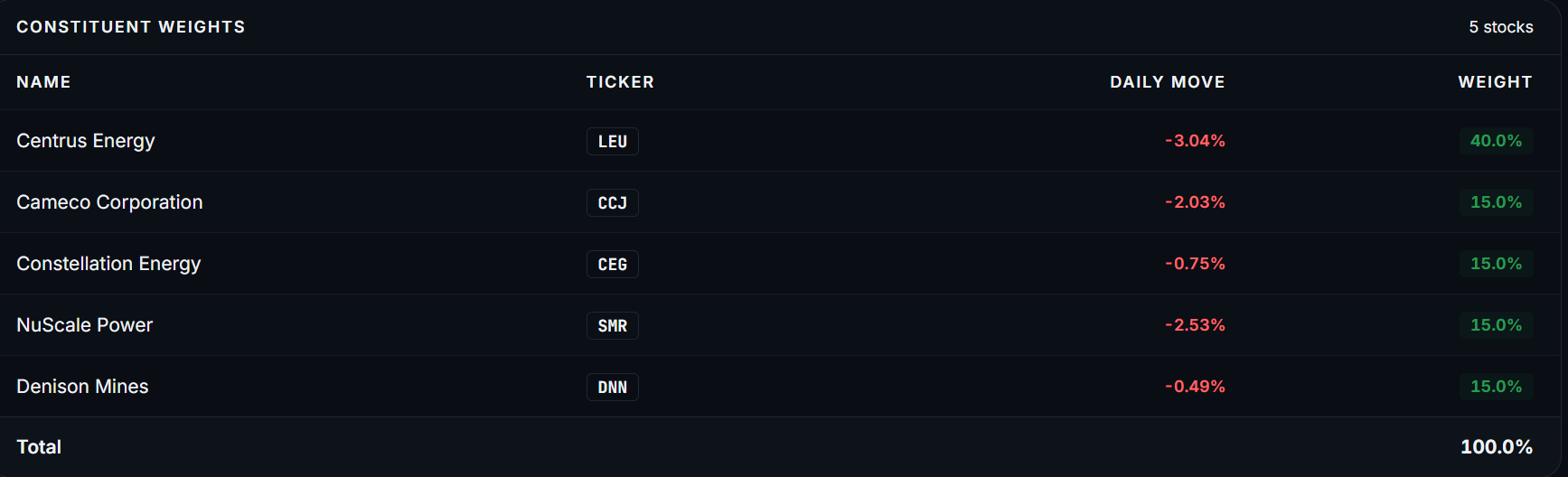
We’ve got:
Centrus Energy | LEU
Cameco Corporation | CCJ
Constellation Energy | CEG
NuScale Power | SMR
Denison Mines | DNN

Before we move on, a quick word about TrendSpider - the charting platform I personally use.
If you manage your own portfolio the way I do, here’s how TrendSpider fits into my process:
Scanners for technical and fundamental setups
Sidekick AI to dig through market data, filings, news, and the names I own or watch without bouncing between tabs
Charting and automated technical analysis to track support, breakouts, and moving averages across my portfolio and watchlist
Real-time options, sector rotation, market breadth, news, and sentiment to understand the wider context behind each position
TrendSpider brings the research, charting, and monitoring parts of my process into one place.
If this seems like a useful tool for automating your workflow, take advantage of this 50% discount offer.
Disclosure: I may receive a commission if you sign up or make a purchase through links in this post.
Brazil
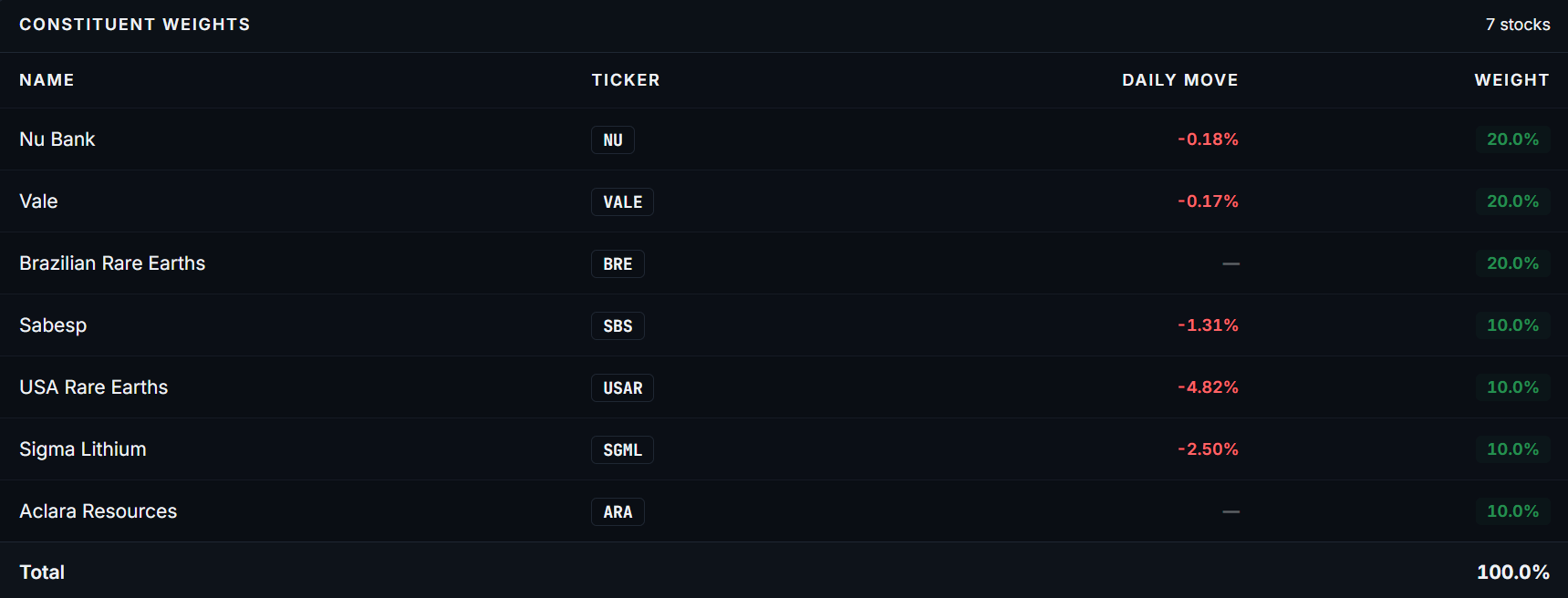
The MMMT Brazil index is currently up 31% over the last year (in line with EWZ).
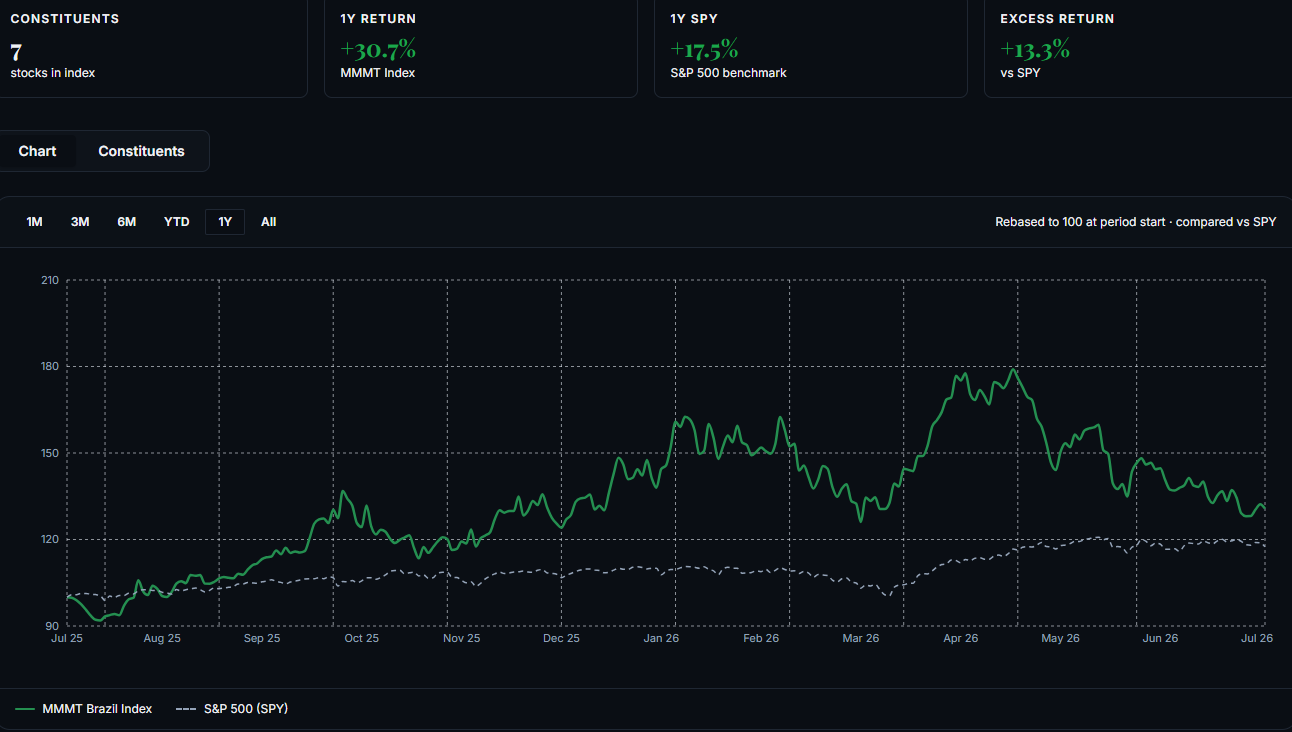
There a lot of valid lenses to look at the Brazil investment case through (Selic rate, politics, Ibovespa valuation etc) which can all lead to different conclusions on whether Brazil is investable today or not.
I’ll dive into them very briefly. But my main focus is on the fact that Brazil is becoming / has already become one of the most strategically important countries in the world.
The US has a critical mineral national security issue that is much bigger than news and headlines suggest. As we’ve known, China dominates the critical mineral supply chain. That doesn’t sound too damaging right now to most, but when you understand the critical minerals needed for technology for the next 10-20 years it becomes a national security issue:
Humanoids: Rare earth permanent magnets (neodymium, terbium, dysprosium) power every joint actuator and motor.
Quantum: High purity germanium and indium for qubit substrates, niobium for dilution refrigerator components.
AI: Copper and fibre-optic rare earths (erbium and thulium) for data center interconnect, cobalt and lithium for power infrastructure.
The aim is therefore to “nearshore”. I.e. move dependence away from China by building supply chains domestically and building supply chains with allies closer to US borders. Outside of the US, Brazil and Venezuela are the key opportunities.
Venezuela has potential but it’s far less investable because of the infrastructure gap and the governance risk and whether this can be monetized at scale yet is still a big question mark.
Brazil on the other hand has:
Proximity
Scale
Relative political investability (italicised for a reason).
It’s rare earths are second only to China’s in terms of % of global reserves held. It holds the the largest niobium reserves and has huge deposits of lithium, graphite, nickel, copper, and phosphate.
Ultimately, this is all why the Brazilian Mining Institute expects the country to attract ~$21.3 billion in investment through to 2030.
However, there’s an obvious complication or two. But the main one is President Lula and it’s a key reason the Brazil trade isn’t working out just yet.
Lula is a big believer in not allowing foreign powers to exploit its countries mineral resources. The workaround so far has essentially been to bypass the federal government by making agreements with Goias and Minas Gerais (home to large rare earth and lithium deposits) but the federal Industry Minister keeps pushing back on these deals. Repeatedly it’s a one step forward one step backwards situation.
But it’s not all bad news amongst a big, unexploitable opportunity.
The US Development Finance Corporation has backed Aclara Resources rare earths project in Brazil with a $5 million loan.
The US Development Finance Corporation has backed Serra Verde with a $565 million grant.
After this grant, the US government took a 10% stake in USA Rare Earths (USAR), which is in the basket, which then acquired Serra Verde’s Pela Ema mine in a $2.8 billion deal.
It has begun letting its existing offtake contracts with Chinese buyers expire.
A 15 year set-price supply agreement has been signed with a consortium of private investors and the US government (mainly terbium and dysprosium).
The next significant catalyst is in October 2026 when Brazil’s elections happen. It’s probably the most important catalyst for this entire Brazil and rare earth trade in 2026.
Currently it’s quite even between Lula and Bolsonaro. For reference, Bolsonaro is positioning himself as the candidate that will turn Brazil into the solution for the West’s US mineral dependency on China and therefore likely open up those forecasted $21.3 billion investment opportunities through to 2030 that I mentioned above.
Risks are clear. Upside seems to me even clearer.
It’s one of the reasons NU is quite a substantial position in my portfolio. I personally think a lot of the bad news has been priced into Brazil (given all the metrics like Ibovespa valuation) so the downside just seems far less than than the potential upside.
Application Layer
The MMMT Application Layer index is currently down 2.5% over the last year.
I wrote about the application layer in a lot more detail here in June.
AI Will Enter the Application Era Soon

In a lot - but not all - of the infrastructure buildout, the easy money has been made.
I’ve always been optimistic about the application layer because history has evidenced it time and time again as the place where capital accrues over the long-term.
